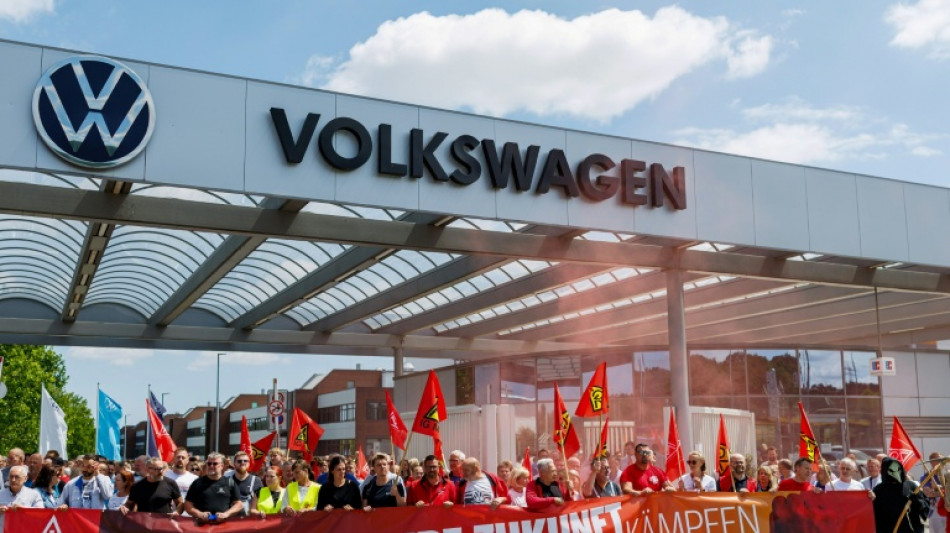
Workers reeling after VW cuts open door to factory closures / Photo: Jens SCHLÜTER - AFP/File

 Municipal Elections: How Service Failure Becomes a Public Health Crisis in South Africa

 Rene Eyre Revisits Autobiographical Performance 'Say A Little Prayer' in London

 UAE's HCT Holds Record Graduation and Announces Major Training Expansion

 NASA Awards $10B Lunar Contract Framework to SpaceX, Blue Origin

 Katy Perry Tells Fans Ex-Husband Russell Brand 'Should Be in Jail' During UK Concert

 South African election results renew debate over identity-based voting

 South African voters report smoother local election but declining IEC trust

 Dolly Parton museum and Nashville hotel open after singer’s death

 George and Amal Clooney attend New York political-comedy reading
The day after Volkswagen management, shareholders and unions agreed to cut a total 100,000 jobs over the coming years, automotive workers told AFP Friday they were feeling a mix of fury and disappointment.
The German 10-brand group, which apart from its namesake also includes the likes of Skoda, Audi, Seat and Porsche, said late Thursday it would cut an additional 50,000 jobs, bringing total planned reductions to 100,000.
That makes it the largest restructuring programme in global automotive history, exceeding the 50,000 cuts General Motors made after declaring bankruptcy in 2009.
Investors have cheered the cuts, seeing them as a sign Volkswagen can cut costs to compete with cheaper Chinese rivals.
The carmaker's shares opened up almost 10 percent Friday, topping Germany's bluechip DAX index, and analysts at Deutsche Bank said the agreement showed the company was "capable of making the difficult decisions required".
But for workers -- for many of whom carmaking is a way of life, not just a career -- it is what the agreement does not cover that jars.
The long-term future of four German plants -- in Neckarsulm, Emden, Hannover and Zwickau is unclear. Management and unions agreed Thursday only to seek "alternative uses" for the plants.
Lars Bochmann, a 50-year-old who has spent his entire professional life at the VW plant in Zwickau, told AFP that the agreement was "utterly deficient".
"We at least expected people to speak plainly," he said. "That they wouldn't just keep stringing people along, they'd be straight-forward and say whether the site has a future or not."
- 'It could all be over' -
Much is at stake for the regions surrounding the four factories, where vast numbers of businesses from automotive suppliers to bars to cafes can have a stake in a plant's future.
Denny Pohl, a logistics worker at wheel-maker Radsystem, told AFP that about 80 percent of the company's revenue came from the Zwickau plant.
"The plant is important for all Saxony, all Germany," he said, adding that the lack of certainty would hit the local economy.
"Everyone's going to say, 'Right, I'm not going to invest anything for the time being, because I don't know yet whether any more orders will come in'", he said. "In five years' time it could all be over."
Martin Lehmann, another lifer at the Zwickau plant, hopes that day never comes.
The 38-year-old told AFP that Volkswagen was more than just an employer, pointing out that he spent childhood holidays in car parks, trying to spot if the Volkswagens there were made at home or elsewhere.
"Those kinds of things I'll never forget," he said. "There's so much passion, so much heart and soul and tradition bound up with these jobs."
The uncertainty surrounding the Zwickau factory was palpable, he added.
"You can sense it in town, when you speak to shopkeepers, hairdressers, bakers, all sorts," he told AFP.
"If this factory were to close and we didn't make cars here there's no way you could make up for what we would lose," he added. "Everything depends on the future of this plant."
F.Ferraz--PC


