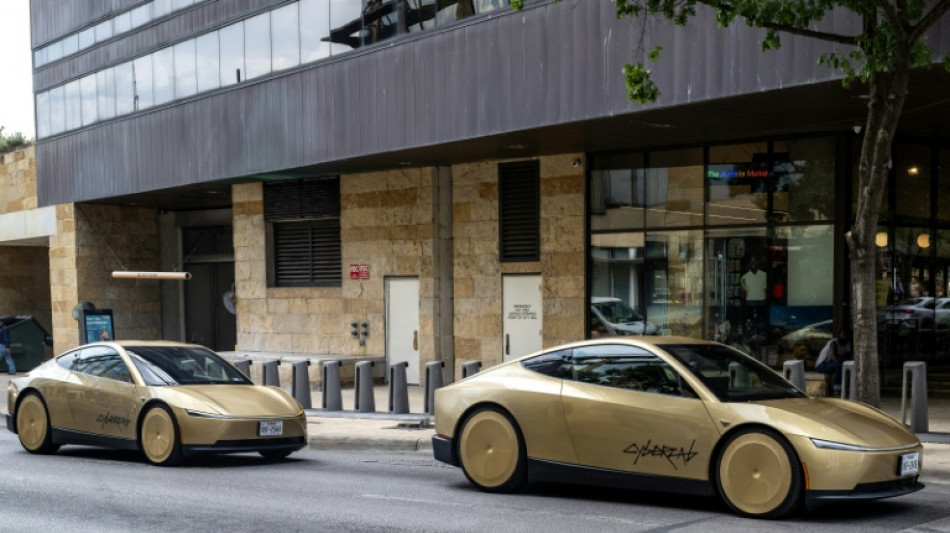
US safety regulator probes Tesla's Cybercab / Photo: RONALDO SCHEMIDT - AFP

 Municipal Elections: How Service Failure Becomes a Public Health Crisis in South Africa

 Rene Eyre Revisits Autobiographical Performance 'Say A Little Prayer' in London

 UAE's HCT Holds Record Graduation and Announces Major Training Expansion

 NASA Awards $10B Lunar Contract Framework to SpaceX, Blue Origin

 Katy Perry Tells Fans Ex-Husband Russell Brand 'Should Be in Jail' During UK Concert

 South African election results renew debate over identity-based voting

 South African voters report smoother local election but declining IEC trust

 Dolly Parton museum and Nashville hotel open after singer’s death

 George and Amal Clooney attend New York political-comedy reading
US auto safety regulators have opened an inquiry into Tesla's driverless Cybercab, questioning how the company concluded that a vehicle with no steering wheel, pedals or mirrors meets federal safety rules.
In a filing late Thursday, the National Highway Traffic Safety Administration said it would examine the process and technical data Tesla relied on when certifying the two-seater vehicle.
The announcement came hours after the company began deploying the Cybercab commercially in Austin, Texas after a launch event.
Tesla has touted what it called the vehicle's safety and ease of use for disabled people, and said the Cybercab was "democratizing clean transportation for all."
In the United States, automakers certify their own vehicles as compliant with the federal standards.
Tesla notified the agency it had certified the Cybercab as meeting all applicable standards, and that it planned to widen deployment to more vehicles and more locations.
NHTSA said it would weigh how much that certification rested on Tesla's own determinations that certain standards simply do not apply to a car lacking permanently attached manual controls.
Tesla began driverless service in Austin last year using Model Y SUVs, expanding to cities in Texas, Florida and California.
State rules require many of those vehicles to carry a human supervisor who is able to take over.
Tesla had registered 314 robotaxis in Texas as of Wednesday, including 45 Cybercabs, according to FSD Database, based on data from the Texas Department of Motor Vehicles.
Waymo, the self-driving vehicle subsidiary of Google parent company Alphabet, offers its services in 11 US cities.
V.F.Barreira--PC


