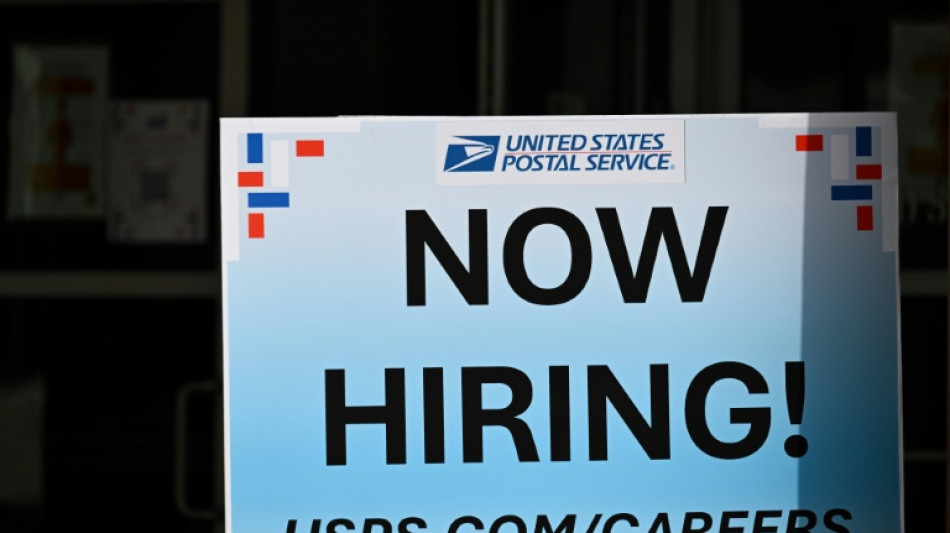
Job growth, but surging diesel prices - Trump's midterms mixed bag / Photo: Patrick T. Fallon - AFP/File

 Municipal Elections: How Service Failure Becomes a Public Health Crisis in South Africa

 Rene Eyre Revisits Autobiographical Performance 'Say A Little Prayer' in London

 UAE's HCT Holds Record Graduation and Announces Major Training Expansion

 NASA Awards $10B Lunar Contract Framework to SpaceX, Blue Origin

 Katy Perry Tells Fans Ex-Husband Russell Brand 'Should Be in Jail' During UK Concert

 South African election results renew debate over identity-based voting

 South African voters report smoother local election but declining IEC trust

 Dolly Parton museum and Nashville hotel open after singer’s death

 George and Amal Clooney attend New York political-comedy reading
Fresh economic data on Friday brought US President Donald Trump's Republican Party good and bad news ahead of midterm elections, with the labor market showing strong growth but record-high diesel prices likely to further fuel inflation.
Employment in the United States grew by 162,000 jobs in August, and the unemployment rate remained steady at 4.1 percent, the US Bureau of Labor Statistics (BLS) said.
The price of diesel -- used for road hauling, agriculture and construction -- hit a new record on Friday, however. The cost of a gallon of diesel is up 55 percent since the Iran war began in late February, according to the AAA motorists' association.
Stock markets were down on the employment figures, with all eyes on the Federal Reserve's next interest rate-setting meeting later this month.
Strong job growth indicates a healthy labor market, which would allow the central bank to focus on its other mandate: keeping long-term inflation to its two-percent target.
The Fed has missed that target for more than five years, with consumer inflation running at 3.3 percent in July. August data is due next week.
Prices rises have been fuelled by Trump's war on Iran -- which has sent energy costs skyrocketing -- and his signature tariff policies.
Overall inflation hit a three-year high in May, but has dropped since then.
Several Fed policymakers have indicated that they would be open to raising interest rates if August's data does not show a continuing downward trend.
Three of the committee's 12 voting members dissented at its last meeting in July, calling for an immediate hike.
Responding to the August jobs data, Trump on Friday made a surprising link between the Fed's setting of interest rates and Washington's trade ties with other countries.
"Lower the interest rates because the U.S.A. is a much stronger credit than it was just a short time ago!" Trump posted on his Truth Social platform. "LOWER THE RATE OR I'LL STOP TRADING WITH COUNTRIES WITH WHICH WE HAVE A DEFICIT."
He later railed against the stock markets being down due to expectations of a Fed rate hike, saying they were living in a "false reality that if things are good, you've got to 'KILL IT' because of a 'fear' of Inflation."
- 'Heating back up' -
The job report showed that US employment expanded in the restaurant and bar sectors, and jobs in public schools bounced back from a contraction a month earlier.
The strong report also revised up job numbers for June and July by a combined 55,000, indicating the US labor market remains in a state of steady growth.
Average hourly earnings increased by 3.1 percent year-on-year, still lagging behind inflation -- indicating that many workers are seeing their salaries contract in real terms.
Diane Swonk, chief economist at KPMG, told AFP that the August data was "reassuring" but cautioned that "one month does not a trend make."
"This report does suggest that the labor market is heating back up," she said. "The labor market is now stronger, and this is worrisome for the Federal Reserve because now you have demand along with supply shocks."
Still, strong job growth was "welcome news for workers out there. Welcome news for people trying to make ends meet."
The health care sector, one of the major drivers of job growth in the United States as the population ages, expanded at a slower pace than its average over the last year.
Kathy Bostjancic, chief economist at Nationwide, said the overall "across-the-board robust gains" were encouraging.
"Today's report supports our forecast that real GDP growth accelerates to at least three percent in Q3, reflecting a strong labor market, resilient consumer spending, and continued ebullient AI investment," she said in a note.
The information technology sector, however, lost 23,000 jobs, with analysts saying it is more exposed to Artificial Intelligence-related layoffs due to wider adoption of the technology than other industries.
L.Mesquita--PC


