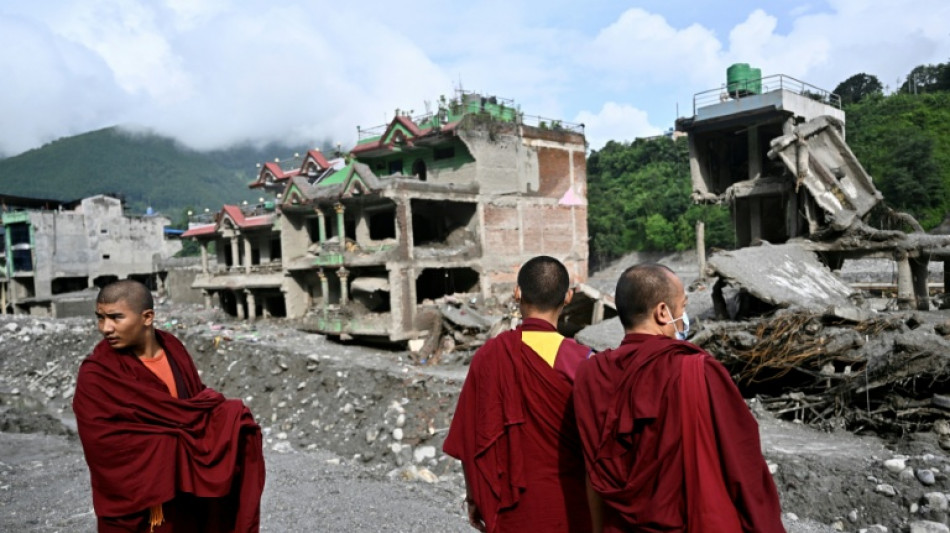
Nepal holds day of mourning as families pray missing still alive / Photo: Pedro PARDO - AFP

 Municipal Elections: How Service Failure Becomes a Public Health Crisis in South Africa

 Rene Eyre Revisits Autobiographical Performance 'Say A Little Prayer' in London

 UAE's HCT Holds Record Graduation and Announces Major Training Expansion

 NASA Awards $10B Lunar Contract Framework to SpaceX, Blue Origin

 Katy Perry Tells Fans Ex-Husband Russell Brand 'Should Be in Jail' During UK Concert

 South African election results renew debate over identity-based voting

 South African voters report smoother local election but declining IEC trust

 Dolly Parton museum and Nashville hotel open after singer’s death

 George and Amal Clooney attend New York political-comedy reading
Nepal held a national day of mourning Monday for victims of devastating glacial floods, as families of missing hydropower workers feared trapped in tunnels prayed rescuers might yet find them alive.
The August 26 glacial and mountain collapse on the China-Nepal border killed at least 1,398 people, with more than 5,500 missing, including around 800 foreigners.
Flags flew at half-mast, with candlelight vigils planned later in the day, following traditional Hindu mourning rituals on the 13th day after death.
Hundreds of hydropower workers are among the missing, but the rescue of three of them from deep inside tunnels -- two Nepalis on Friday and a Chinese man on Saturday -- have buoyed hopes that more could still be alive.
Nepal Army spokesman Raja Ram Basnet told AFP on Monday rescue efforts were continuing "with the same tempo we had on day one".
"Our focus is on search and rescue at three levels -- on ground, by air, and in the tunnels," he said.
"We are making sure that no one is still stranded."
Entire communities have been swept away, roads destroyed, and homes demolished.
- 'Hope' -
But families of some of the missing workers who gathered in the capital Kathmandu said the government must move faster.
"We have a lot of hope," said Reena Amatya Shrestha, whose brother is among the missing.
"They say they are doing rescue. If the rescue is there, where's the result? We need the result."
Australian tunnel rescue expert Arnold Dix, who is advising Nepali teams, said the operation presented an unprecedented challenge.
"We are facing something I have never faced before," said Dix, president of the International Tunnelling and Underground Space Association, in a post on social media.
"Not one rescue, but multiple potential rescues, unfolding at the same time, in different places, each with its own dangers, uncertainties, and lives that may still be saved."
Foreign experts, including from China, India and South Korea, are aiding Nepali teams in rescue efforts.
"We are measured not only by the lives we save, but by the lives we refuse to abandon," said Dix, a key adviser during the Indian rescue of 41 men trapped for 17 days inside the collapsed Silkyara tunnel in Uttarakhand state in 2023.
"Silkyara taught me never to confuse unlikely with impossible," he said.
- 'Help Nepal' -
With mortuaries overflowing, Nepal has buried hundreds of bodies in mass graves after taking DNA samples for future identification, according to police.
Only around 100 bodies have been identified and handed over to families.
While the exact cause of the glacial collapse is unclear, climate change is accelerating glacial melting worldwide, increasing the risk of such disasters.
Nepal, a largely rural nation of 30 million people that has contributed little to the greenhouse gas emissions driving global warming, says reconstruction could cost billions of dollars.
Its economy is already under pressure, with limited resources to respond to a disaster of this scale.
The disaster has come just ahead of the anniversary of last year's September 8-9 mass anti-corruption protests that toppled the government, and the young government now faces the enormous task of rebuilding communities and critical infrastructure.
A UN preliminary assessment estimated building damage from Nepal's floods at $158 million alone, warning that total losses -- including damage to roads and bridges, agricultural land and humanitarian costs -- would be far higher.
The United Nations has appealed for $50 million to help more than 84,000 people.
"My plea to the international community is -- this is the time to help Nepal," UN country chief Lila Pieters Yahia told AFP.
In Nepal, rescuers have retrieved 1,355 bodies, while around 4,996 people are missing, according to the disaster agency.
In China, the toll is 43 dead and 519 missing, according to state media.
P.Cavaco--PC


