
Meta tests fact-check replacement in Latin America / Photo: INA FASSBENDER - AFP

 Turkish Energy Minister Highlights Qatar as Key Partner for Regional and Global Energy Security

 London Museum Granted 24/7 License Ahead of November Opening

 Dana White Confirms Flight to Washington for Trump Meeting on Press Secretary Role

 Dengue Fever Expands Into High Himalayas as Climate Change Warms Nepal

 IoT Refrigerator Hacks Disrupt Blood Labs and Supermarkets Across Europe and US

 Post-election pressures complicate US and Israeli decisions on Iran

 UN members approve talks on treaty protocol against environmental crime

 Family-run West Sussex beach café prepares for first winter season

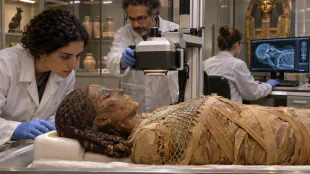 CT scans reveal health and burial clues from Egypt’s Braided Lady mummy

 Oxford faces complaints over lecturer’s classroom attire

 Kyren Wilson and John Higgins reach International Championship snooker final
Meta said Wednesday it had begun testing Community Notes in 16 Spanish-speaking countries in Latin America, a step toward replacing the professional fact-checking program it runs with partner organizations across the region.
The crowd-sourced notes system, modeled on the one used by Elon Musk's X, is designed to supplant checks carried out by accredited newsrooms and fact-checking agencies, which Meta ended in the United States last year.
Meta said it hoped the notes would become the standard way it adds context to misleading posts on Facebook, Instagram and Threads, ending the need for the fact-checking program.
The company gave no timeline for that transition, saying only that full rollout would come when it was confident the product worked.
Users in the 16 countries can sign up as contributors from Tuesday, but Meta said no notes would be visible to the public during the test and that independent fact-checking would continue unchanged in the meantime.
The list covers Argentina, Bolivia, Chile, Colombia, Costa Rica, Ecuador, El Salvador, Guatemala, Honduras, Mexico, Nicaragua, Panama, Paraguay, Peru, Uruguay and Venezuela.
Brazil, the region's largest market for Meta's platforms, was left out.
The head of the world's main fact-checking network said she was "deeply concerned" by Meta's decision.
"The community notes program alone is simply not adequate when it comes to reducing the impact of harmful falsehoods on social media platforms," Angie Holan, director of the International Fact-Checking Network, of which AFP is a member, said in a statement.
- Right-wing surge -
The announcement lands after a run of elections that has pushed Latin America sharply toward right-wing parties.
Hard-right conservatives, including in the United States and Europe, are largely against fact-checking programs on social media, accusing them of political bias.
Far-right politician Jose Antonio Kast won Chile's runoff in December before taking office in March, and this year Peru and Colombia both elected right-wing presidents.
Argentina's libertarian President Javier Milei, a close ally of US President Donald Trump, strengthened his hand in last year's midterms.
Just days before Trump took office for a second term, Meta chief executive Mark Zuckerberg announced that the company would end its US fact-checking partnerships and replace them with Community Notes.
In line with Republican views, Zuckerberg cast the shift as a return to free expression.
Testing began in the United States that March. Three weeks later the notes started appearing publicly and the US fact-checking program was shut down.
Meta said Tuesday that the US program now had more than 1.4 million contributors and that the daily volume of notes had overtaken what fact-checkers produced, often faster.
Last year, the company pointed to a far thinner output of roughly 70,000 contributors who wrote 15,000 notes over six months.
Meta's Oversight Board, the quasi-independent body the company funds to review its moderation decisions, warned in March that Community Notes were not an adequate replacement for professional fact-checking outside the United States.
It said a global rollout risked human rights harms in politically polarized countries and during tense elections.
AFP is among the fact-checking organizations that participate in Meta's program in Latin America and elsewhere.
Phil Chetwynd, AFP's global news director, said the news agency's verification teams in the region had delivered "outstanding work" over eight years that Meta itself had praised.
He said the two systems should not be treated as alternatives.
"Credible research suggests that community notes can only be effective when contributors can rely on accurate, ethically produced, fact-checked journalism and other high-quality sources when drafting their notes," Chetwynd said.
"Fact-checking and community notes should go hand in hand. What matters is the quality of the notes, not their quantity."
G.M.Castelo--PC

