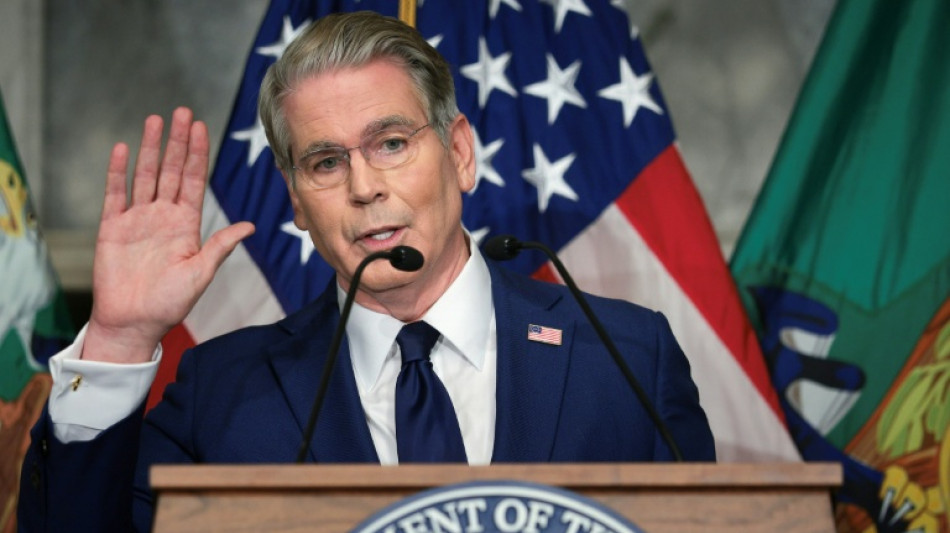
Bond yields jump despite $6 bn US government intervention / Photo: CHIP SOMODEVILLA - GETTY IMAGES NORTH AMERICA/AFP/File

 Turkish Energy Minister Highlights Qatar as Key Partner for Regional and Global Energy Security

 London Museum Granted 24/7 License Ahead of November Opening

 Dana White Confirms Flight to Washington for Trump Meeting on Press Secretary Role

 Dengue Fever Expands Into High Himalayas as Climate Change Warms Nepal

 IoT Refrigerator Hacks Disrupt Blood Labs and Supermarkets Across Europe and US

 Post-election pressures complicate US and Israeli decisions on Iran

 UN members approve talks on treaty protocol against environmental crime

 Family-run West Sussex beach café prepares for first winter season

 CT scans reveal health and burial clues from Egypt’s Braided Lady mummy

 Oxford faces complaints over lecturer’s classroom attire

 Kyren Wilson and John Higgins reach International Championship snooker final
Yields on long-term US Treasury bonds surged Wednesday after a $6 billion government bond buyback that disappointed markets that had expected a bigger number.
The yield on the 10-year US Treasury note hit a three-year high above 4.85 percent after the buyback announcement before moderating somewhat.
Yields on the 30-year bond -- which hit a near-20-year peak of 5.33 percent in August -- stood at 5.29 percent, up from 5.26 percent a day earlier.
The rise in yields came after the Treasury Department announced it was tripling buybacks of long-term Treasury bonds to $6 billion, part of a strategy announced last month by Treasury Secretary Scott Bessent to calm the bond market.
The jump in yields also came as Brent oil prices jumped above $100 a barrel for the first time since late July on escalations in the US-Iran war.
Higher borrowing costs are a drag on economic growth and can weigh on equity prices.
Bond market insiders had thought that the buyback could reach $10 billion or more instead of the normal $2 billion, based on Bessent's comments, said a column from financial commentator Stephen Innes.
The $6 billion figure was "near the lower end of the whisper range," Innes wrote in a Substack column.
"The Treasury market spent the morning waiting for Scott Bessent to reveal how much firepower he was prepared to put behind the expanded buyback program," Innes said.
"When the number finally arrived, it was larger than the original commitment but still too small to satisfy a market already choking on duration."
Briefing.com analyst Patrick O'Hare said that disappointment with the size of the buyback could explain the jump in yields. But another explanation is that "the market sees it more or less as a shell game," O'Hare said of the policy.
Some big names in finance have criticized the buyback plan as a Band-Aid for systemic challenges with the US fiscal situation, arguing in part that the US Treasury market is too big to influence with such a buyback plan.
Bessent's plan constitutes a "forced effort that's too obvious," O'Hare said.
- Controversial plan -
Wednesday's Treasury announcement followed a plan unveiled on August 19 to "at least double" government bond buybacks under a Treasury program meant to guarantee sufficient market liquidity after the yield on the 30-year bond jumped to a near-two-decade high.
On August 20, Bessent told CNBC that the spike in yields was exacerbated by thin market trading in the sleepy summer period and "don't reflect the underlying fundamentals."
Analysts have seen the jump in yields as reflective of several dynamics, including high oil prices, a surge in costly artificial intelligence investment and a flood of US government issuance because of the deficit.
The plan has also sparked criticism from some leaders in finance, including Stanley Druckenmiller, a billionaire investor and mentor.
"Markets aggregate information no committee possesses, and prices are how that information reaches decision makers," Druckenmiller said in a Wall Street Journal op-ed last month.
"Every basis point of artificial yield suppression is a subsidy to procrastination," he said.
Traders also see tension between the Treasury buyback plan and Federal Reserve Chair Kevin Warsh's goal of addressing persistent inflation.
Futures markets have lifted the odds of a Fed interest rate hike in light of higher oil prices and increased yields.
The market in the next two days will also get data points on wholesale and consumer inflation.
Friday's consumer price index data will "either exacerbate or temper" market concerns about a Fed interest rate hike, O'Hare said.
T.Batista--PC

