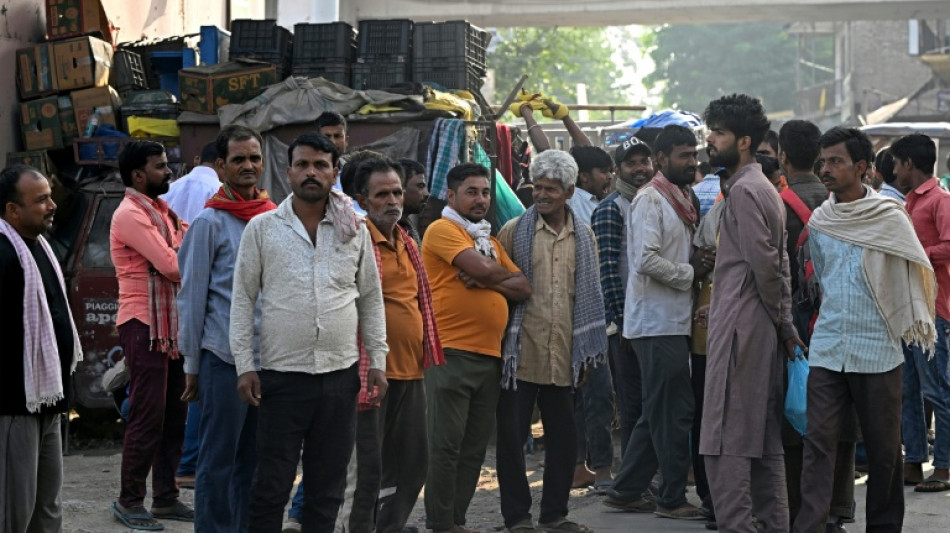
Migrant workers flock to Indian Kashmir despite militant threats / Photo: Tauseef MUSTAFA - AFP

 Russia's Stalin-admiring provincial leader waging an ultra-conservative crusade
 Marcelo Gallardo appointed as new Ecuador head coach

 'Widow's Bay' and 'The Pitt' tipped for success at Emmy Awards
 For club and comfort: Rodman makes it to Shelton's US Open final
 Houthis say Saudi Arabia launched over 50 strikes against them in 24 hours

 'Fed up': Thousands march against Sinaloa Cartel violence

 Controversial Zverev: from tennis nearly-man to multiple Grand Slam winner

 Swedish left-wing cheers far-right decline amid tight election race

 Yamal double helps Barca beat Levante, Atletico triumph

 Sassuolo stun Juve, Lobotka eases pressure on Allegri with Napoli winner

 Bills beat Texans and Ravens roll Colts in NFL openers

 US fight off spirited France to win 12th World Cup

 Drivers give cool reception to new Madring circuit

 Maresca makes flawless Man City start to leave Man Utd trailing

 Dozens arrested in major anti-LGBTQ raids in Turkey

 Leftwing opposition seen leading Sweden election, far-right losing ground

 Senegal goalkeeper Mendy retires from international football

 Carrick 'worried' by decision to award Man City winner

 Lobotka eases pressure on Allegri with Napoli winner

 Trump watches as Lowry wins Irish Open in record-breaking style

 Poland, Ukraine slam Russian strikes near border as 'escalation'

 Haaland fires 10-man Man City to memorable win over Man Utd

 I miss the adrenaline, but it's not my moment - Bolt

 Championship leader Antonelli to 'keep pushing' for title
 Yamal double helps Barca edge Levante thriller

Every spring, mason Mohammad Ghulam Sarwar boards a train to Indian Kashmir, seeking higher wages despite the risk of being targeted by militants in the disputed Himalayan region.
Sarwar, 25, is one of an estimated half a million migrant workers who stream into the Himalayan region each year, forming the backbone of an economy increasingly reliant on labour from some of India's poorest states.
The dependence has endured despite decades of insurgency and a series of militant attacks that have made migrant workers vulnerable targets.
Since 2019, at least 24 migrant workers have been killed in militant attacks across the territory, according to local media reports.
More than 1500 people were killed in the same period, according to the South Asia Terrorism Portal, 219 of them civilians.
The latest attack last month saw gunmen shoot dead two brick kiln workers from the central state of Chhattisgarh.
But for workers like Sarwar, the rewards outweigh the risks.
"Kashmir is real paradise. I will keep coming every year for as long as I have the strength to work," Sarwar, from the eastern state of Bihar, told AFP.
While millions of Indians seek jobs in the Gulf, some workers say Kashmir offers nearly comparable earnings without the costs and complications of overseas migration.
Sarwar earns 1,200 rupees ($12) a day in Kashmir, compared with about 700 rupees in Bihar for the same work, if he could find any at all.
The Muslim-majority region, battling some of India's highest unemployment rates, has become increasingly dependent on outsiders to perform jobs that many locals consider menial, including domestic work, agriculture and construction.
Local businesses say they struggle to find workers willing or able to take up many jobs.
"Outside the handicrafts sector there is not nearly enough local skilled labour available in Kashmir," said Mohammad Ashraf Mir of the Kashmir Chamber of Commerce and Industry.
"We see a rising dependence on migrant workers, tending towards absolute dependence."
- Waiting to be hired -
Each morning, groups of labourers gather at prominent squares in the main city of Srinagar, waiting to be hired.
Most stay for about eight months before departing ahead of Kashmir's harsh winter, when construction slows and agricultural activity dwindles.
Muslim-majority Kashmir has been divided between India and Pakistan since their independence in 1947, while an insurgency against Indian rule that erupted in 1989 has claimed tens of thousands of lives.
Although the rebellion has been largely weakened in recent years, sporadic attacks continue.
Sarwar said he saw a barber from his home state shot dead by suspected rebels some years ago.
While he was saddened by the incident, it failed to deter him.
"Life and death are in the hands of God," he said.
"If I remain fearful, I will have nothing. But if I overcome, I will have everything."
Sarwar shares a building in Srinagar with around 200 other labourers. Some 7-10 workers squeeze into tiny rooms, sleeping and cooking in the same cramped space while paying little more than five dollars a month each.
Outside, security is conspicuous.
Paramilitary troops, armoured vehicles and police special operations units patrol streets. CCTV cameras monitor the compound around the clock.
"They have been soft targets for the terrorists in the past," a senior security official said on condition of anonymity.
"But security arrangements for them have become robust over time."
- 'Feels peaceful' -
Police encourage labourers to live in clusters and avoid venturing out after dark.
A labourer from West Bengal said many Hindu workers adopt Muslim-sounding names while in Kashmir, fearing that displaying their religion could make them targets.
Rebel groups say they target migrant workers to avenge police harassment of their families.
Many labourers are reluctant to discuss security concerns publicly.
"I face no troubles here," said Mohammad Iqbal, a 53-year-old painter from Uttar Pradesh state who has worked in Kashmir since before the insurgency began and is now accompanied by his son.
"It feels peaceful."
Others are more candid.
"I am afraid of terrorists here," said Shahid Sofi, a 24-year-old mason from Bihar who previously worked in Delhi and Mumbai.
"But overall working conditions here are good, the weather is good, and I like working in the wide, open spaces of Kashmir."
X.Matos--PC