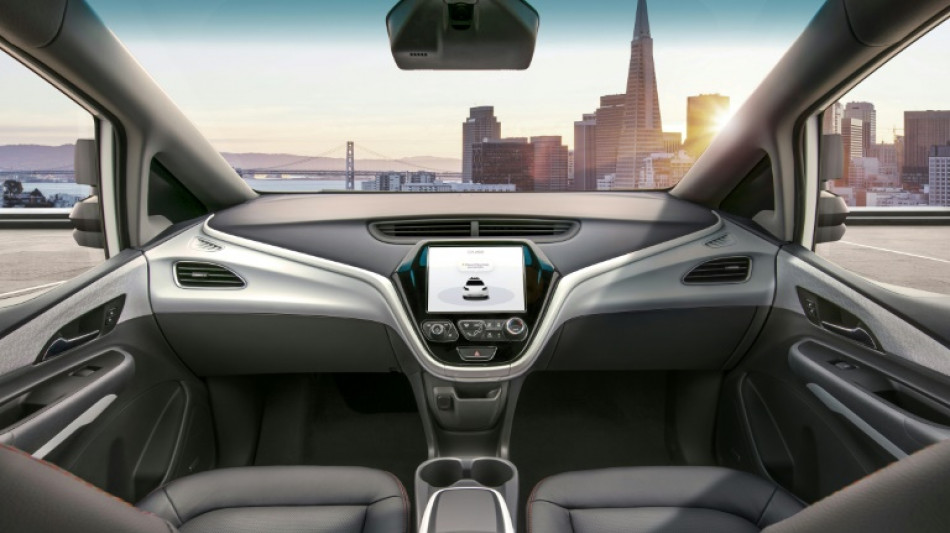
GM driverless car unit recalls vehicles after accident / Photo: Handout - General Motors/AFP/File

 Comet returns as online electrical marketplace 14 years after collapse
 KUFOS Signs MoU With Old Dominion University to Expand Academic Ties

 Karen Wazen Launches First Standalone Boutiques in Cairo

 Opti Digital Launches NEXA, an AI-Powered Intelligence Layer

 Turkish Energy Minister Highlights Qatar as Key Partner for Regional and Global Energy Security
General Motor's autonomous vehicle unit Cruise recalled 80 cars and updated their software after one failed to properly predict the trajectory of an oncoming vehicle.
The company, which is the first to have deployed driverless taxis in San Francisco in June, sent a notice this week to the US agency in charge of road safety, the National Highway Traffic Safety Administration (NHTSA).
In filings which came to public attention Thursday, Cruise explains that on June 3 one of its cars was hit from the rear by another vehicle after breaking sharply while making an unprotected left turn.
The self-driving vehicle decided "a hard brake was necessary to avoid a severe front-end collision with an oncoming vehicle," the document said.
Two people were slightly injured, according to a report submitted to the California Department of Motor Vehicles.
Police determined that the other vehicle was primarily responsible for the incident as it was not in the correct lane and was traveling over the speed limit.
The NHTSA, however, did not fully exonerate Cruise from liability, stating that the software could, "in certain circumstances when making an unprotected left, cause the ADS (automated driving system) to incorrectly predict another vehicle's path or be insufficiently reactive."
Cruise has modified the software and says were the vehicle to be in the same situation again, it would act differently to avoid error.
Carmakers, led by Tesla, have been working for several years on development of autonomous driving and driving assistance systems, but progress has been slower than initially hoped.
Waymo, a Cruise rival and subsidiary of Google's parent company Alphabet, has offered a ride-hailing program in Phoenix, Arizona for several years.
Cruise is the first company to be granted permission to transport passengers for a fee in a larger city.
P.Queiroz--PC