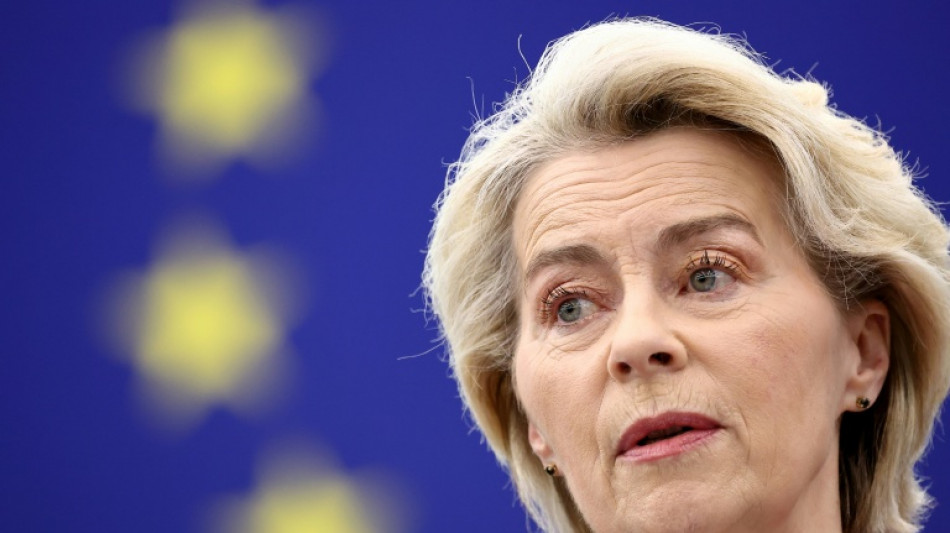
EU chief to unveil social media, gaming curbs for under-15s / Photo: FREDERICK FLORIN - AFP/File

 Turkish Energy Minister Highlights Qatar as Key Partner for Regional and Global Energy Security

 London Museum Granted 24/7 License Ahead of November Opening

 Dana White Confirms Flight to Washington for Trump Meeting on Press Secretary Role

 Dengue Fever Expands Into High Himalayas as Climate Change Warms Nepal

 IoT Refrigerator Hacks Disrupt Blood Labs and Supermarkets Across Europe and US

 Post-election pressures complicate US and Israeli decisions on Iran

 UN members approve talks on treaty protocol against environmental crime

 Family-run West Sussex beach café prepares for first winter season

 CT scans reveal health and burial clues from Egypt’s Braided Lady mummy

 Oxford faces complaints over lecturer’s classroom attire

 Kyren Wilson and John Higgins reach International Championship snooker final
EU chief Ursula von der Leyen will on Wednesday unveil long-awaited plans to protect children from online harm by curbing access to social media, video-sharing platforms, games and AI chatbots for under-15s.
A global backlash against social media has piled pressure on policymakers, with a rising body of evidence showing negative impacts on children's physical and mental health.
Australia last year became the world's first country to ban social media for under-16s, triggering a wave of similar moves elsewhere.
Von der Leyen will use her annual keynote speech to the European Parliament to outline new EU legislation, which according to a draft document will set strict limits on access to social media, AI chatbots and online gaming for under-15s.
Below that age, there would be a tiered system of access under parental supervision, and a ban on addictive design features such as so-called infinite scrolling where children are concerned.
If platforms break the rules, they face fines of up to six percent of annual turnover, according to a second document seen by AFP.
Among those listening in the grand chamber will be Canadian Prime Minister Mark Carney whose country has also moved to curb social media for under-16s.
Von der Leyen has faced pressure from member states including France, Denmark and Greece for action across the 27-nation bloc.
The commission's president and tech chief Henna Virkkunen will formally present the proposed "EU KIDS Act" in Strasbourg, France on Thursday.
The EU has already told Meta platforms Facebook and Instagram as well as TikTok to change their "addictive" design through its content law known as the Digital Services Act, but Brussels believes existing rules are not sufficient to see the changes it wants.
While the vast majority of EU states back stringent rules on platforms, digital and children's rights groups raise concerns over how the curbs will work in practice, as well as over a new age-check app the EU is preparing to roll out.
"Age verification is not a silver bullet and would raise serious privacy and data protection concerns," said European consumer organisation BEUC's Agustin Reyna.
- Children's rights, privacy concerns -
Under the EU draft seen by AFP, the following would apply:
-- Teens aged 15 and over would be allowed to open their own accounts with social media, AI and gaming platforms.
-- Those aged 13 and 14 would be allowed "introductory" accounts on such platforms, set up under parental control with limited features and strict screen time caps.
-- Children between three and 13 would only have access to "fully parent-controlled accounts on 'childfriendly' services" with strict safety standards.
-- No access at all for children below the age of three.
Ahead of her address, von der Leyen received competing appeals from children's rights groups, parents and Big Tech.
Some 21 parent movements from across Europe called for an age limit of 16 until platforms are safe.
Von der Leyen also had to consider a setback in France, where the government tried to ban social media for children under 15, only to be struck down by a top court on freedom of expression grounds. A reworked proposal was submitted this week.
Critics of age limits argue policymakers should focus on making platforms safe.
Simeon de Brouwer of digital rights group EDRi said curbing access under 15 "does not address the cause of the harm, instead merely delaying people's inevitable exposure to it".
- 'Predatory, addictive, manipulative' -
Once the curbs are lifted, he argues children aged 15 and over would still be "exposed to predatory, addictive, manipulative and extractive systems which are recognised as harmful".
Research shared with AFP by children's advocacy group 5Rights Foundation, found that "manipulative design features" -- like notifications, endless scroll and autoplay -- keep children coming back.
After looking at nine popular services including video-sharing apps, AI chatbots and games, it noted many deployed "emotional manipulation tactics" in notifications like adopting the tone of a friend who said they "miss" the user, "guilting them into engaging".
The EU counters that it is working to force companies to make their platforms safer -- including through the DSA.
Thursday's proposal will only become law after negotiations on a final text between EU capitals and the European Parliament, which could take months.
B.Godinho--PC

