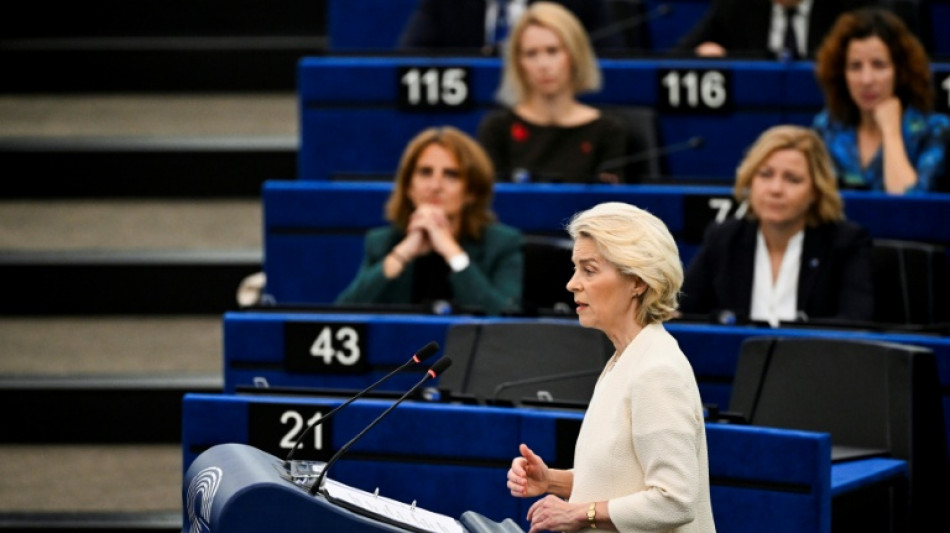
EU to ban social media for under 13s, curb access until 15 / Photo: Jean-Christophe VERHAEGEN - AFP

 Turkish Energy Minister Highlights Qatar as Key Partner for Regional and Global Energy Security

 London Museum Granted 24/7 License Ahead of November Opening

 Dana White Confirms Flight to Washington for Trump Meeting on Press Secretary Role

 Dengue Fever Expands Into High Himalayas as Climate Change Warms Nepal

 IoT Refrigerator Hacks Disrupt Blood Labs and Supermarkets Across Europe and US

 Post-election pressures complicate US and Israeli decisions on Iran

 UN members approve talks on treaty protocol against environmental crime

 Family-run West Sussex beach café prepares for first winter season

 CT scans reveal health and burial clues from Egypt’s Braided Lady mummy

 Oxford faces complaints over lecturer’s classroom attire

 Kyren Wilson and John Higgins reach International Championship snooker final
The European Union will ban social media for children under 13 and allow only limited, supervised access until the age of 15 under plans unveiled Wednesday by EU chief Ursula von der Leyen.
A global backlash against social media has piled pressure on policymakers, with a rising body of evidence showing negative impacts on children's physical and mental health.
Australia last year became the first country to ban social media for under-16s, triggering a wave of similar moves elsewhere.
The 27-country bloc would take a "gradual" approach, von der Leyen confirmed during her annual keynote address to the European Parliament in Strasbourg, France.
"Each age has its own sensitivities. And therefore, each will have its own tailored protection level," she said.
"No social media under the age of 13. No personal account under the age of 15," she said. "That means from 13 to under 15, only mini accounts, set up and supervised by parents or guardians, with limited features and time restriction to one hour a day."
"And between 15 and 18, safe design will be an obligation for the platforms."
Before she outlined the EU's approach, von der Leyen paid tribute to a 14-year-old girl in Belgium, named Olea, who killed herself one month ago after being bullied, and whose mother she quoted as saying: "I am convinced that without these omnipresent networks, my daughter would still be here."
Von der Leyen made no reference to online games or AI chatbots, which according to draft legislation seen by AFP would also be hit by the restrictions.
The European Commission president and tech chief Henna Virkkunen will formally present the proposed "KIDS Act", including the tiered age limits in Strasbourg, France on Thursday.
The EU will also ban addictive design features such as so-called infinite scrolling where children are concerned, according to a draft document.
If platforms break the rules, they face fines of up to six percent of annual turnover, draft details show.
"Europe has the power to act. It is we who decide our rules, not big tech," von der Leyen said.
"We do not have to accept addictive features," she warned, saying "platforms will have to prove that they are safe".
"It is not about our minors accessing social media. It is about when and how do we allow social media to access minors," von der Leyen added.
The "risk" is not limited to children, she noted. "Addictive design, for example, is harming everyone," she said, telling EU lawmakers that Europe needed more rules that will be proposed in the autumn.
- Pressure from EU states -
Among those listening in the grand chamber was Canadian Prime Minister Mark Carney whose country has also moved to curb social media for under-16s.
Von der Leyen had faced pressure from member states including France, Denmark and Greece for action across the 27-nation bloc to limit online harms for children.
The EU has sought for years to rein in Big Tech, empowering itself with a strengthened legal armoury that it now believes is not sufficient.
The bloc has already told Meta platforms Facebook and Instagram as well as TikTok to change their "addictive" design through its content law known as the Digital Services Act, but changes have taken longer than Brussels wants.
Digital and children's rights groups have raised concerns over how the new social media curbs will work in practice, as well as over a related age-check app the EU is preparing to roll out.
"Age verification is not a silver bullet and would raise serious privacy and data protection concerns," said European consumer organisation BEUC's Agustin Reyna.
Thursday's proposal will only become law after negotiations on a final text between EU capitals and the European Parliament, which could take months.
M.Carneiro--PC

