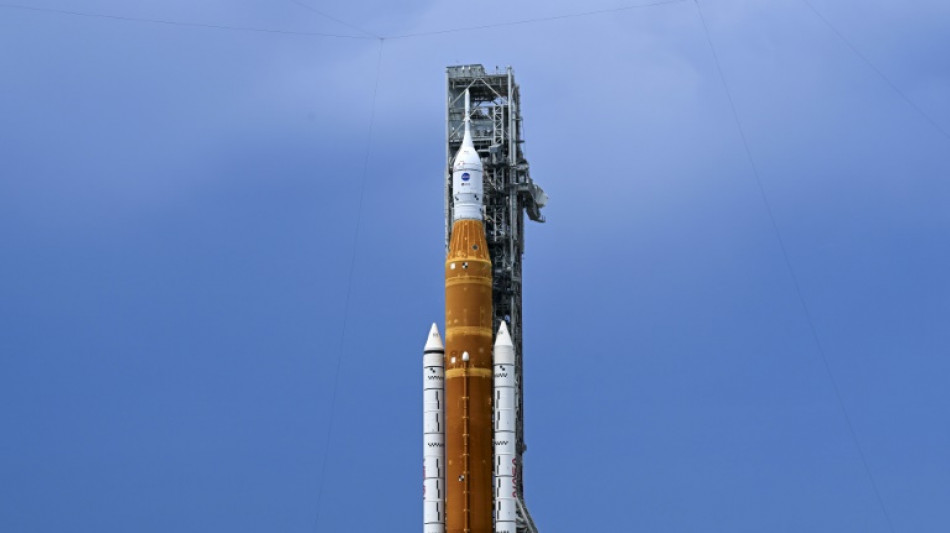
Fuel leak delays preparations for NASA rocket launch / Photo: CHANDAN KHANNA - AFP

 Alcaraz, Sabalenka into US Open last 16 as Williams sisters lose on return

 Williams sisters fall in thrilling return to US Open doubles

 Bangladesh measles toll nears grim 1,000-child mark

 Bolivia farmers return to streets over diesel price hikes
 Tetris distances itself from controversial White House 'arcade' games

 Africa bigger, US smaller - UN adopts new map

 Bad weather will not affect All Blacks, says captain Savea

 Mbappe misses penalty as Parrott lifts Betis past Real Madrid

 PSG still winless in Ligue 1 as Monaco go top

 Defending champion Alcaraz reaches last 16 at US Open

 Lyles ends season before Budapest due to injury flare ups

 US Republicans announce probe into environment groups
 Sabalenka survives despite 'tricky' weed smell at US Open

 S&P Revises Outlook on Freedom Holding Corp. and Core Subsidiaries to Positive

 Job growth but record-high diesel prices -- Trump's midterms mixed bag

 Women's NBA comissioner Engelbert to retire at season's end
 Luis Enrique extends contract as PSG coach until 2030
 Duplantis pulls out of Diamond League finals

 Defending champ Sabalenka, Pegula lead way into US Open fourth round

 UK hard-right party rallies behind leader after new donation scandal

 Nigeria's Dangote refinery looks to raise $1.6 bn in IPO
 Portugal extends talks to privatise national carrier TAP
 Brazil great Formiga says 2027 World Cup will 'change players' lives'
 Job growth, but surging diesel prices - Trump's midterms mixed bag

 Top seed Sabalenka powers into US Open fourth round

As NASA on Saturday resumed its second effort to get its new 30-story rocket off the ground and send its uncrewed test capsule toward the Moon, engineers detected a fuel leak that potentially could lead to a new delay.
With millions around the globe and hundreds of thousands on nearby beaches waiting for the historic launch of the massive Space Launch System (SLS), a leak near the base of the rocket was found as ultra-cold liquid hydrogen was being pumped in.
NASA said engineers would "stop flowing liquid hydrogen to the tank, close the valve used to fill and drain it," then try to reseal it.
The space agency offered no information on the likelihood of a new delay in the Artemis program -- which aims eventually to return a human crew to the Moon -- following Monday's aborted effort.
Saturday's launch is still scheduled for 2:17 pm (1817 GMT) from Kennedy Space Center in Florida. It can be delayed by up to two hours if necessary.
"Our team is ready," Jeremy Parsons, deputy manager of exploration ground systems at Kennedy Space Center, had said Friday.
"They are getting better with every attempt and actually performed superbly during launch countdown number one... I think if the conditions with weather and the hardware align, we'll absolutely go."
Though the area around the launch site will be closed to the public, an estimated 400,000 people were gathering on beaches nearby to see -- and hear -- the most powerful vehicle that NASA has ever launched climb into space.
The initial launch attempt was halted after engineers detected a fuel leak and a sensor showed that one of the rocket's four main engines was too hot.
Both issues have since been resolved, the launch team said.
Shortly before 06:00 am (1000 GMT) Saturday, launch director Charlie Blackwell-Thompson had given the go-ahead to start filling the rocket's tanks with cryogenic fuel.
About three million liters of ultra-cold liquid hydrogen and oxygen was expected to be pumped into the spacecraft.
And the weather appeared to be cooperating: the US Space Force predicts a 60 percent chance of favorable weather at the scheduled liftoff time, growing to 80 percent later in the launch window.
If something requires NASA to stand down again on Saturday, there are backup opportunities on Monday or Tuesday. After that, the next launch window will not be until September 19, due to the Moon's position.
The purpose of the Artemis 1 mission is to verify that the Orion capsule, which sits atop the SLS rocket, is safe to carry astronauts in the future.
Mannequins equipped with sensors are standing in for astronauts on the mission and will record acceleration, vibration and radiation levels.
- Apollo's twin sister -
It will take several days for the spacecraft to reach the Moon, flying around 60 miles (100 kilometers) at its closest approach. The capsule will fire its engines to get to a distant retrograde orbit (DRO) of 40,000 miles beyond the Moon, a record for a spacecraft rated to carry humans.
The trip is expected to last around six weeks and one of its main objectives is to test the capsule's heat shield, which at 16 feet in diameter is the largest ever built.
On its return to Earth's atmosphere, the heat shield will have to withstand speeds of 25,000 miles per hour and a temperature of 5,000 degrees Fahrenheit (2,760 degrees Celsius) -- roughly half as hot as the Sun.
Artemis is named after the twin sister of the Greek god Apollo, after whom the first Moon missions were named.
Unlike the Apollo missions, which sent only white men to the Moon between 1969 and 1972, Artemis missions will see the first person of color and the first woman step foot on the lunar surface.
Fittingly, NASA's first woman launch director, Blackwell-Thompson, will give the final "go" for liftoff on Saturday.
A successful Artemis 1 mission will come as a huge relief to the US space agency, after years of delays and cost overruns.
A government audit estimates the program's cost will grow to $93 billion by 2025, with each of its first four missions clocking in at a whopping $4.1 billion per launch.
The next mission, Artemis 2, will take astronauts to the Moon without landing on its surface.
The crew of Artemis 3 is to land on the Moon in 2025 at the earliest, with later missions envisaging a lunar space station and a sustainable presence on the lunar surface.
According to NASA chief Bill Nelson, a crewed trip to the red planet aboard Orion, which would last several years, could be attempted by the end of the 2030s.
G.Machado--PC