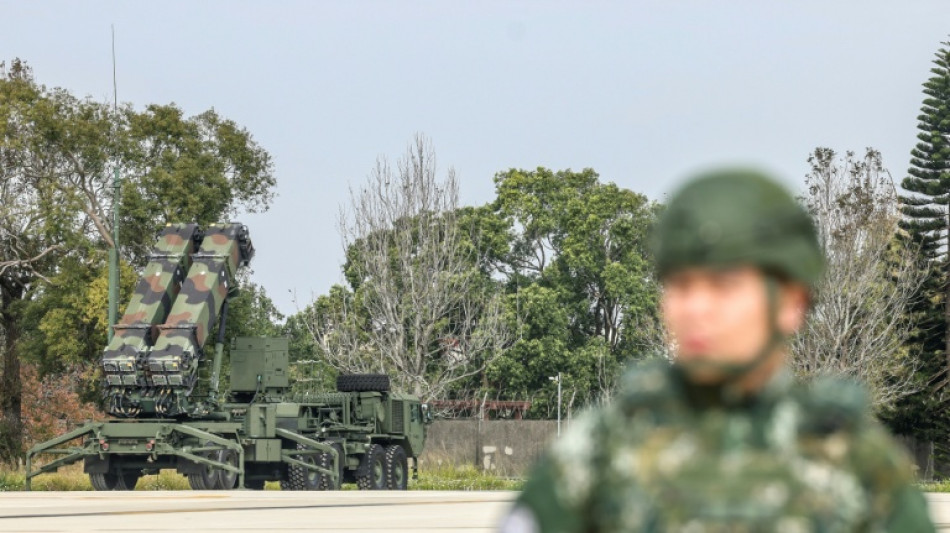
GM delivers first components for US interceptor missiles / Photo: I-HWA CHENG - AFP/File

 Turkish Energy Minister Highlights Qatar as Key Partner for Regional and Global Energy Security

 London Museum Granted 24/7 License Ahead of November Opening

 Dana White Confirms Flight to Washington for Trump Meeting on Press Secretary Role

 Dengue Fever Expands Into High Himalayas as Climate Change Warms Nepal

 IoT Refrigerator Hacks Disrupt Blood Labs and Supermarkets Across Europe and US

 Post-election pressures complicate US and Israeli decisions on Iran

 UN members approve talks on treaty protocol against environmental crime

 Family-run West Sussex beach café prepares for first winter season

 CT scans reveal health and burial clues from Egypt’s Braided Lady mummy

 Oxford faces complaints over lecturer’s classroom attire

 Kyren Wilson and John Higgins reach International Championship snooker final
General Motors has delivered its first components for Lockheed Martin interceptor missiles as the defense contractor boosts production to rebuild US stocks in the middle of the Iran war and to meet international demand, Lockheed said Thursday.
GM, which has targeted defense as an area of revenue growth, is providing precision castings to house the weapon for PAC-3 "Patriot" missiles, touted by Lockheed for delivering "exponentially more kinetic energy" compared with other missiles.
GM worked with the Pentagon in World War II, but the deliveries are the first for missiles in modern times, according to a GM spokesman, who described PAC-3 production as ongoing.
Lockheed's press release touted the speedy GM deliveries as evidence it is moving with "wartime urgency" for the Pentagon, which government reports have found faces eroded supplies of some key systems due to the Iran conflict.
Lockheed and GM signed a formal contract agreement August 6 and the first batch of PAC-3 components was delivered August 28, Lockheed said.
"This extraordinary 22‑day turnaround underscores Lockheed Martin's relentless focus on execution -- delivering for our troops faster, with greater capacity," said Tim Cahill, president of Lockheed Martin Missiles and Fire Control.
Lockheed plans to triple the volume of PAC-3 production to 2,000 by the end of next year, Lockheed Chief Executive Jim Taiclet said Thursday at a Morgan Stanley conference.
"When it also comes to PAC-3, there is significant international demand," Taiclet said. "Right now the US government is parsing out as they always do for foreign military sales. Who gets what."
In light of the strong demand from the United States and internationally, Lockheed is targeting even greater than a tripling of volumes, but Taiclet said it will take time to build the supply chain.
President Donald Trump has brushed aside questions about the hit to military supplies from the Iran war since the United States and Israel launched attacks on February 28.
But a Department of Defense's Inspector general released earlier this week said "the munitions expenditure on Operation Epic Fury has resulted in strategic inventory shortfalls and revealed industrial base bottlenecks for munitions resupply."
A September 15 report by the Congressional Budget Office cited the hit to supplies of missile defense interceptors, "which will leave the United States with a reduced inventory of interceptors for several years."
The CBO report said the Iran conflict as a whole had cost US military around $38 billion as of August 1.
In July, GM Chief Executive Mary Barra said the company expected defense revenues of $700 million in 2026, describing the venture as a way to "improve margins and become less cyclical."
Barra said the Army had ordered more than 10,000 infantry squad vehicles after an initial 1,200 procurement.
"We are focusing our efforts on strengthening supply chain management, improving manufacturing readiness and expanding production capacity in ways that serve the United States and its allies well."
M.Carneiro--PC

