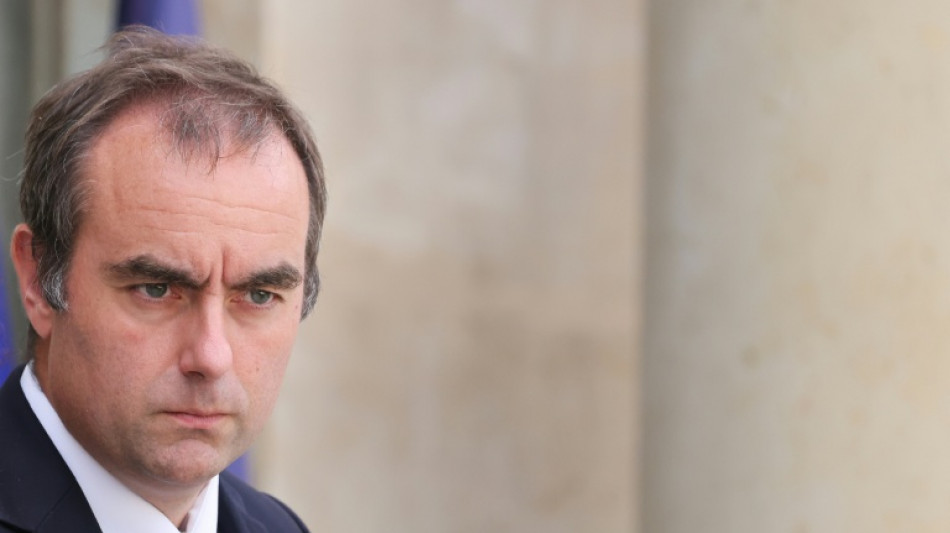
France's debt climbs to highest since 1978: ministry / Photo: Ludovic MARIN - AFP

 Turkish Energy Minister Highlights Qatar as Key Partner for Regional and Global Energy Security

 London Museum Granted 24/7 License Ahead of November Opening

 Dana White Confirms Flight to Washington for Trump Meeting on Press Secretary Role

 Dengue Fever Expands Into High Himalayas as Climate Change Warms Nepal

 IoT Refrigerator Hacks Disrupt Blood Labs and Supermarkets Across Europe and US

 Post-election pressures complicate US and Israeli decisions on Iran

 UN members approve talks on treaty protocol against environmental crime

 Family-run West Sussex beach café prepares for first winter season

 CT scans reveal health and burial clues from Egypt’s Braided Lady mummy

 Oxford faces complaints over lecturer’s classroom attire

 Kyren Wilson and John Higgins reach International Championship snooker final
France's debt mountain is growing and will this year be at its highest level since 1978 because of a soaring deficit, the country's finance ministry said Saturday.
A ministry source told reporters the public debt would reach 119.3 percent of GDP in 2026 and 121.7 percent in 2027 -- more than double the 60-percent-of-GDP reference limit EU member countries are required to aim for.
Those figures are unprecedented since 1978, according to France's statistics institute Insee.
The source said the rise in France's debt was "automatic" as "a consequence of a deficit that remains high".
France is the third most indebted country in the eurozone, behind only Greece and Italy. In Spain, debt passed below 100 percent of GDP in July, and Portugal got its debt to below 90 percent of GDP in 2025.
Under EU rules, the public deficit -- the annual shortfall of revenue to spending -- is meant to be no more than three percent of GDP.
But last year, it came in at 5.1 percent of GDP, and the government forecasts it will hit 5.4 percent this year.
France, which has been under special EU monitoring for the past two years because of those high figures, expects its deficit to drop to five percent next year -- when it holds elections to choose its next president and government.
The government has submitted its draft 2027 budget measures to an independent fiscal watchdog, the High Council of Public Finances (HCFP), to evaluate their viability in macroeconomic terms.
- Massive cuts in 2027 -
Prime Minister Sebastian Lecornu, as he outlined the draft budget Thursday, said the government planned to make adjustments and cuts worth 54 billion euros ($62 billion) in the 2027 budget.
But with elections on the horizon, he left it to parliament to decide some of the more sensitive measures, such as a government proposal to reduce tax breaks for pensioners.
The head of the parliament's finance committee, Eric Coquerel of the hard-left France Unbowed (LFI) party, has already objected that budget cuts will hit all parts of the population indiscriminately -- and thus hit the poorest hardest.
But in an interview with the daily Le Parisien, the head of the HCFP said there was still time to correct course.
"The crisis is neither certain nor guaranteed -- nor is it the only outcome," said Amelie de Montchalin.
"France is not doomed, provided the choices made are swift and responsible," she argued.
The growth forecast for 2026 has recently been revised down, with the French economy hit by weak consumer spending and, more recently, the surge in energy prices from the US-Israeli war against Iran.
A.P.Maia--PC

