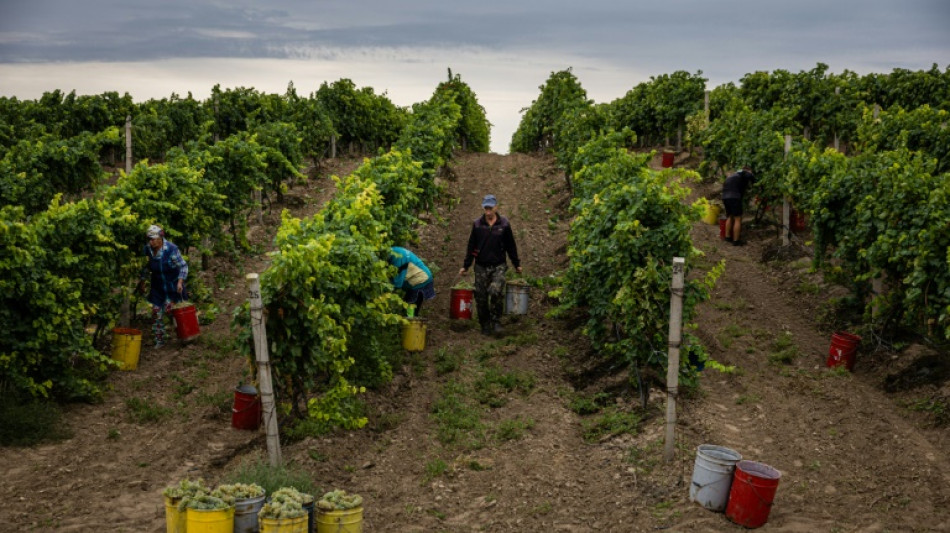
Ukraine's winegrower 'closest to the frontline' / Photo: Dimitar DILKOFF - AFP

 Williams sisters fall in thrilling return to US Open doubles
 Bangladesh measles toll nears grim 1,000-child mark

 Bolivia farmers return to streets over diesel price hikes
 Tetris distances itself from controversial White House 'arcade' games
 Africa bigger, US smaller - UN adopts new map

 Bad weather will not affect All Blacks, says captain Savea

 Mbappe misses penalty as Parrott lifts Betis past Real Madrid

 PSG still winless in Ligue 1 as Monaco go top
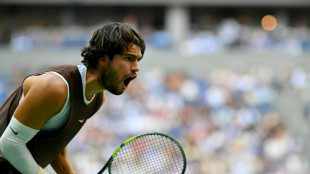 Defending champion Alcaraz reaches last 16 at US Open

 Lyles ends season before Budapest due to injury flare ups

 US Republicans announce probe into environment groups
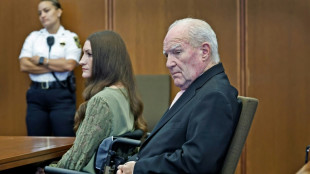
 Sabalenka survives despite 'tricky' weed smell at US Open

 S&P Revises Outlook on Freedom Holding Corp. and Core Subsidiaries to Positive

 Job growth but record-high diesel prices -- Trump's midterms mixed bag

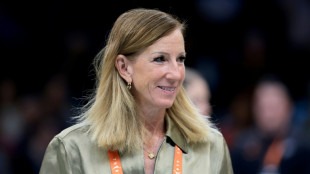 Women's NBA comissioner Engelbert to retire at season's end

 Luis Enrique extends contract as PSG coach until 2030
 Duplantis pulls out of Diamond League finals

 Defending champ Sabalenka, Pegula lead way into US Open fourth round

 UK hard-right party rallies behind leader after new donation scandal
 Nigeria's Dangote refinery looks to raise $1.6 bn in IPO

 Portugal extends talks to privatise national carrier TAP
 Brazil great Formiga says 2027 World Cup will 'change players' lives'
 Job growth, but surging diesel prices - Trump's midterms mixed bag

 Top seed Sabalenka powers into US Open fourth round
 Russia rights group boss fears post-election crackdown

Pavlo Magalias has made two equal piles. On the left are remnants of ancient storage jars unearthed in recent years at his vineyard in southern Ukraine, to the right, cluster bombs, dropped since the war broke out.
Originally from Moldova, the 59-year-old former weightlifter set up the Olvio Nuvo vineyard in 2013 on the slopes of the estuary of Ukraine's long Southern Bug river.
It owes its name to the ancient Greek city of Olbia, founded in the seventh century whose archaeological ruins are just a few hundred metres (feet) away.
Since February 24, however, this out-of-the-way, wind-swept spot has lost its usual tranquillity.
"I'm the winegrower closest to the frontline," Magalias sighs, overseeing the harvest of his grapes as the heavy rumbling of Russian and Ukrainian artillery resonates behind him.
At the start of the invasion, the Russian forces' rapid advance into southern Ukraine allowed them to occupy the opposite bank, south of the city of Mykolaiv.
From there, Moscow's military bombed Ukrainian troops on the riverbank still under Kyiv's control.
That's how Olvio Nuvo "found itself by chance at the epicentre of the war", Magalias says.
During "these very tough months", he counted no fewer than 26 craters pockmarking the 10 hectares (25 acres) of his vineyard and worked hard to dig up and put into a pile every missile remnant.
With the arrival of Western weapons, the Ukrainian forces were able to push back the Russians who abandoned their positions.
Now, the opposite bank is a contested grey zone where all day long smoke rises from artillery hits, followed seconds later by the sound of an explosion that reveals how far away it is -- roughly nine kilometres (six miles).
- Missile-strewn vines –
But the powerful explosions barely provoke a raised eyebrow these days among Magalias' workers, who are local residents paid 600 to 700 hryvnia (about 15 to 18 euros, $15 to $18) for half a day's work.
Earlier in the season, bombs would be exploding around them as they harvested the grapes.
Fifteen-year-old Lisa Bachanova, who has come with a friend to pick and make a bit of pocket money, says she has become used to it since the first time her nearby village was hit.
"We are most afraid for the people on the other side, but, for us, we hardly pay any attention anymore," the teenager says, cutting bunches of Johanniter grapes, which produce a dry white wine of which Magalias is proud.
In this region where the war has been a hammer blow for the local economy and the countryside transformed into a vast battlefield, the harvests bring a welcome source of income for those who have stayed put.
Zyneida Bossa, 66, works as if everything was normal, as if there were not remnants of cluster missiles left in the vines.
"Some people are nervous because of missiles, but I'm OK. What can we do? You have to have something to live on, we need to work," she says.
- Life will prevail -
Despite the bombs, Magalias says he's never thought of leaving.
"I put all my savings into this vineyard. Now I no longer have any money but I do have all this," he says, gesturing towards the estate, which produces 15,000 bottles of red and white wine a year.
Passionate about wine, he used to organise tastings and a wine festival before the war.
And his eyes tear up talking about the conflict, which he says has killed "many friends".
"We were not bothering anyone, we were quietly working and the Russians came. Why the hell are they here?" he says forcefully.
But he wants to remain optimistic, taking heart from the vines that were destroyed in the explosions but are now beginning to grow again.
"It's the same with people. The war isn't going to kill everybody and life will win out," he says.
The worst thing, he says breaking into a sarcastic smile, is that this year is "exceptional".
"Ones like that, you get once every five years! The grape gives its all and the wine is going to be excellent, maybe with just a powdery aftertaste," he jokes.
S.Pimentel--PC