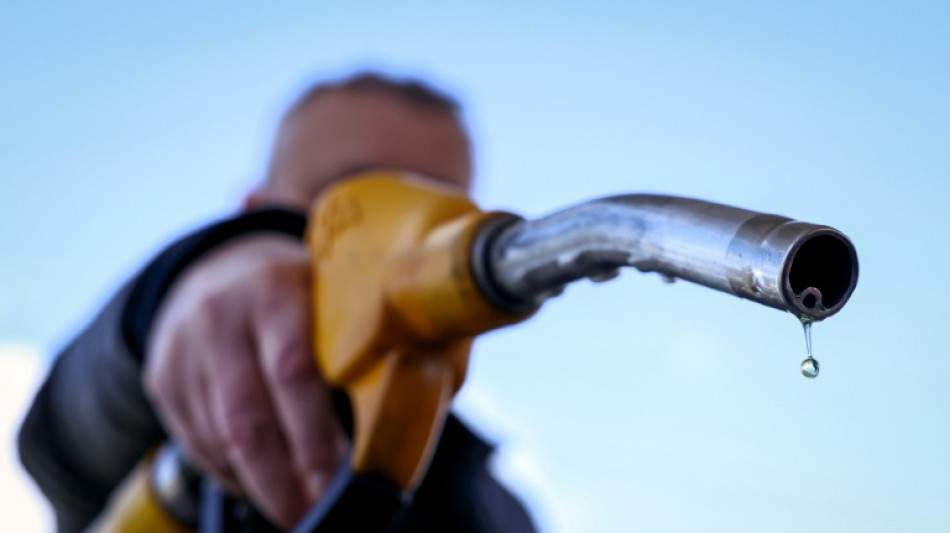
How is the EU approaching record fuel prices? / Photo: Alain JOCARD - AFP/File

 Turkish Energy Minister Highlights Qatar as Key Partner for Regional and Global Energy Security

 London Museum Granted 24/7 License Ahead of November Opening

 Dana White Confirms Flight to Washington for Trump Meeting on Press Secretary Role

 Dengue Fever Expands Into High Himalayas as Climate Change Warms Nepal

 IoT Refrigerator Hacks Disrupt Blood Labs and Supermarkets Across Europe and US

 Post-election pressures complicate US and Israeli decisions on Iran

 UN members approve talks on treaty protocol against environmental crime

 Family-run West Sussex beach café prepares for first winter season

 CT scans reveal health and burial clues from Egypt’s Braided Lady mummy

 Oxford faces complaints over lecturer’s classroom attire

 Kyren Wilson and John Higgins reach International Championship snooker final
Transport fuel prices in the European Union have struck record highs in recent days, driven by oil futures surging because of the Middle East war and Ukranian strikes on Russian refineries.
The scale of the price increases have differed significantly from country to country, however, as have governments' measures to address the spikes.
AFP examines the reasons below:
- Why prices are so high? -
Crude oil prices have risen sharply since the start of the conflict in the Middle East, climbing from around $70 per barrel just before hostilities began at the end of February to about $100 currently.
However, transport fuels refined from crude oil -- notably diesel, petrol and kerosene that is used to power planes -- have faced even greater upward pressure.
In addition to being key producers of crude oil, Gulf nations have become major exporters of refined products.
Europe has relied on these producers following Russia's invasion of Ukraine in 2022.
However, a surge in maritime freight costs in the Middle East, driven by risks to vessels in the Red Sea and the Strait of Hormuz, has made exporting refined products from the Gulf financially unviable.
Tankers designed for refined products carry far fewer barrels than those used for crude oil. Consequently, "the additional transport cost rises to around $50 per barrel" for companies, TotalEnergies chief executive Patrick Pouyanne explained in late August.
Repeated Ukrainian drone attacks on Russian refineries are also significantly reducing the global supply of engine fuels, in particular diesel.
As a result prices are soaring, boosting operating margins for refiners, while countries are scrambling to avoid shortages.
- Why European pump prices differ? -
Across Europe, consumers are paying very different prices for their engine fuels because of governments' different approaches to taxes and subsidies.
Julien Mathonniere, an economist at Energy Intelligence, explained that "Europe, in particular, taxes fuel heavily" with a minimum tax per litre of 33 euro cents for diesel and 35.9 cents for unleaded petrol.
This is before Value Added Tax of at least 15 percent in Europe. French VAT is at 20 percent.
"Each EU country can add its own taxes" to the minimum rates, Mathonniere told AFP, causing significant differences at the pump.
On September 14, according to European Union data, a litre of diesel cost around 2.50 euros in Denmark and Finland, 2.29 euros in France and 1.83 euros in Spain.
In general, across Europe, "taxes often make up more than two-thirds of the price", added Mathonniere.
Arne Lohmann Rasmussen of Global Risk Management, explained that this is why "diesel prices are actually higher in Europe than in Asia, despite Asia being more directly affected by the conflict involving Iran".
Transport and production costs also play a marginal role but "prices before taxes cannot diverge too much", otherwise sellers would simply route fuel to markets where prices are higher, he added.
- How is Europe responding? -
EU nations Portugal and Romania have implemented measures to directly cut fuel taxes to limit price hikes at the pump.
Others have favoured targeted aid. Bulgaria announced that nearly 550,000 vulnerable citizens would receive a one-off payment of 50 euros to offset rising fuel costs.
At the European Union level, the priority appears to be protecting the sectors hardest hit by price increases.
The European Commission has authorized state aid for the most affected industries -- agriculture, fisheries, and transport.
French President Emmanuel Macron has written to EU chief Ursula von der Leyen in an effort to sway certain European regulations.
He is calling in particular for a "relaxation" of European fuel quality standards.
Meanwhile, prices risk rising further as the wars continue.
burs-pml/bcp/rl
C.Amaral--PC

