
Anthropic touts AI-led biology discovery / Photo: SEBASTIEN BOZON - AFP/File

 Turkish Energy Minister Highlights Qatar as Key Partner for Regional and Global Energy Security

 London Museum Granted 24/7 License Ahead of November Opening

 Dana White Confirms Flight to Washington for Trump Meeting on Press Secretary Role

 Dengue Fever Expands Into High Himalayas as Climate Change Warms Nepal

 IoT Refrigerator Hacks Disrupt Blood Labs and Supermarkets Across Europe and US

 Post-election pressures complicate US and Israeli decisions on Iran

 UN members approve talks on treaty protocol against environmental crime

 Family-run West Sussex beach café prepares for first winter season

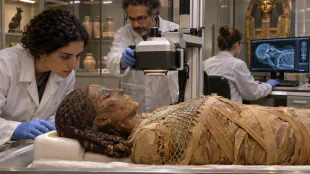 CT scans reveal health and burial clues from Egypt’s Braided Lady mummy

 Oxford faces complaints over lecturer’s classroom attire

 Kyren Wilson and John Higgins reach International Championship snooker final
US artificial intelligence startup Anthropic on Wednesday unveiled the first discovery from its molecular biology lab, a previously unknown enzyme system spotted by its Claude model and touted by the company as proof that AI can speed up basic research.
Enzyme systems found in nature have led to some of biology's biggest breakthroughs, from the tools that launched the biotech industry to the DNA-copying method behind many medical tests.
According to the company, some 950 Claude-powered software agents combed through a database of DNA sequences for 21 hours.
The agents found more than 200,000 genes for one type of enzyme and picked out 20 worth a closer look -- work that would take an expert scientist weeks or even months.
Anthropic said its researchers' involvement was limited to the initial instructions and the lab experiments, with the AI agents working autonomously to decide which leads to pursue.
One of the agents spotted something in viruses that infect bacteria that scientists appear to have missed: a string of short, repeating pieces of DNA sitting next to two genes, one for a known enzyme and one for a mystery protein.
The setup looks like CRISPR, a natural defense system in bacteria that scientists turned into a gene-editing tool now used in medicine.
Anthropic chief Dario Amodei, who recently called for slowing AI development because of its risks, cited the discovery on Wednesday in remarks to the UN Security Council, which he addressed by video link.
The finding is "preliminary," he said, but "may constitute a new gene editing mechanism that could have applications in gene therapy."
He predicted "profound progress in the near future on diseases that have plagued humanity for millennia."
The function of the newly identified system, dubbed ART, remains unknown, Anthropic said.
The company added that its initial experiments suggest the system could, like CRISPR, be programmable.
The results, published as a preprint, have not yet been reviewed by other scientists.
Feng Zhang, one of the pioneers of CRISPR and a professor at MIT and the Broad Institute, called the identification of the repeated DNA fragments "genuinely intriguing" and said it "merits further investigation," in remarks released by Anthropic.
Amodei also said on X that a team at Stanford University had independently described a comparable but distinct system.
Formed in the spring, Anthropic's lab team works in the San Francisco Bay Area and does not handle pathogens capable of infecting humans.
All experiments are carried out by human scientists, Anthropic said. Amodei did not rule out Claude eventually operating lab equipment itself, with appropriate safeguards.
T.Resende--PC

