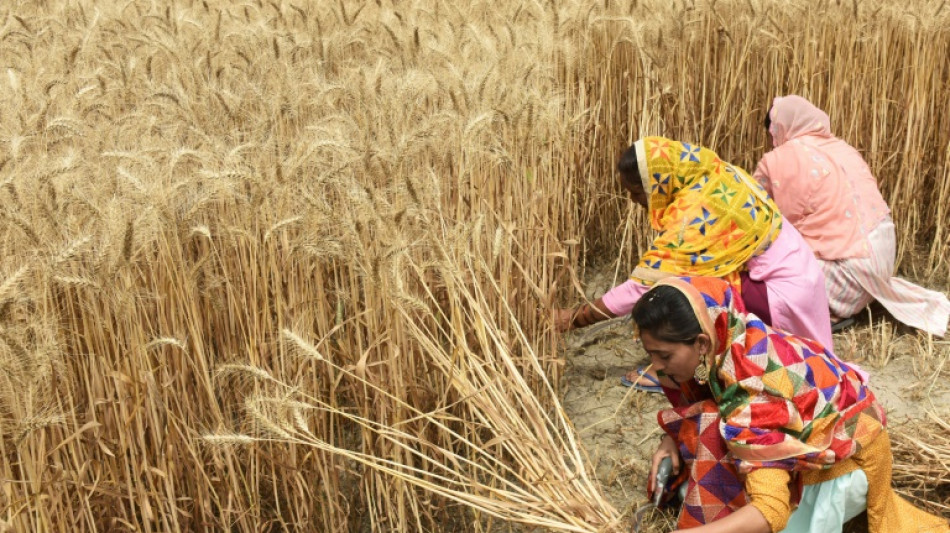
Countries growing 70% of world's food face 'extreme' heat risk by 2045 / Photo: NARINDER NANU - AFP/File

 Williams sisters fall in thrilling return to US Open doubles

 Bangladesh measles toll nears grim 1,000-child mark

 Bolivia farmers return to streets over diesel price hikes
 Tetris distances itself from controversial White House 'arcade' games

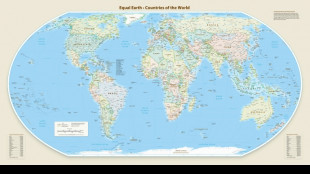 Africa bigger, US smaller - UN adopts new map

 Bad weather will not affect All Blacks, says captain Savea

 Mbappe misses penalty as Parrott lifts Betis past Real Madrid

 PSG still winless in Ligue 1 as Monaco go top

 Defending champion Alcaraz reaches last 16 at US Open

 Lyles ends season before Budapest due to injury flare ups

 US Republicans announce probe into environment groups

 Sabalenka survives despite 'tricky' weed smell at US Open

 S&P Revises Outlook on Freedom Holding Corp. and Core Subsidiaries to Positive

 Job growth but record-high diesel prices -- Trump's midterms mixed bag

 Women's NBA comissioner Engelbert to retire at season's end

 Luis Enrique extends contract as PSG coach until 2030

 Duplantis pulls out of Diamond League finals

 Defending champ Sabalenka, Pegula lead way into US Open fourth round

 UK hard-right party rallies behind leader after new donation scandal

 Nigeria's Dangote refinery looks to raise $1.6 bn in IPO

 Portugal extends talks to privatise national carrier TAP
 Brazil great Formiga says 2027 World Cup will 'change players' lives'
 Job growth, but surging diesel prices - Trump's midterms mixed bag

 Top seed Sabalenka powers into US Open fourth round

 Russia rights group boss fears post-election crackdown

Blistering crop-withering temperatures that also risk the health of agricultural workers could threaten swathes of global food production by 2045 as the world warms, an industry analysis warned Thursday.
Climate change is already stoking heatwaves and other extreme weather events across the world, with hot spells from India to Europe this year expected to hit crop yields.
Temperature spikes are causing mounting concern for health, particularly for those working outside in sweltering conditions, which is especially dangerous when humidity levels are high.
The latest assessment by risk company Verisk Maplecroft brings those two threats together to calculate that heat stress already poses an "extreme risk" to agriculture in 20 countries, including agricultural giant India.
But the coming decades are expected to expand the threat to 64 nations by 2045 -- representing 71 percent of current global food production -- including major economies China, India, Brazil and the United States.
"With the rise in global temperatures and rise in global heat stress, we're going to see crops in more temperate countries as well start being affected by this," said Will Nichols, head of climate and resilience at Verisk Maplecroft.
Rice is particularly at risk, the assessment said, with other crops like cocoa and even tomatoes also singled out as of concern.
- Growing risk -
Maplecroft's new heat stress dataset, using global temperature data from the UK Met Office, feeds into its wider risk assessments of countries around the world.
It is based on a worst-case emissions scenario leading to around 2 degrees Celsius of warming above pre-industrial levels as soon as 2045.
However, the authors stress that in projections to mid-century, even scenarios that assume higher levels of carbon-cutting action could still result in temperatures nearing 2C.
India -- responsible for 12 percent of global food production in 2020 and heavily reliant on outdoor labour productivity -- is already rated as at extreme risk, the only major agricultural nation in that category at current temperatures.
"There's a very real worry that people in rural areas, which are obviously highly dependent on agriculture, are going to be much more vulnerable to these kinds of heat events going forward," Nichols told AFP.
That could impact productivity and in turn exports -- and have potentially "cascading" knock-on effects on issues such as the country's credit rating and even political stability, he said.
By 2045, the list grows much longer.
Nine of the top ten countries affected in 2045 are in Africa, with the world's second largest cocoa producer Ghana, as well as Togo and Central African Republic receiving the worst possible risk score.
The top 20 at-risk countries in the coming decades include key Southeast Asian rice exporters Cambodia, Thailand and Vietnam, the authors said, noting that rice farmers in central Vietnam have already taken to working at night to avoid the high temperatures.
The assessment highlights that major economies like the US and China could also see extreme risk to agriculture in 2045, although in these large countries the impacts vary by region.
Meanwhile, Europe accounts for seven of the 10 countries set to see the largest increase in risk by 2045.
"I think what it reinforces is that, even though a lot of us are sort of sitting in sort of Western countries, where we might think we're a bit more insulated from some of these threats, actually we are not necessarily," Nichols said.
"Both in terms of the sort of physical risks that we're facing, but also in terms of the kind of knock on effects down the supply chain."
S.Pimentel--PC