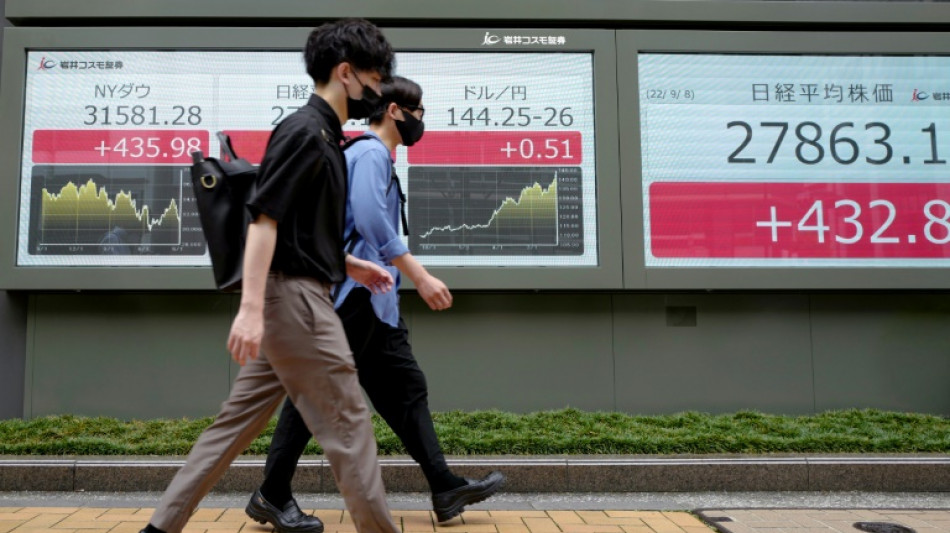
Japan says ready for 'necessary response' as yen dives / Photo: Kazuhiro NOGI - AFP

 Energy bill plan could use HMRC income data to target support

 Business owner earning £6,000 a month tackles £70,000 debt

 Nvidia chief faces inquiry after disclosing affair with suspected Chinese agent

 Comet returns as online electrical marketplace 14 years after collapse

 KUFOS Signs MoU With Old Dominion University to Expand Academic Ties

 Karen Wazen Launches First Standalone Boutiques in Cairo

 Opti Digital Launches NEXA, an AI-Powered Intelligence Layer

Japan is ready to take action if the yen's plummeting value remains volatile, officials repeated on Thursday, after the currency hit 24-year lows.
The yen has tumbled from around 115 per dollar in March to lower than 140 last week, as the Bank of Japan (BoJ) sticks with its monetary easing policies in contrast to rate hikes from other central banks including the US Federal Reserve.
It has continued to drop fast, nearly touching 145 per dollar overnight in New York, as investors flooded into the US currency hoping for better returns and as a safe-haven hedge.
Japan has not announced any specific measures to bolster the yen, such as instructing the central bank to buy it against other currencies.
But on Thursday, officials from the BoJ, the finance ministry and the government's fiscal services agency held a meeting while the yen hovered close to 144 per dollar.
"If (the yen) continues to fluctuate like this, the government is ready to take the necessary response in financial markets," Masato Kanda, Vice-Minister of Finance for International Affairs, told reporters after the meeting.
"Various measures" are on the table, he said without giving details. His comments closely echoed remarks made Wednesday by Japan's finance minister, who said rapid shifts in foreign exchange rates were "not desirable".
Ray Attrill, head of FX strategy at National Australia Bank, said the rhetoric would have little effect.
"The market's not buying what the Japanese officials are selling in terms of their public concerns about the moves in the yen. They've basically been singing from exactly the same hymn sheet," he told AFP.
A weaker yen can help Japanese companies to sell products overseas, but "at these levels, the disadvantages of a weak yen are starting to outweigh the benefits," with households and businesses facing higher import prices, Attrill said.
Inflation more broadly has risen to seven-year highs in Japan, partly due to the impact of the war in Ukraine on energy prices, but it is still less severe than in many major economies.
Prime Minister Fumio Kishida announced Thursday that the government will use 3.5 trillion yen ($24 billion) of reserve funds to address the domestic impact of inflation, and will deliver cash relief packages to low-income households.
P.Serra--PC
