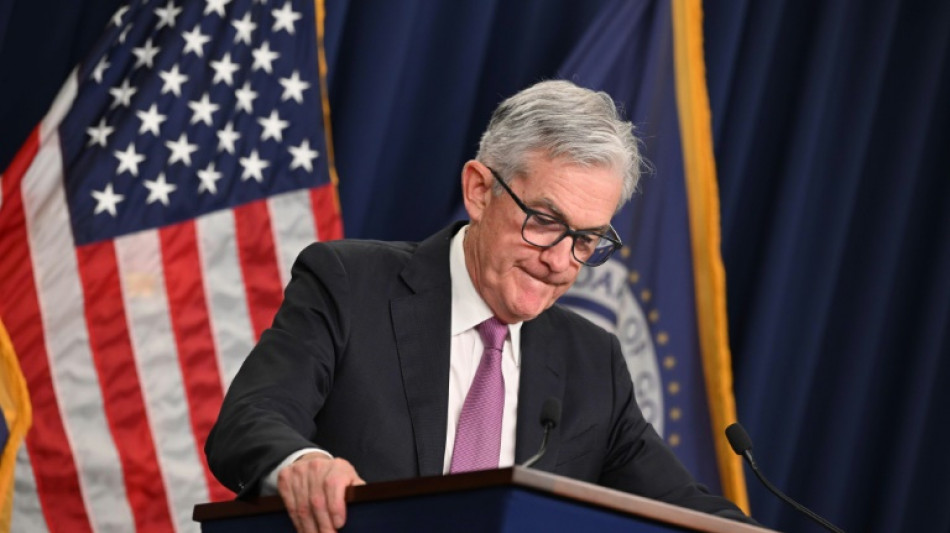
Fed Must act 'strongly' to avoid repeat of 1980s inflation spike: Powell / Photo: MANDEL NGAN - AFP/File

 Energy bill plan could use HMRC income data to target support

 Business owner earning £6,000 a month tackles £70,000 debt

 Nvidia chief faces inquiry after disclosing affair with suspected Chinese agent

 Comet returns as online electrical marketplace 14 years after collapse

 KUFOS Signs MoU With Old Dominion University to Expand Academic Ties

 Karen Wazen Launches First Standalone Boutiques in Cairo

 Opti Digital Launches NEXA, an AI-Powered Intelligence Layer

The Federal Reserve must continue to act "strongly" to cool demand and contain price pressures to avoid a repeat of the inflation surge the US economy suffered in the 1970s and 1980s, Fed Chair Jerome Powell said Thursday.
With soaring prices in recent months pushing US annual inflation to the fastest in four decades, Powell's Fed has raised the benchmark lending rate four times this year, with a third massive, three-quarter point hike possible later this month.
His predecessor from that era, Paul Volcker, had to take extreme measures because high inflation had become entrenched, resurging and surpassing the peak of the mid-1970s after repeated failed efforts to tame the price increases.
"We need to act now forthrightly, strongly as we have been doing and we need to keep at it until the job is done to avoid ... the kind of very high social costs" of the Volcker era, Powell said.
The comments, which reaffirm his steadfast commitment to bring inflation back down, come as the European Central Bank announced its first ever increase of 75 basis points -- underscoring the pressure on policymakers worldwide to combat the global threat of rising prices.
American families have been struggling with the prices sparked initially by high demand but exacerbated by supply chain woes, Covid lockdowns in China and surging gasoline prices due to Russia's war in Ukraine.
Powell said inflation would not have spiked the way it did without the pandemic effects, which included a shortage of labor. The inflation rate this year hit 9.1 percent in June, before slowing to 8.5 percent in July. Data for August are due to be released next week.
The US jobs market remains tight, with nearly two openings for everyone looking for work, and Powell noted that even with new data last week showing more people joined the labor force last month, it remains well below the pre-pandemic level.
With many people remaining on the sidelines, that has driven up worker pay, which policymakers fear could fuel a dangerous wage-price spiral.
Though the Fed is hoping the world's largest economy will continue growing, Powell has acknowledged that the Fed's aggressive inflation-fighting campaign could cause some pain.
But he has stressed repeatedly that acting now will prevent more damaging consequences down the road.
"The clock is ticking," Powell warned.
US annual inflation spiked to a painful 12.3 percent in December 1974 before trending down, but then resurged. It peaked at 14.8 percent in early 1980 and didn't fall into single digits until late the following year amid Volcker's campaign.
Powell said "history cautions strongly against prematurely loosening policy," once again dousing hopes the central bank might cut interest rates next year as the economy slows.
M.Carneiro--PC
