Voice-operated smartphones target Africa's illiterate / Photo: Sia KAMBOU - AFP/File

 Bolivia farmers return to streets over diesel price hikes

 Tetris distances itself from controversial White House 'arcade' games

 Africa bigger, US smaller - UN adopts new map

 Bad weather will not affect All Blacks, says captain Savea

 Mbappe misses penalty as Parrott lifts Betis past Real Madrid

 PSG still winless in Ligue 1 as Monaco go top

 Defending champion Alcaraz reaches last 16 at US Open

 Lyles ends season before Budapest due to injury flare ups
 US Republicans announce probe into environment groups

 Sabalenka survives despite 'tricky' weed smell at US Open

 S&P Revises Outlook on Freedom Holding Corp. and Core Subsidiaries to Positive

 Job growth but record-high diesel prices -- Trump's midterms mixed bag

 Women's NBA comissioner Engelbert to retire at season's end

 Luis Enrique extends contract as PSG coach until 2030

 Duplantis pulls out of Diamond League finals

 Defending champ Sabalenka, Pegula lead way into US Open fourth round

 UK hard-right party rallies behind leader after new donation scandal

 Nigeria's Dangote refinery looks to raise $1.6 bn in IPO
 Portugal extends talks to privatise national carrier TAP

 Brazil great Formiga says 2027 World Cup will 'change players' lives'

 Job growth, but surging diesel prices - Trump's midterms mixed bag

 Top seed Sabalenka powers into US Open fourth round
 Russia rights group boss fears post-election crackdown

 WHO says key warehouse destroyed by attack in Ukraine
 Hesson says Pakistan players used to 'chaos' after shake-up

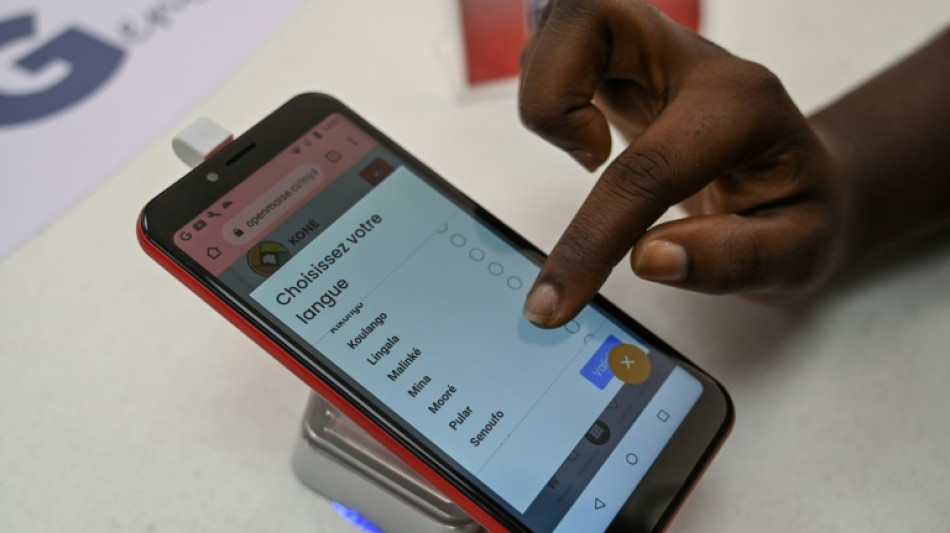
Voice-operated smartphones are aiming at a vast yet widely overlooked market in sub-Saharan Africa -- the tens of millions of people who face huge challenges in life because they cannot read or write.
In Ivory Coast, a so-called "Superphone" using a vocal assistant that responds to commands in a local language is being pitched to the large segment of the population -- as many as 40 percent -- who are illiterate.
Developed and assembled locally, the phone is designed to make everyday tasks more accessible, from understanding a document and checking a bank balance to communicating with government agencies.
"I've just bought this phone for my parents back home in the village, who don't know how to read or write," said Floride Jogbe, a young woman who was impressed by adverts on social media.
She believed the 60,000 CFA francs ($92) she forked out was money well spent.
The smartphone uses an operating system called "Kone" that is unique to the Cerco company, and covers 17 languages spoken in Ivory Coast, including Baoule, Bete, and Dioula, as well as 50 other African languages.
Cerco hopes to expand this to 1,000 languages, reaching half of the continent's population, thanks to help from a network of 3,000 volunteers.
The goal is to address the "frustration" illiterate people feel with technology that requires them to be able to read or write or spell effectively, said Cerco president Alain Capo-Chichi, a Benin national.
"Various institutions set down the priority of making people literate before making technology available to them," he told AFP.
"Our way skips reading and writing and goes straight to integrating people into economic and social life."
Of the 750 million adults around the world who cannot read or write, 27 percent live south of the Sahara, according to UN figures for 2016, the latest year for which data is available.
The continent also hosts nearly 2,000 languages, some of which are spoken by tens of millions of people and are used for inter-ethnic communication, while others are dialects with a small geographical spread.
Lack of numbers or economic clout often means these languages are overlooked by developers who have already devised vocal assistants for languages in bigger markets.
- Twi and Kiswahili -
Other companies investing in the voice-operation field in Africa include Mobobi, which has created a Twi language voice assistant in Ghana called Abena AI, while Mozilla is working on an assistant in Kiswahili, which has an estimated 100 million speakers in East Africa.
Telecommunications expert Jean-Marie Akepo questioned whether voice operation needed the platform of a dedicated mobile phone.
Existing technology "manages to satisfy people", he said.
"With the voice message services offered by WhatsApp, for example, a large part of the problem has already been solved."
Instead of a new phone, he recommended "software with local languages that could be installed on any smartphone".
The Ivorian phone is being produced at the ICT and Biotechnology Village in Grand-Bassam, a free-trade zone located near the Ivorian capital.
It came about through close collaboration with the government. The company pays no taxes or customs duties and the assembly plant has benefited from a subsidy of more than two billion CFA francs.
In exchange, Cerco is to pay 3.5 percent of its income to the state and train around 1,200 young people each year.
The company says it has received 200,000 orders since launch on July 21.
Thanks to a partnership with French telecommunications giant Orange, the phone will be distributed in 200 shops across Ivory Coast.
F.Santana--PC