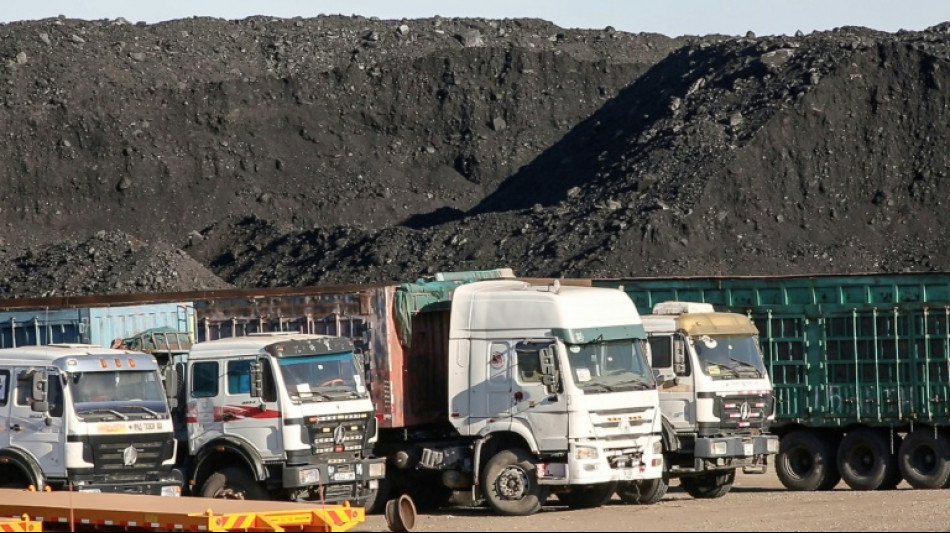
Mongolia completes rail crossing with China to boost coal exports / Photo: Uugansukh Byamba - AFP

 Energy bill plan could use HMRC income data to target support

 Business owner earning £6,000 a month tackles £70,000 debt

 Nvidia chief faces inquiry after disclosing affair with suspected Chinese agent

 Comet returns as online electrical marketplace 14 years after collapse

 KUFOS Signs MoU With Old Dominion University to Expand Academic Ties

 Karen Wazen Launches First Standalone Boutiques in Cairo

 Opti Digital Launches NEXA, an AI-Powered Intelligence Layer

Mongolia has launched a rail line that could help boost coal exports to China to 50 million tonnes a year, the country's president said, ending a decade-long wait for the crossing.
A ceremony to mark the launch of the rail service between the Tavan Tolgoi coal field and Gashuun Sukhait on the Chinese border was held on Friday.
Mongolian President Ukhnaa Khurelsukh was among the dignitaries in attendance, according to his website.
Heavily dependent on mining, Mongolia has long sought cheaper and more efficient ways to export its minerals abroad and has a national strategy to expand its rail network connections with Russia and China.
Mining makes up a quarter of the country's gross domestic product.
China has stepped up its investment in coal in the face of extreme weather, an economic slowdown and a global fuel crisis.
The 233-kilometre (145-mile) Tavan Tolgoi rail line has the capacity to export between 30 million and 50 million tonnes of coal to China annually, according to Tavantolgoi Railway LLC, the state agency that built the line.
In 2020 the North Asian country exported 28.6 million tonnes of coal. Last year, exports fell to 15.9 million tonnes.
The railway is also expected to lower the cost to transport coal to $8 per tonne, compared to $32 per tonne when coal is delivered by truck, according to the railway authority.
Tavan Tolgoi is rich in coking coal, an essential ingredient in the steel-making process.
For years coal has been transported in trucks to China, a process that has led to long queues at the border and frequent accidents.
Mongolian governments have attempted to build a railway from Tavan Tolgoi to the Gashuun Sukhait border for more than a decade.
Tavantolgoi LLC was formed in 2018 to complete the project. Ulaanbaatar-based Bodi International served as the general contractor.
The Gashuun Sukhait-Gantsmod border crossing is now the second Mongolia-China border point with a rail crossing, with the other at Zamyn-Uud-Erlian.
Progress Rail, a division of Caterpillar, agreed to supply 16 locomotives to support operations for the railway project.
The new locomotives are designed to fit the 1,520 mm gauge used in Mongolia, Russia, and other former Soviet republics.
Mongolia's current 1,900 km rail network was almost entirely constructed during the 20th century with help from the Soviet Union.
It consists mainly of the Trans-Mongolia line between Russia and China, and a spur line to the city of Erdenet.
A.P.Maia--PC
