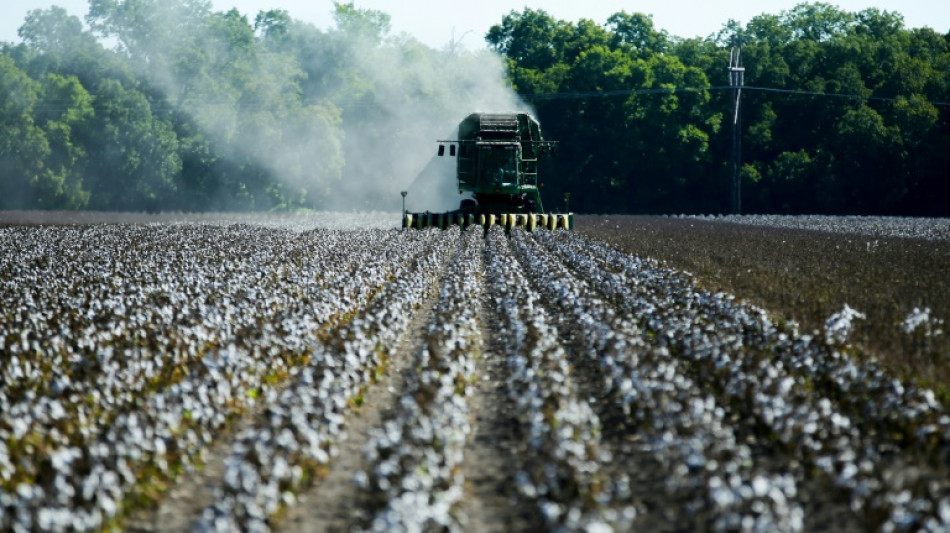
Drought decimates Texas' key cotton crop / Photo: Andy JACOBSOHN - AFP

 Mistrial declared in case of US woman who killed her three children

 Seville, Alfred win at Diamond League finals, Duplantis hit with injury

 Moody’s Assigns First-Time Insurance Financial Strength Ratings to Freedom Insurance and Freedom Life

 Trump says envoys taking plan to 'end the war' to Moscow, Kyiv

 US Football Hall of Fame revamps selection process

 Judge declares mistrial in case of US woman who killed her children

 Edgar Davids art thief misses sentencing after being 'knocked out by luggage'

 Pegula rallies to reach US Open fourth round

 Defending champ Sabalenka leads way into US Open fourth round

 Bayeux Tapestry 'virtually unchanged', UK museum says, after France spots broken threads

 More than 120 killed in Yemen's worst clashes in years: sources

 Germany hunts climate activist suspected of power grid sabotage

 5 EU countries aim to send rejected migrants to 'return hub' by 2027

 Argentina to return Nazi-looted painting to Jewish collector's heir
 Australian Simmons makes NBA comeback with Kings: reports
 Two broken threads on Bayeux Tapestry, no major damage: French minister

 Meloni marks record in power with eye on 2027 elections

 Israel emptying West Bank refugee camps could be crime against humanity: UN

 Portugal extends talks to privatise airline

 CoinRabbit Wins “Best Crypto Lending Platform 2026” Award from International Business Magazine

 Judge declares mistrial in US infanticide case but puts ruling on hold

 US midterms begin with chaos over mail-voting crackdown

 Russell tops second practice to beat Ferrari and Antonelli in Italy

 'I love the players we have', insists Arsenal boss Arteta

 Jury resumes deliberations in case of US mother who killed her three children

On Sutton Page's ravaged cotton fields, there is almost nothing left to pick. The Texas farmer managed to salvage maybe a fifth of his crop, but the rest was lost to the severe drought that has taken a steep toll across the region.
This year, his harvest is "not well," he says, but in reality, the drought in northern Texas has proven to be a disaster, with most of Page's neighbors not even bothering to harvest their crop, leaving "bare, bare fields."
Texas produces almost half of America's cotton, and the United States is the world's third largest supplier, behind India and China.
This year, national production will hit its lowest level since 2015, down 21 percent year-on-year, and Texas will suffer a 58 percent drop, the US Department of Agriculture estimates.
In the northwest of the state, where cotton is the lifeline of the local economy and water is scarce, the 2022 harvest "could be one of the worst in 30 years," worries Darren Hudson, professor of agricultural economics at Texas Tech University.
With the cascading consequences for the global textile industry, in an economy already reeling from the pandemic, Hudson put the likely economic impact for the region at $2 billion.
Landon Orman, 30, works on 2,000 acres of cotton near Abilene, three hours west of Dallas. His non-irrigated cotton did not even sprout, while his partially watered crop grew but its yield will be slashed by half.
In total, he predicts an 85 percent drop in production compared to a normal year. Like so many others, he has crop insurance, so "financially we're not really doing that bad. But as a farmer, it sucks pretty bad that we can't grow stuff sometimes."
- Depressing -
In Lubbock, the region's cotton hub, rainfall over the past 12 months has roughly been half its normal volume, and what little fell came too late to save the crop.
"Starting in January, all the way to the month of May, no, no literally no rain," said Sutton Page, 48. And from May "we started having 100 degree days and 30 mile an hour winds and it just dried everything out."
He had to plow 80 percent of his dying crop back into the ground to stop the land drying out. Of the few small plants that actually grew, it may not even be economical to harvest them.
"It's a little depressing to some degree, because you work hard all year and you get to get the farms ready and you fertilize and, and and your crop doesn't come up," he said.
- Frequency -
Cotton farmers in the plains of Texas know there will always be bad years, but the drought of 2022 could be the worst yet. And some worry there could be more on the way.
The region is "seeing worse conditions than this time last year," and these are settling in over time, notes Curtis Riganti, a climatologist specializing in drought.
"In the past 10 years, we saw maybe five or six of those years where we saw drought. Maybe one or two of those years we saw a very catastrophic drought," said Kody Bessent, director of one of the region's cotton growers' associations.
These farmers in Texas, a state where climate skepticism abounds, prefer to see unpredictable weather cycles repeating themselves rather than the effects of global warming, which makes extreme weather events more common.
While waiting for answers, everyone is trying their best just to maintain humidity in their soil.
R.Veloso--PC