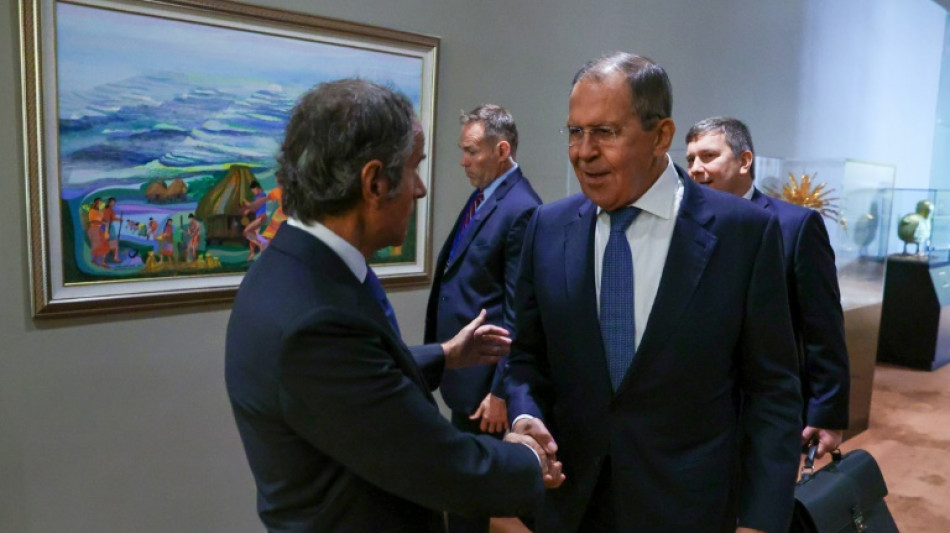
IAEA, Western powers air growing worries on Ukraine nuclear plant / Photo: Handout - RUSSIAN FOREIGN MINISTRY/AFP

 Energy bill plan could use HMRC income data to target support

 Business owner earning £6,000 a month tackles £70,000 debt
 Nvidia chief faces inquiry after disclosing affair with suspected Chinese agent

 Comet returns as online electrical marketplace 14 years after collapse
 KUFOS Signs MoU With Old Dominion University to Expand Academic Ties

 Karen Wazen Launches First Standalone Boutiques in Cairo

 Opti Digital Launches NEXA, an AI-Powered Intelligence Layer

The UN nuclear watchdog and Western powers voiced alarm Wednesday over the safety of Ukraine's Zaporizhzhia atomic power plant as Kyiv accused Russia of new shelling.
The strike by Russian "terrorists" damaged a power line at the facility, forcing a brief launch of emergency generators, Ukrainian nuclear operator Energoatom said on Telegram.
But it said radiation levels remained normal.
Rafael Grossi, director of the UN's International Atomic Energy Agency (IAEA), renewed his warning of "playing with fire" at the plant.
"The situation is still getting worse and we can't wait for something regrettable to happen," Grossi said at United Nations headquarters in New York.
"I've proposed technical parameters to give the necessary protection to this installation," he told reporters after a meeting led by French President Emmanuel Macron.
Grossi said he had met in New York with Russian Foreign Minister Sergei Lavrov on Wednesday and was speaking later with Ukraine's top diplomat Dmytro Kuleba.
But he acknowledged the lack of progress in his recommendation of a security zone around the plant.
"Demilitarizing is an objective but for now it's about protecting the plant," Grossi said.
Ukrainian President Volodymyr Zelensky, in a video address Wednesday to the UN General Assembly, warned that Russian President Vladimir Putin has turned the Zaporizhzhia plant "into a target," something he said should raise profound alarm worldwide.
"Russian radiation blackmailing is something that should concern each and every one of you, because none of you will find a vaccine against radiation sickness," he said.
In a joint statement, top diplomats from powers including the United States, France, Britain and Germany said they had "grave concern" over Ukraine's nuclear facilities.
They laid out seven "indispensable pillars" for nuclear safety including that safety and security systems "remain fully functional at all times."
Energoatom called for "more resolute actions" against Russia, saying that even "the presence of IAEA inspectors does not stop" them.
Europe's largest atomic facility was seized by Russian troops in March, and shelling around it has spurred calls from Kyiv and its Western allies to demilitarize areas around nuclear plants in Ukraine.
Early in the war, there was fighting around Chernobyl in the north, where an explosion in 1986 left swaths of the surrounding territory contaminated.
Putin has warned of "catastrophic" consequences of fighting there, leading Ukraine to charge that Moscow is using the security of Zaporizhzhia as blackmail.
Russia was accused on Monday of bombing a third nuclear plant, Pivdennoukrainsk, in the southern Mykolaiv region.
T.Resende--PC
