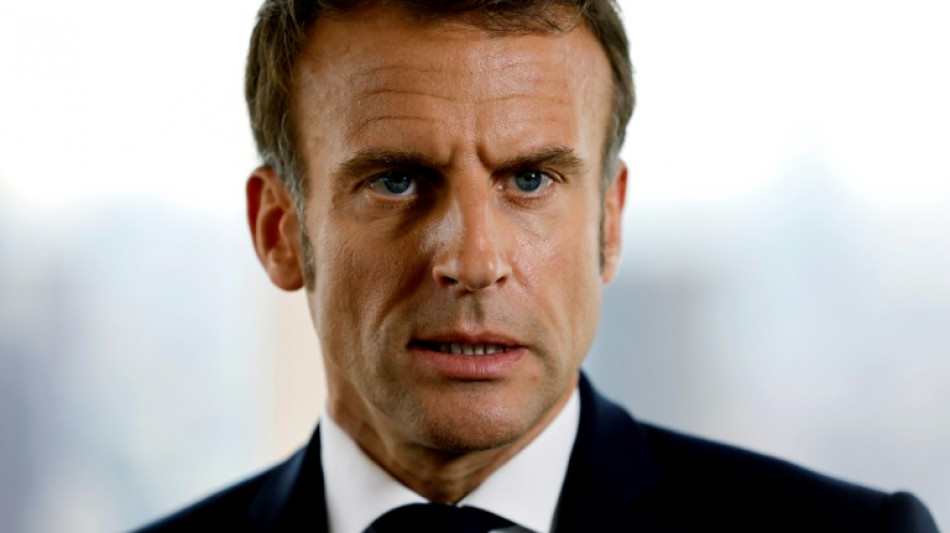
Macron restarts reform drive as opponents prepare for battle / Photo: Ludovic MARIN - AFP

 Thames Water seeks to delay £12bn in debt repayments

 Newark boxing gym expands alternative education programme

 Democrats consider impeachment drive against Defence Secretary Hegseth

 Energy bill plan could use HMRC income data to target support

 Business owner earning £6,000 a month tackles £70,000 debt

 Nvidia chief faces inquiry after disclosing affair with suspected Chinese agent

 Comet returns as online electrical marketplace 14 years after collapse

 KUFOS Signs MoU With Old Dominion University to Expand Academic Ties

 Karen Wazen Launches First Standalone Boutiques in Cairo

 Opti Digital Launches NEXA, an AI-Powered Intelligence Layer

French President Emmanuel Macron will get a taste of public resistance to his second-term reform agenda this week during the first nationwide strike called since his re-election in April.
The 44-year-old head of state has pledged to push ahead with raising the retirement age having backed away from the explosive issue during his first five years in power.
But having lost his parliamentary majority in June, the pro-business centrist faces severe difficulties passing legislation, while galloping inflation is souring the national mood.
Despite warnings from allies about the risk of failure, Macron has tasked his government with hiking the retirement age to 64 or 65 from 62 currently, with changes to start taking effect next year.
"I'm not pre-empting what the government and the parliament will do, but I'm convinced it's a necessity," Macron told the BFM news channel last Thursday.
With deficits spiralling and public debt at historic highs, the former investment banker argues that raising the retirement age and getting more people into jobs are the only ways the state can raise revenue without increasing taxes.
On Thursday, France's far-left CGT union, backed by left-wing political parties, has organised a national day of strikes, the opening shot in what is expected to be a months-long tussle.
Though the protests were originally planned to demand wage increases, they are now intended to signal broad opposition to the government's plans.
"We're against the raising of the retirement age," Philippe Martinez, the head of the CGT, told the LCI broadcaster last week. "The government's arguments don't stack up."
- Unpopular -
Public opinion towards pension reform and the strikes is likely to be decisive in determining whether Macron succeeds with a reform he called off in 2020 in the face of protests and Covid-19.
An opinion poll last week from the Odoxa group found that 55 percent of respondents did not want the reform and 67 percent said they were ready to support protests against it.
But a separate survey from the Elabe group gave a more nuanced picture.
It also found that only a minority, 21 percent, wanted the retirement age increased, but a total of 56 percent thought the current system no longer worked and 60 percent thought it was financially unsustainable.
"I don't know anyone who wants to work for longer, but I don't know anyone who thinks they are not going to work for longer," a minister close to Macron told AFP last week on condition of anonymity.
"Maybe I'm mistaken but I'm not sure that the turnout will be as large as the unions and LFI are hoping for," he said, referring to the hard-left France Unbowed (LFI) political party that has backed the strikes.
The second decisive factor will be how the government introduces the reform in parliament where Macron's allies are around 40 seats short of a majority.
Some favour slipping it into a social security budget bill that will be voted on in October -- a stealthy move that will be denounced as under-handed by critics.
Others think more time should be taken for consultations with trade unions and opposition parties, even though they have all ruled out working with the government.
Macron prefers the quicker option, one senior MP told AFP on condition of anonymity.
In both scenarios, observers expect the government to resort to a controversial constitutional mechanism called "article 49.3" that allows the executive to ram legislation through the national assembly without a vote.
If opposition parties unite against the measure or call a no-confidence motion in the government, they could trigger new elections.
The reform was "ballsy but dangerous," one ally told French media last week.
- Macron II -
Success with the pension reform and separate changes to the unemployment benefits system will help the president re-launch his image as a reformer, experts say.
Since winning a historic second term in April, he has been caught up in the Ukraine war crisis amid reports the parliamentary election setback in June left him disoriented and even depressed.
"We've slightly lost the narrative of Macronism," political scientist Bruno Cautres, a researcher at Sciences Po university in Paris, told AFP recently.
The challenge was giving the second term a "direction" and showing "how it builds on the results of the first", he said.
"The essence of Macronism, which does not have a long history, is the leader and the programme," added Benjamin Morel from Paris II university.
Since being elected as France's youngest-ever president in 2017, Macron has made overhauling social security and workplace regulation part of his political DNA.
"Emmanuel Macron can't easily back away from a reform because burying a reform, it's like disavowing himself," Morel said.
adp-bpa-jri-are/sjw/gw/it
E.Borba--PC