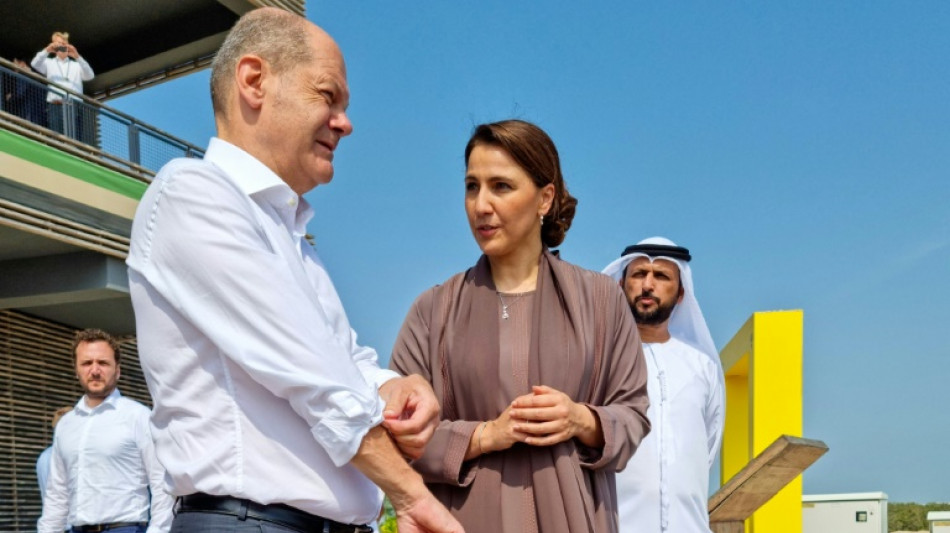
United Arab Emirates agrees to supply Germany with gas, diesel / Photo: Mohamad Ali Harissi - AFP

 Thames Water seeks to delay £12bn in debt repayments

 Newark boxing gym expands alternative education programme
 Democrats consider impeachment drive against Defence Secretary Hegseth
 Energy bill plan could use HMRC income data to target support

 Business owner earning £6,000 a month tackles £70,000 debt

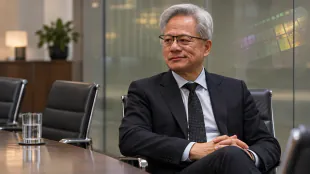 Nvidia chief faces inquiry after disclosing affair with suspected Chinese agent

 Comet returns as online electrical marketplace 14 years after collapse
 KUFOS Signs MoU With Old Dominion University to Expand Academic Ties

 Karen Wazen Launches First Standalone Boutiques in Cairo

 Opti Digital Launches NEXA, an AI-Powered Intelligence Layer

The United Arab Emirates agreed Sunday an "energy security" deal with Germany to supply liquefied natural gas and diesel as Berlin searches for new power sources to replace Russian supplies.
Emirati industry minister Sultan Ahmed Al Jaber called it a "landmark new agreement" that "reinforces the rapidly growing energy partnership between the UAE and Germany", at a signing attended by German Chancellor Olaf Scholz, the UAE's state news agency WAM reported.
Scholz was on a visit to the UAE as part of a Gulf tour that also includes stops in Saudi Arabia and Qatar.
He met with Emirati President Sheikh Mohamed bin Zayed Al-Nahyan, who said on Twitter afterwards they had discussed "further opportunities for cooperation in areas including energy security, emissions reduction and climate action".
The German leader said he "welcomed" the "energy security" agreement, WAM said.
As part of the deal, the UAE will provide "an LNG cargo for delivery in late 2022, to be used in the commissioning of Germany’s floating LNG import terminal at Brunsbuettel", a North Sea port, the WAM report added.
UAE state oil company ADNOC completed its first ever direct diesel delivery to Germany earlier this month, and will "supply up to 250,000 tons of diesel per month in 2023", it said.
"ADNOC has reserved a number of further LNG cargos exclusively for German customers in 2023," it said.
Sunday was the second and final day of Scholz's Gulf tour, which he hoped would seal new energy deals to replace Russian supplies and mitigate the energy crisis resulting from Moscow's invasion of Ukraine.
On Saturday, he met in Jeddah with Saudi Crown Prince Mohammed bin Salman, and on Sunday afternoon he arrived in gas-rich Qatar to hold talks with Emir Sheikh Tamim bin Hamad Al-Thani.
- Energy transition -
Scholz's stop in the UAE included a tour of an environmental project at a mangrove park with Emirati climate change minister Mariam Almheiri.
Almheiri said discussions on Sunday would, in addition to energy security, cover "climate action and economic growth".
"The UAE believes all three pillars must go hand and hand. We cannot look at one or two of these pillars separately," she said.
She also reiterated Abu Dhabi's insistence on "a just transition" away from fossil fuels.
Both the UAE and Saudi Arabia have been leading critics of what they describe as "unrealistic" transition models they say have contributed to the current energy crunch.
Scholz told reporters in Abu Dhabi that his country had "made progress on a whole series of projects here in terms of the production and purchase of diesel and gas", while adding it was determined to avoid energy dependence on Russia in the future.
"The fact that we are dependent on one supplier and also dependent on its decisions will certainly not happen to us again," he said.
"With the investments that we are now making in Germany, and that will become reality bit by bit next year, we will indeed have an infrastructure for gas imports for Germany, such that we are no longer directly dependent on the specific supplier at the other end of the pipeline, as we are with a pipeline connection."
His visit to Qatar comes one day after France's TotalEnergies signed a new $1.5 billion deal to help expand Doha's natural gas production.
Scholz said such projects were "important".
"We have to ensure that the production of liquefied gas in the world is advanced to such an extent that the high demand that exists can be met -- without having to fall back on the production capacities in Russia that have been used so far," he said.
A.Santos--PC