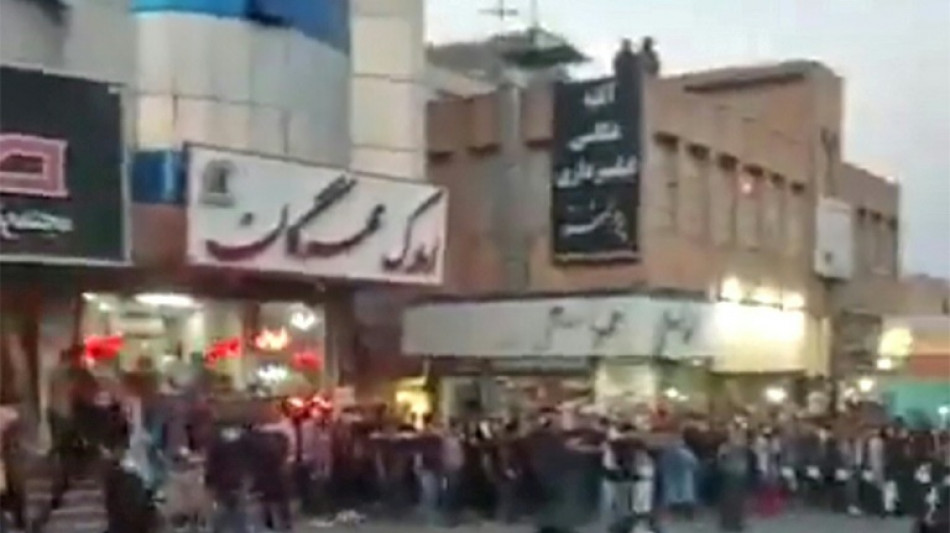
Iran vows 'no leniency' against wave of women-led protests / Photo: - - UGC/AFP/File

 Thames Water seeks to delay £12bn in debt repayments
 Newark boxing gym expands alternative education programme
 Democrats consider impeachment drive against Defence Secretary Hegseth
 Energy bill plan could use HMRC income data to target support

 Business owner earning £6,000 a month tackles £70,000 debt
 Nvidia chief faces inquiry after disclosing affair with suspected Chinese agent

 Comet returns as online electrical marketplace 14 years after collapse

 KUFOS Signs MoU With Old Dominion University to Expand Academic Ties

 Karen Wazen Launches First Standalone Boutiques in Cairo

 Opti Digital Launches NEXA, an AI-Powered Intelligence Layer

Iran's judiciary chief vowed no leniency Sunday against the wave of unrest that has rocked the country since the death of young Kurdish woman Mahsa Amini in the custody of the morality police.
The warning by the head of the Judiciary, Gholamhossein Mohseni Ejei, came after nine nights of protests and street clashes and echoed earlier comments by ultra-conservative President Ebrahim Raisi.
At least 41 people have died so far, mostly protesters but including members of the Islamic republic's security forces, according to an official toll, although human rights groups say the real figure is higher.
The judiciary chief "emphasised the need for decisive action without leniency" against the core instigators of the "riots", the judiciary's Mizan Online website said.
Hundreds of demonstrators, reformist activists and journalists have been arrested amid the mostly night-time demonstrations that have spread to scores of cities since unrest first broke out after Amini's death on September 16.
Security forces have fired live rounds and bird shot, rights groups charge, while protesters have hurled rocks, torched police cars, set ablaze state buildings, and shouted "death to the dictator".
Iran's largest protests in almost three years have been led by women and triggered not by classic political or economic grievances but by anger over the Islamic republic's strictly enforced gender-based dress code.
Amini, whose Kurdish first name was Jhina, was arrested on September 13 for allegedly breaching the rules that mandate tightly-fitted hijab head coverings and which ban, among other things, ripped jeans and brightly coloured clothes.
Some Iranian women protesters have since taken off and burnt their hijabs in the rallies and cut off their hair, some dancing near large bonfires to the applause of crowds that have chanted "zan, zendegi, azadi" or "woman, life, freedom".
- 'Outrage and hope' -
Iranian Academy Award-winning filmmaker Asghar Farhadi was the latest to add his voice of support for Iran's "progressive and courageous women leading protests for their human rights alongside men".
"I saw outrage and hope in their faces and in the way they marched in the streets," he said in a video message on Instagram. "I deeply respect their struggle for freedom and the right to choose their own destiny despite all the brutality they are subjected to."
The world has learnt of much of the turmoil and violence through shaky mobile phone footage posted and spread on social media, even as authorities have throttled internet access.
WhatsApp, Instagram and Skype have been blocked and internet access restricted according to web monitor NetBlocks, following older bans on Facebook, Twitter, TikTok and Telegram.
London-based rights group Amnesty International has warned of "the risk of further bloodshed amid a deliberately imposed internet blackout".
Protests abroad have been held in solidarity with Iranian women in Athens, Berlin, Brussels, Istanbul, Madrid, New York, Paris, Santiago, Stockholm, The Hague, Toronto and Washington, among other cities.
- 'Foreign plots' -
Iran -- which is ruled by supreme leader Ayatollah Ali Khamenei, 83, and which has been hit with tough economic sanctions over its nuclear programme -- has blamed "foreign plots" for the unrest.
The foreign ministry said Sunday it had summoned Britain's ambassador over what it described as an "invitation to riots" by Farsi-speaking media based in London, and Norway's envoy over "unconstructive comments" made by the parliament speaker.
Iran has also organised large rallies in defence of the hijab and conservative values, and another pro-government rally was set to be held Sunday in Enghelab (Revolution) Square in central Tehran.
The main reformist group inside Iran, the Union of Islamic Iran People's Party, has called for the repeal of the mandatory dress code and the winding down of the morality police.
The party -- led by former aides to ex-president Mohammad Khatami, who oversaw a 1997-2005 thaw with the West -- also called on the government to "authorise peaceful demonstrations" and release those arrested.
Human rights groups based abroad have sought to shine light on the turmoil rocking Iran, citing their own sources in the country.
Oslo-based group Iran Human Rights has put the death toll at 54, excluding security personnel.
Iranian authorities have yet to state the cause of death of Amini, who activists say died as a result of a blow to the head.
Interior Minister Ahmad Vahidi has said Amini was not beaten and that "we must wait for the final opinion of the medical examiner, which takes time".
burs/fz/dwo
E.Raimundo--PC