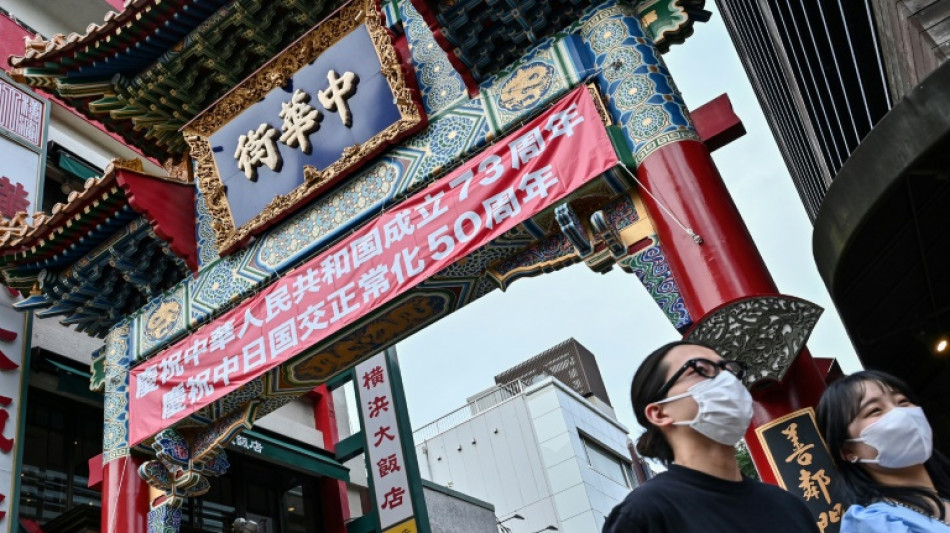
Little cheer as Japan, China mark 50 years of ties / Photo: Richard A. Brooks - AFP

 Meloni marks record in power with eye on 2027 elections

 Israel emptying West Bank refugee camps could be crime against humanity: UN

 Portugal extends talks to privatise airline
 CoinRabbit Wins “Best Crypto Lending Platform 2026” Award from International Business Magazine

 Judge declares mistrial in US infanticide case but puts ruling on hold

 US midterms begin with chaos over mail-voting crackdown

 Russell tops second practice to beat Ferrari and Antonelli in Italy

 'I love the players we have', insists Arsenal boss Arteta

 Jury resumes deliberations in case of US mother who killed her three children

 Farage's Reform UK meets under cloud of new donation scandal

 Man Utd in 'good place' despite imperfect squad, says Carrick

 Le Pen party sparks furore with 'turn off tap' to Ukraine call

 Emery says Madjo's time will come after Villa Euro exclusion

 Workers reeling after VW cuts open door to factory closures

 Liquid Mercury Announces Initial Closing of ACQUA1 Offering

 Stocks slip as robust US jobs data stokes rate hike chances
 France to abandon 'distorted' Mercator map projection: minister

 Celtic, Rangers away fans shut out from Old Firm derbies

 Cadillac enjoying 'very respectable' first season, says team boss

 Five acquitted over deadly 2017 landslide in Swiss Alps

 France unveils 1 bn euro farm aid package after climate-hit summer

 Irish heroine Taylor eyes fairytale finish to trailblazing ring career

 Weather and war push up food prices in August: FAO
 'No longer safe': Nepal flood survivors left landless
 Stocks mixed before US jobs data, oil dips
Japan and China will mark 50 years of diplomatic relations this month with little public celebration, as increasing friction over territorial rivalries and military spending frays ties.
The world's second and third largest economies are key trading partners and just a few years ago seemed poised for a diplomatic blossoming, with plans for a state visit by Chinese President Xi Jinping.
Since then, ties have soured significantly as Beijing bolsters its military, projects power regionally and beyond, and takes a harder line on disputed territory.
In recent months, Chinese missiles are believed to have fallen within Japan's exclusive economic zone, and Tokyo has protested what it calls growing aerial and maritime violations.
Japan also regularly complains about Chinese activity around the disputed Tokyo-controlled Senkaku islands, which Beijing claims and calls the Diaoyus.
"Chinese ships are loitering for dozens of days in the East China Sea, while an artificial island and a base have already been built in the South China Sea," said Kenichiro Sasae, head of the Japan Institute of International Affairs.
"That makes us wonder -- how much further will China's ambition go in terms of naval power?" added Sasae, a former ambassador to Washington and vice-minister of foreign affairs.
The war in Ukraine has only deepened the divide, with Japan backing Western allies opposed to Russia's invasion while Beijing avoids criticising Moscow.
And the conflict has refocused attention on whether China might try to forcibly reunite Taiwan with the mainland, prompting Japan's Prime Minister Fumio Kishida to warn the Ukraine situation "could be East Asia tomorrow".
- 'Anxious about China' -
Beijing and Tokyo normalised relations in a joint communique on September 29, 1972, that officially ended their state of war and saw Japan drop its recognition of Taiwan.
Economic ties grew quickly and steadily, but political relations have been more unstable, weathering a series of crises, including over the disputed Senkaku-Diaoyu islands.
Beijing's growing power has left Japan "anxious about China", said Rumi Aoyama, director of the Waseda Institute of Contemporary Chinese Studies.
"Japan sees China's activities in the Senkaku islands as problematic, and involving a 'core interest'," she told AFP.
"But the problem is, China doesn't understand this Japanese perspective. Instead, it tends to see Japan as just following whatever the US says."
Tokyo is a longstanding and key US ally, but it has been expanding its partnerships as a bulwark against Beijing.
It backed a revived "Quad" alliance with Australia, India and the United States, and Kishida in June became Japan's first leader to attend a NATO summit.
"China is gaining power and confidence, that's a trend that can't be ignored," said Ken Endo, an international politics professor at University of Tokyo and a security expert.
Japan must "consistently state internationally" that changing the status quo by force, whether in Ukraine or Taiwan, is unacceptable.
And he says Tokyo needs a more robust defence capacity, something Kishida and his ruling party have already publicly backed, to show that "it'll cost a lot if you invade us".
- Trading partners -
Japan is reportedly weighing boosting defence spending up to two percent of GDP within five years, from the current one-percent level.
That would represent a sea change in Japan, whose pacifist constitution still limits its military capacity, but a modest increase compared to decades of additional spending by Beijing.
It could also carry its own dangers, stoking regional tensions, if communication with China is not handled carefully, said Sasae.
"Every country has contingency plans, including China, but Japan should make clear that it does not want military confrontation."
Japan's brutal occupation of parts of China before and during World War II remains a sore point, with Beijing accusing Tokyo of failing to atone for its past.
Visits by Japanese officials to the Yasukuni shrine that honours war dead -- including convicted war criminals -- regularly prompt anger from Beijing.
For all the tensions, the two countries remain economically intertwined: China is Japan's largest trading partner and Japan is China's second-largest after the United States.
And reports suggest Tokyo could be seeking Xi-Kishida talks in the coming months, online or in person.
Business ties are "a decisive factor in stopping a free fall of the relation", said Aurelio Insisa, a history professor at the University of Hong Kong and author of a book on Sino-Japanese ties.
But they may not be sufficient to thaw ties.
"Beijing's behaviour in its neighbourhood, and Tokyo's perceptions of it, are the two main factors capable of changing the current dynamic," Insisa said.
"I would not bet on any improvement on these two fronts."
A.Aguiar--PC