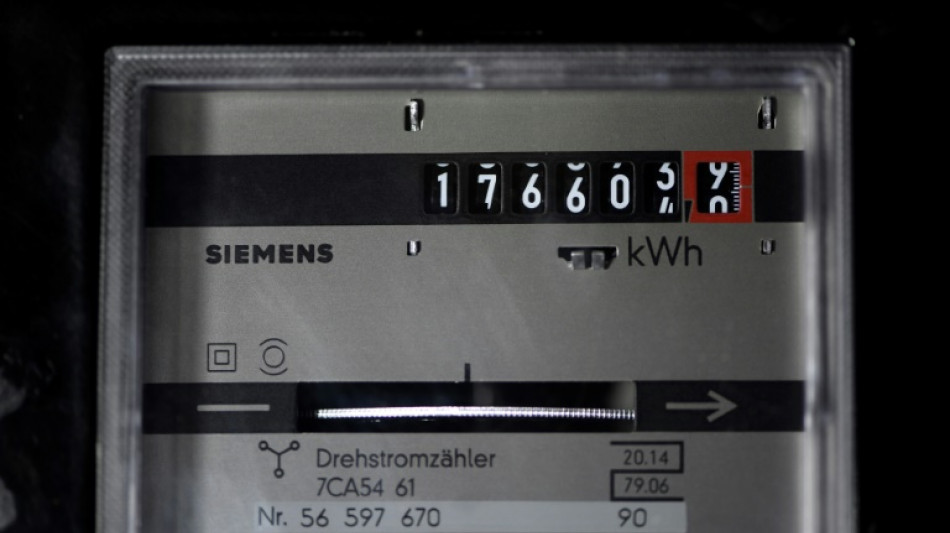
EU to cut power use, levy energy companies / Photo: INA FASSBENDER - AFP/File

 US shows strong job growth in August in boon to Trump
 Alonso urges Chelsea to 'move forward' after Fernandez's exit

 US safety regulator probes Tesla's Cybercab
 Voting begins in crucial US midterm elections
 US shows strong job growth in August in boon to Trump ahead of midterms
 US diesel price hits new high on Iran war, squeezing voters
 Swiss far-right extremists go on trial amid protests
 Record European fires burn over 500,000 hectares over summer
 Former world triathlon champion Jonny Brownlee retires from professional running
 'No room for mistakes' scaling Everest in Venice documentary

 Rubio to visit Trump-friendly allies Colombia, Ecuador, Peru: State Dept

 Indonesia steps up wildfire fight that sparked hazardous haze

 Leclerc on top as Ferrari take 1-2 in Monza opening practice
 Malaysia declares haze emergency in Sarawak state on Borneo
 East German refinery adjusts to life without Russian oil

 Song Yadong looks to become China's first UFC champion after home victory
 India's Mandhana becomes top run-scorer in women's cricket
 IUX Announces Two New Podcast Series: IUX Market Trendline and The Market Journey

 Brussels Diamond League finals Day 2 - four events to watch
 Looming far-right win in Germany sparks security worries
 Tanker captain arrested over cargo ship sinking off Istanbul
 India hopes 'unique idea' will save athletes from cabin fever

 UK asserts 'unshakeable' Falklands commitment after Milei presses claim

 How a Dostoevsky novella took TikTok by storm

 Zverev goes the distance again to reach US Open third round

EU ministers on Friday agreed cuts to peak-hour power consumption and windfall levies on energy companies in an urgent effort to bring down sky-high energy prices.
The decision, announced by the Czech Republic in its role holding the EU presidency, aims to mitigate energy costs sent soaring by Russia's war in Ukraine and as the northern hemisphere winter looms.
European households and businesses are already staggering under surging energy bills, fuelling record inflation that in the eurozone has hit 10 percent.
Extra drama has been injected with several unexplained leaks this week of Russia-Germany undersea gas pipelines, Nord Stream 1 and 2, that were widely seen as "sabotage".
The EU ministers' agreement came a day after Germany -- the bloc's export powerhouse that had long been dependent on Russian gas -- announced a 200-billion-euro (about $200 billion) energy aid package to shield its consumers.
Other EU countries have deployed smaller-scale national measures with the same aim, but several demanded European-level concertation, in part to clamp down on energy-buying competition between EU peers.
- Push for gas price cap -
The two measures adopted were proposed by the European Commission.
The EU executive believes it can raise 140 billion euros from the levies on non-gas electricity producers and on energy majors that are raking in outsized profits from the global energy demand.
Its plan to cut power usage foresees a reduction of "at least five percent" during peak hours, according to a commission document seen by AFP.
Missing from the announced measures, however, was an idea espoused by 15 EU countries -- among them France, Spain, Italy, Greece, Malta and Poland -- for a price cap on imported gas.
The energy crisis, which had been brewing even before the war in Ukraine, took on greater magnitude when Russia severely curtailed natural gas supplies to Europe in retaliation for Western sanctions over its invasion.
Energy prices in the EU are calculated on the basis of the most expensive source, in this case gas, which has gone up around fivefold over the past year.
Several EU ministers went into the meeting wanting a gas price cap to be discussed.
"There is big disappointment that in the proposal that is on the table there is nothing about gas prices," Polish Climate Minister Anna Moskwa said.
"This maximum price for gas would be supported by the majority of European countries" and "cannot be ignored," she said.
But Germany resisted, fearing that a price cap would simply see liquified natural gas (LNG) shipments avoid Europe and sent to more lucrative markets, worsening the supply crunch for the EU.
The European Commission shares those concerns, although EU energy commissioner Kadri Simson said there needed to be a way to target just Russian gas -- which arrives in the EU by pipeline, not in LNG form.
"We have to remove the incentives that are there for Russia to manipulate these volumes, and the answer is clear: We have to offer a price cap for all Russian gas."
She and other participants, including Irish Climate Minister Eamon Ryan, said that, for a gas price cap to be effective other major buyers such as Japan and South Korea needed to cooperate with the EU.
- German opposition -
German Economy Minister Robert Habeck said that, while Berlin was open to the idea of a price cap on Russian gas "as a sanction", the broader application being called for was "treacherous".
He insisted that "we need to bring down consumption" as a priority, and "we must not allow too little gas to reach Europe".
While the measures agreed Friday were steps in the right direction, the Bruegel think tank in Brussels had warned in an analysis they were "not sufficient".
"A more comprehensive plan needs to ensure that all countries bring forward every available supply-side flexibility, make real efforts to reduce gas and electricity demand, keep their energy markets open and pool demand to get a better deal from external gas suppliers," it said.
Further EU measures were likely to be discussed at an informal summit in Prague next week, and another EU energy ministers' meeting on October 11 and 12.
"We need to continue our work. We are in an energy war with Russia," said Czech Energy Minister Jozef Sikela.
A.Motta--PC