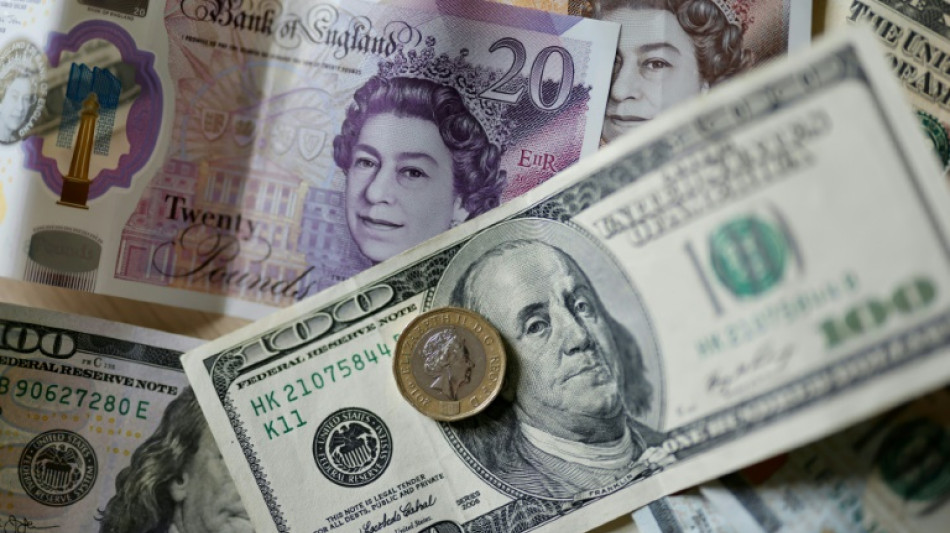
Strong US dollar an unstoppable force endangering other currencies / Photo: Tolga Akmen - AFP/File

 US shows strong job growth in August in boon to Trump

 Alonso urges Chelsea to 'move forward' after Fernandez's exit

 US safety regulator probes Tesla's Cybercab

 Voting begins in crucial US midterm elections

 US shows strong job growth in August in boon to Trump ahead of midterms

 US diesel price hits new high on Iran war, squeezing voters

 Swiss far-right extremists go on trial amid protests

 Record European fires burn over 500,000 hectares over summer

 Former world triathlon champion Jonny Brownlee retires from professional running

 'No room for mistakes' scaling Everest in Venice documentary

 Rubio to visit Trump-friendly allies Colombia, Ecuador, Peru: State Dept

 Indonesia steps up wildfire fight that sparked hazardous haze

 Leclerc on top as Ferrari take 1-2 in Monza opening practice

 Malaysia declares haze emergency in Sarawak state on Borneo

 East German refinery adjusts to life without Russian oil

 Song Yadong looks to become China's first UFC champion after home victory

 India's Mandhana becomes top run-scorer in women's cricket

 IUX Announces Two New Podcast Series: IUX Market Trendline and The Market Journey

 Brussels Diamond League finals Day 2 - four events to watch

 Looming far-right win in Germany sparks security worries
 Tanker captain arrested over cargo ship sinking off Istanbul

 India hopes 'unique idea' will save athletes from cabin fever

 UK asserts 'unshakeable' Falklands commitment after Milei presses claim

 How a Dostoevsky novella took TikTok by storm

 Zverev goes the distance again to reach US Open third round

The dazzling rise of the US dollar, which has hit one record after another, is raising fears of a currency crash of a severity not seen since the 1997 Asian financial crisis reverberated around the world.
The Federal Reserve's rapid, steep interest rate increases and the relative health of the US economy has caused investors to flood into the dollar, driving the greenback up and sending the British pound, Indian rupee, Egyptian pound and South Korean won and others to uncharted depths.
"The moves are definitely getting extreme," said Brad Bechtel of Jefferies, warning that the exchange rates could fall further creating a "dire situation."
Most other major central banks also are forcefully tightening monetary policy to bring down inflation, but so far the moves have not helped stabilized the currency market, nor has Japan's direct intervention to support the yen last week.
Many fear that the same will be the case with the Bank of England's plan announced Wednesday to conduct emergency purchases of government bonds to support the pound.
"We have our doubts that the BoE's plan will be the silver bullet to kill all of the angst that has been pressuring the pound ... considering its plan doesn't have permanency," said Patrick O'Hare of Briefing.com.
Others, especially emerging market countries, are even worse off. The Pakistani rupee has lost 29 percent of its value against the US dollar in the past year, and the Egyptian pound has weakened by 20 percent.
Those countries, and others like Sri Lanka and Bangladesh which "benefitted from cheap and plentiful liquidity," when interest rates were low during the pandemic, "are all suffering from tighter global liquidity," said Win Thin, head of currency strategy at BBH Investor Services.
"Those countries with the weakest fundamentals are likely to be tested first but others may join them," he warned.
Those countries rely on imported oil and grain which have seen prices soar, widening their trade deficits and fueling inflation, massive blows to their currencies.
The appreciation of the US currency has exacerbated the problem, since many commodities are denominated in dollars.
Already in a fragile position, Pakistan was hit with historic flooding in August, which prompted the government to discuss a restructuring of its debt.
"There are severe pressures on the financial system now. And it's only a matter of time until there's a larger crisis somewhere in the world," warns Adam Button of ForexLive.
- Bad memories -
US Treasury Secretary Janet Yellen earlier this week said she has not yet seen signs of "disorderly" financial market developments amid the interest rate hikes.
For countries like Taiwan, Thailand or South Korea, which also dependent on energy imports, China's zero-Covid policy has caused their exports to this key trading partner to plummet.
Larger economies like China and Japan have contributed in recent weeks to the turbulence on the foreign exchange market. The Japanese yen plunged its lowest level in 24 years, while the Chinese yuan hit its weakest in 14 years.
Fear of destabilization brings back memories of the 1997 Asian financial crisis, which was triggered by the devaluation of the Thai baht.
Malaysia, the Philippines and Indonesia followed, which panicked foreign investors and led to massive outflows of capital, pushing several countries into a severe recession and South Korea to the brink of default.
At the time, the collapse of the baht was in part linked to its fixed parity with the dollar, which forced the Thai government to support its currency, depleting its foreign exchange reserves, which was unsustainable in the face of market forces.
Argentina eventually was forced to abandon its peg to the dollar and defaulted in late 2001 -- the largest sovereign default in history.
Erik Nielsen of Wells Fargo said that is a key difference between 2022 and 1997.
"Now there's not a lot of fixed exchange rates," he said. "I'm frankly more worried about developed markets right now."
Lebanon, one of the few to still peg its currency to the greenback, on Thursday announced a drastic devaluation, taking the country's pound to 15,000 to the dollar from the previous fixed value of 1,507.
In the United States, by contrast, where inflation has soared to a 40-year high "the Fed sees strong dollar as a blessing," said Christopher Vecchio of DailyFX, noting that it helps "insulate the economy from more significant price pressures."'
A strong currency means the country pays less for its imported products.
X.M.Francisco--PC