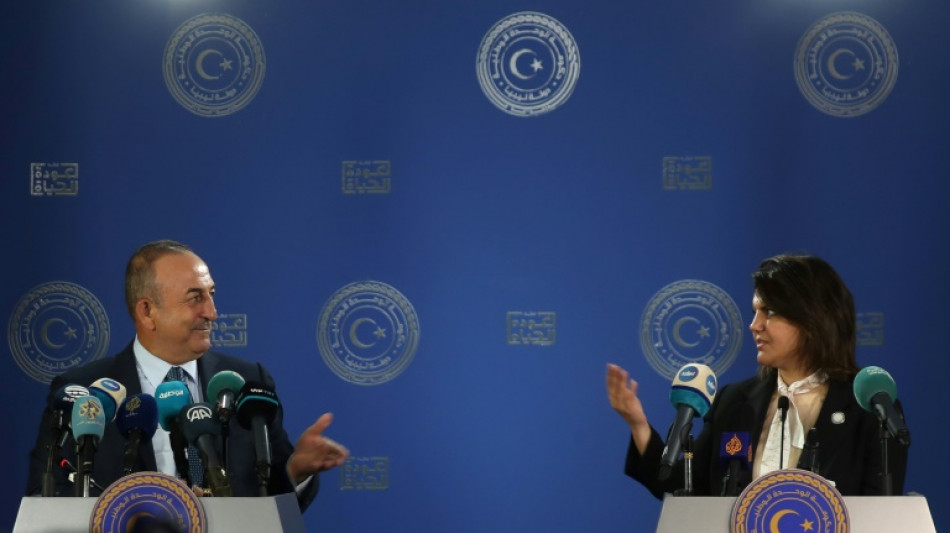
Turkey and Libya sign maritime hydrocarbons deal / Photo: Mahmud Turkia - AFP

 Physicians Urge Arizona to Ban Medical Gag Clauses and Enable Private Lawsuits

 New Campaign Highlights Knowledge Gaps on Carbon Monoxide Safety Among Americans

 GoodData.AI Launches the Agentic Serving Plane, a New Category of Enterprise Data Infrastructure for AI Agents

 US Government Questions Effectiveness of Waymo’s School Bus Software Fix

 Panthers expected to begin 2027 NRL season away from new stadium

 Sweet As app launches restaurant discovery platform

 MLA seeks inquiry into reported sectarian gestures on Ormeau Road

 Louise O’Reilly attacks Simon Harris over unemployment remarks

 Virginia overwhelms Arkansas 91-72 behind balanced scoring

 Second major storm brings destructive winds and outages to British Columbia
 Godzilla Minus Zero leads North American box office with $31.6m

Turkey's foreign minister signed a deal in Libya's capital Monday allowing for oil and gas exploration in Libya's Mediterranean waters, three years after a maritime border deal that angered European nations.
"We've signed a memorandum of understanding on exploration for hydrocarbons in Libya's territorial waters and on Libyan soil, by mixed Turkish-Libyan companies," Mevlut Cavusoglu said at a press conference in Tripoli.
The deal follows an agreement Turkey signed with authorities in Tripoli in 2019, which demarcated the countries' shared maritime borders but sparked anger in Greece and Cyprus.
Cavusoglu however stressed on Monday that the new accord was between "two sovereign countries -- it's win-win for both, and other countries have no right to interfere".
Najla al-Mangoush, foreign minister in Libya's Government of National Unity, said the new deal was "important", especially in light of "the Ukrainian crisis and its repercussions" for energy markets.
The deal was rejected by a rival administration in the war-torn country's east.
Turkey had signed a controversial security agreement in November 2019 with Libya's UN-recognised government at the time, laying claim to extensive, potentially gas-rich areas of the Mediterranean.
The deal came at the height of a year-long battle between rival governments vying for control of Libya's capital.
The arrival of Turkish drones shortly afterwards was seen as crucial in the victory of Tripoli-based forces against those of eastern military chief Khalifa Haftar, backed at the time by Egypt, Russia and the United Arab Emirates.
- 'Unacceptable' -
Turkey continues to play a major role in Libya's west, where rival governments are again struggling for control two years after the end of the last major conflict.
Since March, a government appointed by Libya's eastern-based parliament has been attempting to take office in Tripoli, but has so far failed.
Both the speaker of parliament and the head of the rival administration rejected Monday's accord.
Speaker Aguila Saleh, who has long argued that the Tripoli-based government's mandate has expired, called the deal "illegal and unacceptable", while the rival government of former interior minister Fathi Bashagha threatened to use the courts to annul it.
Cavusoglu was accompanied in Tripoli by a high-level delegation also including Turkey's energy, defence and trade ministers.
Libya has been mired in violence for more than a decade since the 2011 toppling of dictator Moamer Kadhafi in a NATO-backed uprising.
Dozens of armed groups have been struggling for influence, backed by multiple foreign powers.
T.Vitorino--PC

