As Iraq concrete jungle swelters, ancient stone houses stay cool / Photo: SAFIN HAMED - AFP

 Irish heroine Taylor eyes fairytale finish to trailblazing ring career
 Weather and war push up food prices in August: FAO

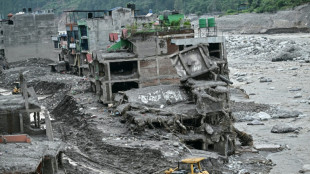 'No longer safe': Nepal flood survivors left landless
 Stocks mixed before US jobs data, oil dips
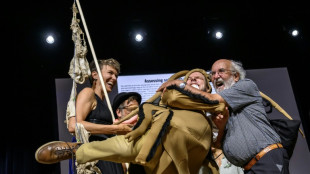 Optimised urinals and buried underwear at 2026 Ig Nobels

 German factory orders rise again in latest recovery sign

 Nepal's 'Himalayan tsunami': what we know

 SPAYZ.io brings Africa’s payment growth story to Forex Expo Dubai 2026

 Zelensky slams his security services for 'unacceptable' shootout

 Farage's Reform UK meets as new donation scandal hits
 Volunteers fight uphill battle against Indonesian fires
 PU Prime Launches Australian Operations under ASIC Licence
 Night-owl Zverev goes distance to advance as upsets rock US Open

 Marathon man Zverev goes distance again to reach US Open third round

 US study tests psilocybin to fight cancer side effects

 Italy's Meloni throws party to celebrate record in power
 After heatwaves, will EU pivot back to the climate fight?

 South Korean football referee faces hearing over 'period' insult

 Toulouse eye Top 14 history after 'difficult' summer

 Springboks and All Blacks seek series lead after war of words

 Bundesliga brings the band back together in Premier League's shadow

 Asian stocks rally as traders pare rate bets ahead of jobs data
 War-bruised Myanmar finds relief in bareknuckle bloodsport

 Gauff downs Badosa to reach US Open third round

 New Zealand approves use of party drug MDMA to treat trauma

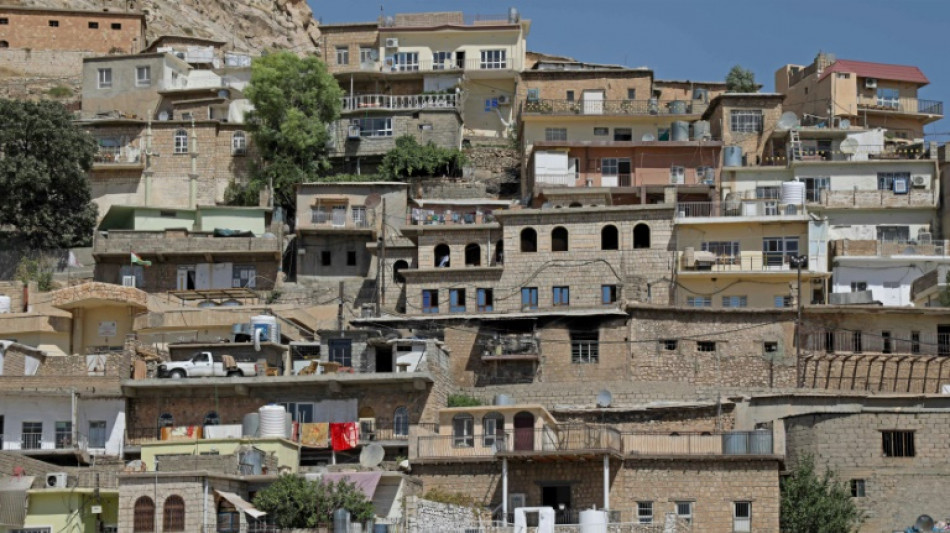
As the sun beats down on Iraq, most people swelter in their concrete homes -- but not the inhabitants of one mountain town known for its ancient and cool stone houses.
Tracing its roots back 2,700 years, the picturesque Kurdish town of Akre says it is better adapted to the modern-day perils of climate change than other parts of Iraq.
"Stone houses are far more resistant" to the rising temperatures and also preserve the town's unique character, said Mayor Baland Reda Zubair.
"Cement radiates heat, raises temperatures and affects the environment," said Zubair of the building material that is allowed only in outlying neighbourhoods.
Many of Akre's narrow alleyways can only be navigated by donkeys and wind through a historic city centre bathed in the pale yellow and brown hues of the locally quarried stone.
Oil-rich Iraq is the world's fifth-most vulnerable country to the effects of climate change, according to the United Nations.
The Kurdistan region where Akre lies suffers from heat and water scarcity like the rest of the country.
But while Iraqi authorities have done little to address the challenges, Akre, a city of 100,000 residents about 500 kilometres (311 miles) north of Baghdad, believes sticking with the old ways will help it adapt.
Since 1991, when Kurdistan gained de facto autonomy from Iraq, it has declared concrete off limits for construction and renovation in the old city of Akre.
- No air-con -
An impressive building welcomes those entering the old city. Dating to 1853, it is a remnant of the Ottoman Empire that once ruled the area.
"It's an old military barracks," said Jamil Siddik, a 63-year-old engineer who oversees renovation works in the city.
The limestone used for renovation is sourced from the mountains that surround Akre, he explained. For its residents, "limestone is easy to use. It's cheap and available," Siddik said.
It also provides great insulation. "Concrete blocks may only be 20 centimetres (7.9 inches) wide, while the stones are 40 or 60 centimetres wide," he said.
Bewar Majeed, 37, lives in the old city. By his doorstep, kittens were playing in the sun, as the temperature reached 40 degrees Celsius (104 degrees Fahrenheit).
But inside the house, the rooms are nice and cool thanks to its limestone walls.
"I don't need an air conditioner," he said. "I have a small air cooler, which is enough for me, and it's less expensive."
The city's policy promoting stone over concrete relies on public financing.
For years after 2011, public funds paid for the renovation of 25 old houses and a mosque. In 2014, however, funding was suspended "because of the financial crisis", said Mayor Zubair.
Now, he added, old city residents may renovate or build with their own money, so long as they avoid concrete, or "eventually cover it with stone".
- Tourist draw -
On top of the environmental benefits, Akre's conservation efforts aim to preserve its heritage value and attract tourism.
According to the regional tourism board, 1.7 million visitors came to Iraqi Kurdistan during the first quarter of 2022, the vast majority of them Iraqis.
The autonomous region has cultivated an image of stability, distancing itself from the violence that has engulfed other parts of Iraq in recent years.
Still, Kurdistan hasn't been entirely spared the sounds of battle.
Neighbouring Turkey regularly carries out military operations there in its fight against the rebel Kurdistan Workers' Party (PKK), which has been designated a "terrorist" group by Turkey and its Western allies.
In July, artillery bombardment several dozen kilometres away from Akre killed nine civilians, most of them Iraqi holidaymakers. Baghdad blamed Ankara, which denies the Iraqi claim.
But Akre's residents shy away from politics.
Ali, an ice cream vendor, said tourists who are drawn to the town bring him "joy".
"We get Iraqis, Germans and French," he added. "They like our historic city centre."
X.Brito--PC