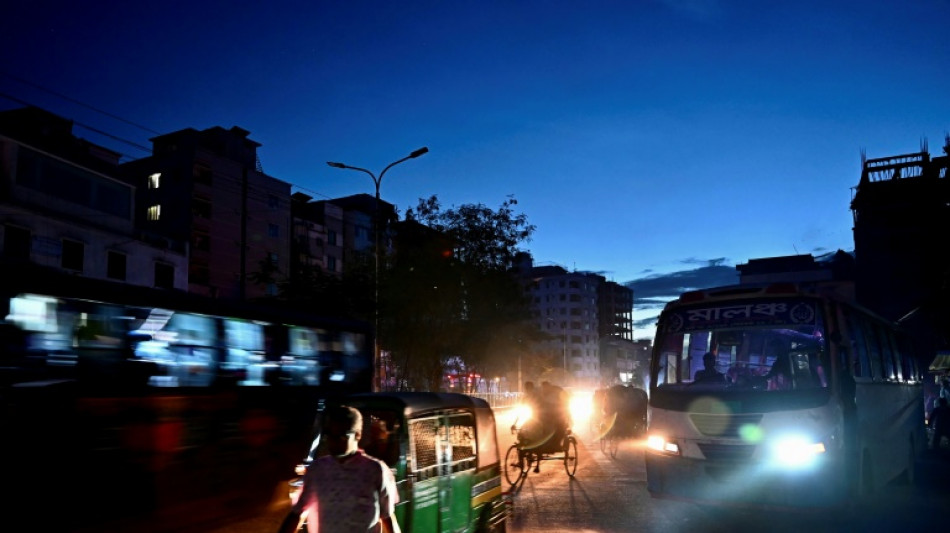
Power blackouts hit 130 million people in Bangladesh / Photo: Munir uz zaman - AFP

 Physicians Urge Arizona to Ban Medical Gag Clauses and Enable Private Lawsuits

 New Campaign Highlights Knowledge Gaps on Carbon Monoxide Safety Among Americans

 GoodData.AI Launches the Agentic Serving Plane, a New Category of Enterprise Data Infrastructure for AI Agents

 US Government Questions Effectiveness of Waymo’s School Bus Software Fix

 Panthers expected to begin 2027 NRL season away from new stadium

 Sweet As app launches restaurant discovery platform

 MLA seeks inquiry into reported sectarian gestures on Ormeau Road
 Louise O’Reilly attacks Simon Harris over unemployment remarks

 Virginia overwhelms Arkansas 91-72 behind balanced scoring

 Second major storm brings destructive winds and outages to British Columbia
 Godzilla Minus Zero leads North American box office with $31.6m

At least 130 million people in Bangladesh were left without power on Tuesday after a grid failure caused widespread blackouts, the government's power utility company said.
Bangladesh has suffered a major power crisis in recent months as a result of higher global energy prices following Russia's invasion of Ukraine, and has imposed regular cuts to conserve electricity.
But it remained unclear what caused Tuesday's unscheduled blackout, which hit more than 80 percent of the country shortly after 2:00 pm (0800 GMT), according to the Power Development Board.
Apart from some locations in Bangladesh's northwest, "the rest of the country is without power", spokesman Shamim Ahsan told AFP.
The normally brightly lit streets of central Dhaka and other cities were dark on Tuesday evening.
Ahsan said 130 million people or more were without electricity and it remained unclear what had caused the fault.
"It is still under investigation," he said, adding that a technical malfunction was the probable cause.
Another official said later that only 60 percent of the poor country, which is home to factories supplying garments for Western brands, had been affected.
Since then half of those affected had had their power restored by the evening, A.B.M Badruddoza, spokesman of the state-run power grid company, told AFP.
Junior technology minister Zunaid Palak said on Facebook that power would be restored by 8:00 pm in the capital Dhaka, a megacity home to more than 22 million people.
- Energy crisis -
Prices of energy as well as food as other staples have soared worldwide in the wake of Russia's invasion of Ukraine in February, including in Asia.
This has wrought havoc on Bangladesh's electricity grid in recent months, with utilities struggling to source enough diesel and gas to meet demand.
A depreciating currency and dwindling foreign exchange reserves left Bangladesh unable to import sufficient fossil fuels, forcing it to close diesel plants and leave some gas-fired power stations idle.
The government imposed lengthy power cuts to conserve existing stocks in July, with outages lasting up to 13 hours a day at their peak.
Tens of thousands of mosques around the Muslim-majority South Asian country have been asked to curtail the use of air conditioners to ease pressure on the electricity grid.
The blackouts sparked widespread public anger and helped mobilise large demonstrations on the streets of Dhaka.
At least three protesters were killed by security forces during the rallies, partly motivated by rising cost-of-living pressures.
Around 100 others were injured during a police crackdown on one demonstration, according to the opposition Bangladesh Nationalist Party.
Consumer inflation has hit household budgets hard and the government recently pledged to cap the price of several staple foods, including rice, to quell public discontent.
Bangladesh last witnessed a major unscheduled blackout in November 2014, when around 70 percent of the country went without power for nearly 10 hours.
Ferreira--PC