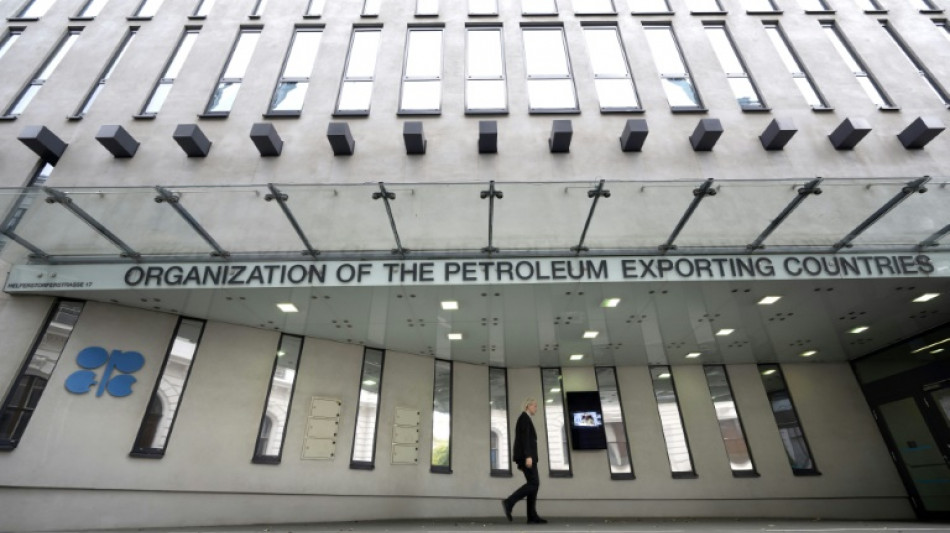
OPEC+ agrees major oil output cut / Photo: JOE KLAMAR - AFP

 Physicians Urge Arizona to Ban Medical Gag Clauses and Enable Private Lawsuits

 New Campaign Highlights Knowledge Gaps on Carbon Monoxide Safety Among Americans

 GoodData.AI Launches the Agentic Serving Plane, a New Category of Enterprise Data Infrastructure for AI Agents

 US Government Questions Effectiveness of Waymo’s School Bus Software Fix

 Panthers expected to begin 2027 NRL season away from new stadium

 Sweet As app launches restaurant discovery platform

 MLA seeks inquiry into reported sectarian gestures on Ormeau Road

 Louise O’Reilly attacks Simon Harris over unemployment remarks

 Virginia overwhelms Arkansas 91-72 behind balanced scoring

 Second major storm brings destructive winds and outages to British Columbia

 Godzilla Minus Zero leads North American box office with $31.6m

OPEC and its Russia-led allies agreed on a major cut in oil production on Wednesday, a move to prop up prices that could bolster sanction-hit Moscow's coffers and irk Washington.
The 13-nation OPEC cartel and its 10 Russian-led allies agreed to reduce two million barrels per day from November at a meeting in Vienna, said Iran's OPEC Governor Amir Hossein Zamaninia.
It is the biggest cut since the height of the Covid pandemic in 2020.
Such a move could turbocharge crude prices, further aggravating inflation which has reached decades-high levels in many countries and is contributing to a global economic slowdown.
It could also give Russia a boost ahead of a European Union ban on most of its crude exports later this year and a bid by the Group of Seven wealthy democracies to cap the country's oil prices.
US President Joe Biden personally appealed to Saudi leaders in July to boost production in order to tame prices which soared following Russia's invasion of Ukraine earlier this year.
But crude price have fallen in recent months on concerns over dwindling demand and fears over a possible global recession.
"With consumers only just breathing a sigh of relief after being forced to pay record prices at the pump, today's cut is not going to go down well," said Craig Erlam, an analyst at trading platform OANDA, ahead of the meeting.
When asked how the United States would react to a cut, the energy minister of the United Arab Emirates, Suhail al-Mazrouei, insisted that OPEC was merely a "technical organisation".
Alexander Novak, the Russian deputy prime minister in charge of energy who is under US sanctions, remained mum as he arrived for the group's first in-person meeting at its Vienna headquarters since March 2020.
- Geopolitical tensions -
Collectively known as OPEC+, the alliance drastically slashed output by almost 10 million barrels per day (bpd) in April 2020 to reverse a massive drop in crude prices caused by Covid lockdowns.
OPEC+ began to raise production last year after the market improved. Output returned to pre-pandemic levels this year, but only on paper as some members have struggled to meet their quotas.
The group agreed last month on a small, symbolic cut of 100,000 bpd from October, the first in more than a year.
Consumer countries had pushed for months for OPEC+ to open taps more widely to bring down prices, but the group ignored them again.
"Knowing that Russia is willing to cut output, the move could also be perceived as another escalation of the geopolitical tensions" between Moscow and the West, said Ipek Ozkardeskaya, a Swissquote bank analyst.
- US elections -
Biden made a controversial trip to Saudi Arabia in July in part to convince the kingdom to loosen the production taps. The trip saw Biden meet Crown Prince Mohammed bin Salman despite his promise to make Riyadh a "pariah" following the 2018 killing of journalist Jamal Khashoggi.
The OPEC+ decision comes ahead of a midterm congressional elections in the United States next month, and a surge in prices for Americans at fuel stations would not help Biden's cause.
White House press secretary Karine Jean-Pierre said on Tuesday that "we will continue to take steps to protect American consumers", declining to comment on the OPEC discussions directly.
While the cut will not be welcomed by the United States, several OPEC+ nations have struggled to meet their quotas in the first place.
After rallying earlier this week on speculation over the OPEC+ cut, the international benchmark, Brent North Sea crude, seesawed on Wednesday at around $92.
burs-jza/lth
V.Dantas--PC

