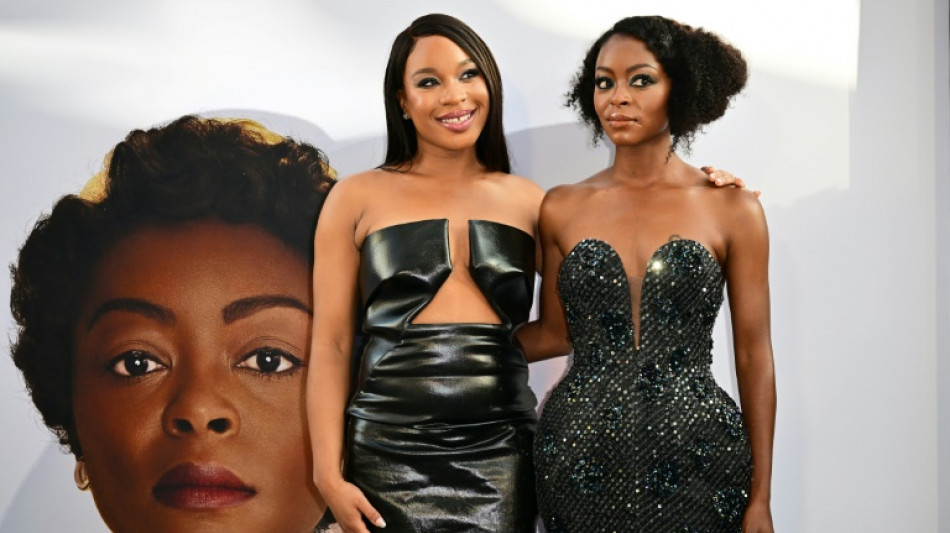
'Till' lynching film 'not interested' in showing traumatic anti-Black violence / Photo: Frederic J. BROWN - AFP

 India hopes 'unique idea' will save athletes from cabin fever

 UK asserts 'unshakeable' Falklands commitment after Milei presses claim
 How a Dostoevsky novella took TikTok by storm

 Zverev goes the distance again to reach US Open third round

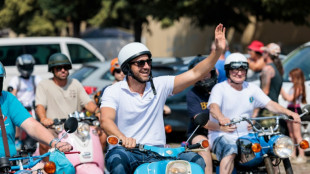 German AfD's love for Simson mopeds dismays Jewish family behind brand
 Two trapped tunnel workers rescued in Nepal 'miracle'

 Ex-Pakistan coach Gillespie tells Javed 'look in the mirror' over sackings
 Monfils falls to Tien in US Open in Grand Slam farewell
 Arsenal brace for Chelsea test as Spurs seek spark
 Efficient Rybakina reaches US Open third round

 Taiwan boxer Lin considered 'graceful exit' after Paris Games gold
 'I miss my home': Cambodians displaced by conflict start over

 Ailing Auger-Aliassime falls at US Open as Swiatek, Osaka and Gauff advance
 Tesla launches self-driving 'Cybercab' in Texas

 'Wallace & Gromit' creators turn 50 with spook-tacular Shaun yarn
 New York's Muslims reclaim their city after 9/11 backlash
 Premier League transfer windfall a lifeline for ailing French clubs
 Chile protesters see shades of Pinochet in new security plan
 Carreras reverts to fullback as Argentina change four for Australia Test
 Wilson back to lead Australia as Kiss rotates team for Argentina
 Yen surges on new intervention talk, US stocks rally
 Japan's Ueda fires Lille top of Ligue 1 on debut

 Arsenal chief executive reveals 'dynasty' ambition
 Spanish PM says no 'solid proof' Morocco planned migrant rush

 Iran war is not a war, US VP Vance says

The director of "Till," an Oscar-tipped movie about the lynching of a young Black teenager in 1950s Mississippi, said she deliberately chose not to show any on-screen violence inflicted against Black people in order to spare both filmmakers and audiences.
The movie, in theaters next Friday, tells the horrifying true story of 14-year-old Emmett Till's death and its aftermath through the eyes of his mother Mamie, who reluctantly became an activist and helped to inspire the United States' sweeping civil rights movement.
Till was visiting relatives in rural Mississippi in the summer of 1955 when he was kidnapped, beaten and shot dead by racist vigilantes after being accused of flirting with a white woman at a grocery store.
While the film depicts the moment Till is taken from his uncle and aunt's home at gunpoint, audiences do not see him being beaten or killed. A short exterior shot of the murder scene and brief audible cries of pain convey the incident.
Asked at a press conference if she wanted to avoid contributing to the "exploitation" of violence against African Americans by Hollywood, director Chinonye Chukwu said she was "not interested in showing physical violence inflicted on Black bodies."
"As a Black person, I didn't want to shoot it and I didn't want to watch it. I didn't want to put the audiences through that as well or retraumatize myself," she explained.
"We just don't need it."
Till's mother was hundreds of miles away in their home city of Chicago when the killing took place, and Chukwu opted to tell the story from her point of view.
"I knew that by doing that, it took away a need to show the physical violence inflicted on Black bodies, because that wasn't a part of the story that I wanted to tell," Chukwu told the press conference.
"Where the camera focuses is its own act of resistance," she said at the movie's world premiere in New York earlier this month.
- 'Big bang' -
Hollywood has previously been accused of exploiting Black trauma for profit, such as the controversy that swirled around Quentin Tarantino's hyper-violent slavery movie "Django Unchained."
In a Hollywood Reporter column in 2019, Kareem Abdul-Jabbar said a spate of graphic movies featuring anti-Black violence including "12 Years a Slave" and "Harriet" could risk "defining African Americans' participation in American history primarily as victims."
While it does not show the killing, "Till" does, however, present young Emmett's mutilated and bloated corpse lying in an open casket.
Chukwu said in this instance, she took her cue from Mamie herself, who insisted her son's body be publicly displayed in order to confront the nation with the true horror of lynching. (Jesse Jackson would later call Till's death the "big bang" of the civil rights movement.)
"It was critical, but I knew that I wanted to do it sparingly, yet effectively," she said.
The director also warned her crew that there would be very few chances to film disturbing scenes, including one in which Mamie -- played by Danielle Deadwyler -- identifies the cadaver.
"I told the crew, 'Listen, we got two takes, right? That's it, right? Try to get as perfect as you can, but whatever we get is what we got, because I'm not putting Danielle through that more than twice,'" Chukwu said.
The movie employed a therapist who was on-set every day for the cast and crew.
- 'Bittersweet' -
The film's release follows the enacting in March of the Emmett Till Anti-Lynching Act, which finally made lynching a federal hate crime more than 65 years after its namesake was killed.
Till's murderers were found not guilty by an all-white jury and lived out the rest of their lives in freedom, despite confessing to killing the boy in a magazine article in 1956.
Keith Beauchamp, who wrote "Till," attended the signing of the anti-lynching act earlier this year. He told AFP it was a "bittersweet" landmark.
"Bittersweet because it has taken close to over a hundred years for it to get passed, and two hundred attempts to finally get a federal hate crime law for lynching in America, something that all of us know is wrong," he said.
"It was bittersweet on one hand, and it was a victory on the other. Bittersweet as well because we're still fighting for justice for Emmett Till."
N.Esteves--PC