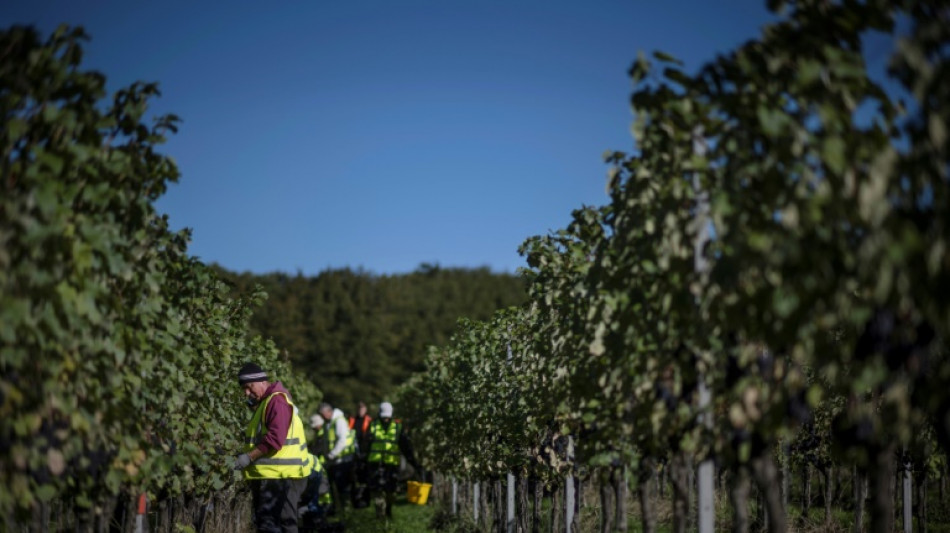
English winemakers toast summer heatwaves / Photo: Ben Stansall - AFP

 India hopes 'unique idea' will save athletes from cabin fever

 UK asserts 'unshakeable' Falklands commitment after Milei presses claim

 How a Dostoevsky novella took TikTok by storm

 Zverev goes the distance again to reach US Open third round

 German AfD's love for Simson mopeds dismays Jewish family behind brand

 Two trapped tunnel workers rescued in Nepal 'miracle'

 Ex-Pakistan coach Gillespie tells Javed 'look in the mirror' over sackings

 Monfils falls to Tien in US Open in Grand Slam farewell

 Arsenal brace for Chelsea test as Spurs seek spark

 Efficient Rybakina reaches US Open third round

 Taiwan boxer Lin considered 'graceful exit' after Paris Games gold

 'I miss my home': Cambodians displaced by conflict start over

 Ailing Auger-Aliassime falls at US Open as Swiatek, Osaka and Gauff advance

 Tesla launches self-driving 'Cybercab' in Texas
 'Wallace & Gromit' creators turn 50 with spook-tacular Shaun yarn

 New York's Muslims reclaim their city after 9/11 backlash

 Premier League transfer windfall a lifeline for ailing French clubs

 Chile protesters see shades of Pinochet in new security plan

 Carreras reverts to fullback as Argentina change four for Australia Test

 Wilson back to lead Australia as Kiss rotates team for Argentina

 Yen surges on new intervention talk, US stocks rally

 Japan's Ueda fires Lille top of Ligue 1 on debut

 Arsenal chief executive reveals 'dynasty' ambition

 Spanish PM says no 'solid proof' Morocco planned migrant rush

 Iran war is not a war, US VP Vance says

Under a blue sky, seasonal workers ran their secateurs along long rows of grapevines, harvesting a variety of pinot noir grown during the summer heatwave.
This was not a village in France, however, but Appledore in Kent in southern England, where high temperatures needed to grow the grape variety are no longer rare.
"At the moment, I think we have similar growing conditions to Champagne in the (19)70s and 80s," said Charlie Holland, head winemaker and chief executive at Gusbourne Estate.
"We're seeing the same sort of growth conditions, the same ripening period" in England as back then in France, he added.
That is good news for Britain's embryonic viticulture which is now able to produce a wide variety of still and sparkling wines from grape varieties including pinot noir, chardonnay and riesling that are traditionally more accustomed to France and Germany.
"It's not so often that you see a new wine region appearing on the map," said Holland.
"In England, now we can make an exceptional sparkling wine, we have a perfect climate, we have a very long growing season."
- 'Quite frightening' -
At Gusbourne Estate, tractors were transporting baskets full of grapes to the winery. The fruit was immediately destemmed and pressed to begin the fermentation process.
During the harvest period, the estate is a beehive of 200 workers, more than half of them seasonal.
Holland was everywhere, darting between presses, vats and oak barrels as he inspected and tasted the produce.
Climate change may be helping England's vineyards for now but the fast pace of transition risks major planning difficulties, warned Alistair Nesbitt, co-author of an outlook study on the country's winemaking industry.
"That's a really quite frighteningly short period of time to have such a transition of varietals suitability, and that really shows the pace of change that certain areas of the UK are starting to see as a result of climate change," he noted.
"Hopefully the world will get (its) act together and we won't see that continuing increase for too much longer, because that's threatening to everyone, including producers in the UK," added Nesbitt, who is chief executive of consultancy Vinescapes.
Nesbitt forecasts that beyond 2040, England's vineyards could be working with grape varieties found further south in France, such as merlot and cabernet sauvignon.
This assumes that climate change continues on its expected path amid global reductions in carbon emissions.
- 'Niche producer' -
Britain's wine growers are planting grapes in droves to meet booming demand at home and abroad.
The surface area of vineyards in the country has doubled in eight years, according to industry organisation WineGB.
UK vineyards are however dwarfed on the international stage, covering a total of 3,800 hectares -- or about one tenth of France's champagne-producing region.
Britain "will likely remain a niche wine producer", said Daniel Mettyear, research director at consultancy IWSR Drinks Market Analysis.
Despite the relatively high price -- £45 ($50) for one of Gusbourne's sparkling wines -- demand is growing both in Britain and abroad for the drink.
"Quality has improved significantly in recent years," added Mettyear, noting strong interest from North American and Nordic countries, as well as from Australia.
Gusbourne exports about one third of its wine to 28 nations worldwide, mostly to Norway but also to France.
F.Ferraz--PC