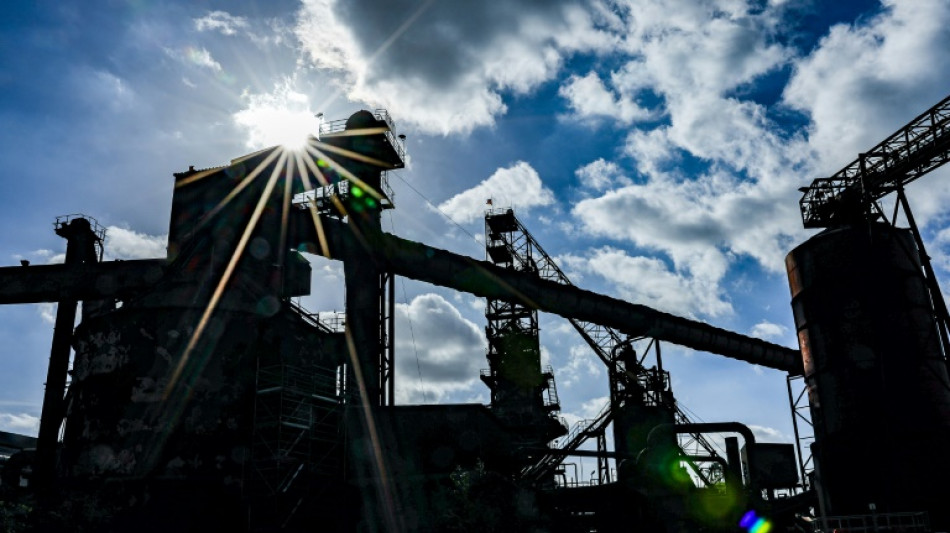
Idled plants fuel German angst about de-industrialisation / Photo: Axel Heimken - AFP

 India hopes 'unique idea' will save athletes from cabin fever

 UK asserts 'unshakeable' Falklands commitment after Milei presses claim

 How a Dostoevsky novella took TikTok by storm

 Zverev goes the distance again to reach US Open third round

 German AfD's love for Simson mopeds dismays Jewish family behind brand
 Two trapped tunnel workers rescued in Nepal 'miracle'
 Ex-Pakistan coach Gillespie tells Javed 'look in the mirror' over sackings

 Monfils falls to Tien in US Open in Grand Slam farewell

 Arsenal brace for Chelsea test as Spurs seek spark

 Efficient Rybakina reaches US Open third round
 Taiwan boxer Lin considered 'graceful exit' after Paris Games gold
 'I miss my home': Cambodians displaced by conflict start over

 Ailing Auger-Aliassime falls at US Open as Swiatek, Osaka and Gauff advance

 Tesla launches self-driving 'Cybercab' in Texas
 'Wallace & Gromit' creators turn 50 with spook-tacular Shaun yarn

 New York's Muslims reclaim their city after 9/11 backlash

 Premier League transfer windfall a lifeline for ailing French clubs

 Chile protesters see shades of Pinochet in new security plan
 Carreras reverts to fullback as Argentina change four for Australia Test

 Wilson back to lead Australia as Kiss rotates team for Argentina
 Yen surges on new intervention talk, US stocks rally

 Japan's Ueda fires Lille top of Ligue 1 on debut
 Arsenal chief executive reveals 'dynasty' ambition

 Spanish PM says no 'solid proof' Morocco planned migrant rush

 Iran war is not a war, US VP Vance says

The familiar plume of smoke no longer billows from one of the two chimneys at ArcelorMittal's massive steelworks in Hamburg's harbour.
Soaring energy prices have forced operators to partially idle the plant, adding to fears that Germany's industrial companies, the backbone of Europe's biggest economy, are facing an existential threat.
Germany is already bracing for a recession as the energy crisis triggered by Russia's war in Ukraine takes its toll, and the latest government forecasts on Wednesday will likely make grim reading.
But some economists say the long-term impact could run far deeper and see entire manufacturing sectors trim production or relocate to countries where running costs are lower, fundamentally reshaping Germany's industrial landscape.
In Hamburg, the 530 workers at the ArcelorMittal steelworks have been placed on reduced hours since early October.
"Gas plays a crucial role in the (iron ore) reduction process" carried out at the plant, said Uwe Braun, CEO of ArcelorMittal Hamburg.
But the energy bill has risen "seven-fold" since Russia's February invasion of Ukraine, he told AFP at the site, where activity was subdued and helmet-clad workers were spread out around the imposing 1970s steelworks.
The steep price increase made it unaffordable to continue business as usual at the site, which on average consumes two terawatt-hours of gas and one terawatt-hour of electricity per year -- enough to power a medium-sized city.
Similar steps to curb production have been taken at other European sites operated by ArcelorMittal, the continent's biggest steelmaker.
In a September statement announcing the cost-saving measures, the company blamed the "exorbitant" rise in energy prices and weaker demand as the global economic outlook darkens.
- 'Broken' -
Germany in recent decades managed to avoid the waves of de-industrialisation that hit other European countries.
Industrial production remains a pillar of the country's economy and accounts for around 22 percent of gross domestic product (GDP), compared with around 13 percent in neighbouring France.
"Germany's business model in a nutshell is buying cheap energy from Russia, raw materials and intermediate products... make some outstanding cars and machines... and export them" to the United States and China, said LBBW bank economist Jens-Oliver Niklasch.
"Now, some of the tiles on the roof are broken," he told AFP.
Alarm bells are ringing across Germany's energy-hungry sectors, from steel to chemicals, glass, paper and ceramics production.
Chancellor Olaf Scholz's government has unveiled a 200-billion-euro ($198 billion) energy fund to cushion the impact of price shocks on households and businesses, including a temporary cap on gas prices from next year.
Despite those efforts many experts agree that because of the severed ties to Russian imports, European energy prices are unlikely to return to their cheap pre-war levels anytime soon, if ever.
"We'll see in the months ahead who can still afford to manufacture in Germany," Arndt Kirchhoff of the family-owned Kirchhoff car parts supplier recently told Der Spiegel weekly.
- America beckons -
Outside ArcelorMittal's Hamburg plant, a mound of iron ore pellets is piled high, awaiting the steelworks' full resumption.
Before the crisis, the site produced one million tonnes of steel annually, mainly for Germany's flagship automobile sector.
If nothing is done to drastically bring down energy costs, "it's clear that some parts of the production process will be relocated", said Braun.
Analyst Niklasch said it was not unthinkable that German industry would have to say goodbye to "its most energy-intensive branches".
The United States, where gas prices remain low thanks to abundant domestic production, could be an attractive alternative, according to Niklasch.
But Stefan Kooths, of the IfW Kiel economic institute, said he didn't expect a widespread exodus of industrial companies from Germany.
"The price of gas should stabilise in the medium term, even if the cost will remain higher than before the crisis," he reasoned.
F.Ferraz--PC