
IMF warns against 'costly' tax cuts to fight inflation / Photo: Stefani Reynolds - AFP

 How a Dostoevsky novella took TikTok by storm

 Zverev goes the distance again to reach US Open third round

 German AfD's love for Simson mopeds dismays Jewish family behind brand
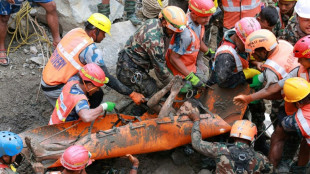 Two trapped tunnel workers rescued in Nepal 'miracle'

 Ex-Pakistan coach Gillespie tells Javed 'look in the mirror' over sackings

 Monfils falls to Tien in US Open in Grand Slam farewell

 Arsenal brace for Chelsea test as Spurs seek spark

 Efficient Rybakina reaches US Open third round

 Taiwan boxer Lin considered 'graceful exit' after Paris Games gold

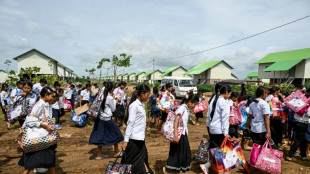 'I miss my home': Cambodians displaced by conflict start over

 Ailing Auger-Aliassime falls at US Open as Swiatek, Osaka and Gauff advance

 Tesla launches self-driving 'Cybercab' in Texas

 'Wallace & Gromit' creators turn 50 with spook-tacular Shaun yarn

 New York's Muslims reclaim their city after 9/11 backlash

 Premier League transfer windfall a lifeline for ailing French clubs

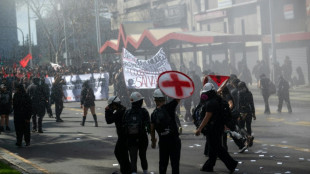 Chile protesters see shades of Pinochet in new security plan

 Carreras reverts to fullback as Argentina change four for Australia Test

 Wilson back to lead Australia as Kiss rotates team for Argentina

 Yen surges on new intervention talk, US stocks rally

 Japan's Ueda fires Lille top of Ligue 1 on debut

 Arsenal chief executive reveals 'dynasty' ambition

 Spanish PM says no 'solid proof' Morocco planned migrant rush

 Iran war is not a war, US VP Vance says

 Khachanov stuns third-seeded Auger-Aliassime in US Open second round

 Bordeaux facing sixth-tier football after French federation upholds relegation

Soaring food and energy prices are raising the risk of social unrest, but attempting to tame costs through tax cuts, subsidies and price controls would be too costly, the IMF said Wednesday.
The fund's comments, in its latest Fiscal Monitor report, come as food prices have surged by half since 2019 while energy bills soared in the wake of Russia's invasion of Ukraine.
"Countries all around the world are facing more pressing and more painful trade offs," Vitor Gaspar, director of the International Monetary Fund's fiscal affairs department, told AFP as the crisis lender holds its annual meetings in Washington this week.
The combination of inflation along with food and energy price surges point to a cost-of-living crisis, he said.
Countries spent heavily to protect their economies during the pandemic, then faced supply chain issues as they emerged from Covid lockdowns.
Inflation soared further after Russia invaded Ukraine in February, with food and energy costs going through the roof, forcing central banks to raise interest rates aggressively.
"Households are struggling with elevated food and energy prices, raising the risk of social unrest," the IMF Fiscal Monitor report said.
But, it added, "fiscal policy trade-offs are increasingly difficult, especially for high-debt countries where responses to the Covid-19 pandemic exhausted their fiscal space."
- 'More generous' food aid -
As governments operate within tighter budgets, prioritizing policies and programs becomes vital, the report said, adding that key goals are ensuring access to affordable food and protecting low-income households from inflation.
There appears to be an "association between social unrest and episodes of spikes in food prices," while fuel prices are politically sensitive, IMF fiscal affairs department deputy director Paolo Mauro told reporters.
Countries have to be selective in giving support, he said, but the IMF recommends being "more generous" on food as a need for survival.
However, with long-lasting supply shocks and broad-based inflation, attempts to cap surging costs through price controls, subsidies or tax cuts will be "costly to the budget and ultimately ineffective," the IMF warned.
Officials should instead allow prices to adjust and provide targeted cash transfers to the most vulnerable.
Most countries should continue "tightening" their budgets, the report said.
Asked about Britain's controversial tax-slashing plans, which rocked the pound and raised the country's borrowing costs, Gaspar told reporters that monetary and fiscal policies should be consistent, with markets "looking for certainty in a very uncertain world."
"The expectation is that the announcement of a full-fledged fiscal plan on October 31 accompanied by a macroeconomic forecast... will contribute to give to the market the certainty that it seeks," he said.
Countries may need to raise added revenues and contain the growth of other expenditures as they prioritize policies, the IMF report said.
Fiscal costs can be offset by measures like taxes, it added, suggesting that a permanent tax on "windfall profits" from fossil fuel extraction based on excess gains "can be considered" if an adequate instrument is not already in place.
But the report cautioned that low-income countries will need more global humanitarian assistance and emergency financing given their limited resources, adding that the biggest challenge comes from the food price surge.
L.Carrico--PC