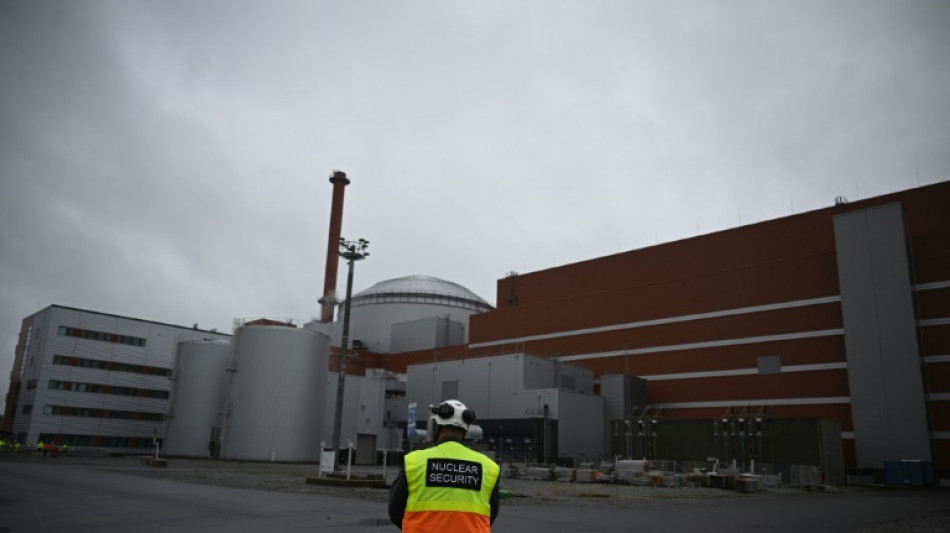
Finland hopes new nuclear reactor eases energy crunch / Photo: Olivier MORIN - AFP

 How a Dostoevsky novella took TikTok by storm

 Zverev goes the distance again to reach US Open third round

 German AfD's love for Simson mopeds dismays Jewish family behind brand
 Two trapped tunnel workers rescued in Nepal 'miracle'
 Ex-Pakistan coach Gillespie tells Javed 'look in the mirror' over sackings

 Monfils falls to Tien in US Open in Grand Slam farewell

 Arsenal brace for Chelsea test as Spurs seek spark

 Efficient Rybakina reaches US Open third round

 Taiwan boxer Lin considered 'graceful exit' after Paris Games gold
 'I miss my home': Cambodians displaced by conflict start over

 Ailing Auger-Aliassime falls at US Open as Swiatek, Osaka and Gauff advance

 Tesla launches self-driving 'Cybercab' in Texas
 'Wallace & Gromit' creators turn 50 with spook-tacular Shaun yarn

 New York's Muslims reclaim their city after 9/11 backlash

 Premier League transfer windfall a lifeline for ailing French clubs
 Chile protesters see shades of Pinochet in new security plan
 Carreras reverts to fullback as Argentina change four for Australia Test

 Wilson back to lead Australia as Kiss rotates team for Argentina
 Yen surges on new intervention talk, US stocks rally

 Japan's Ueda fires Lille top of Ligue 1 on debut
 Arsenal chief executive reveals 'dynasty' ambition

 Spanish PM says no 'solid proof' Morocco planned migrant rush

 Iran war is not a war, US VP Vance says

 Khachanov stuns third-seeded Auger-Aliassime in US Open second round
 Bordeaux facing sixth-tier football after French federation upholds relegation

After over a decade of delays, the deafening sound of Finland's new Olkiluoto 3 nuclear reactor finally running its turbine at full power was welcomed with joy -- and relief.
The Nordic country is hoping the plant will be able to ease the coming winter's challenges as Europe battles soaring energy prices following Russia's invasion of Ukraine.
"It has taken a lot of perseverance and years of hard work to get to this point, so we feel pretty good at the moment," Johanna Aho, a spokeswoman for the plant's operator TVO, told AFP.
The almost 300-degree Celsius (572 F) steam gushing from the reactor turns the over 60-meter-long turbine up to 25 times every second, making a visit to the turbine island in protective gear feel as hot as one of Finland's ubiquitous saunas.
More than 12 years behind schedule, on September 30, Olkiluoto 3 reached full power for the first time since construction began in 2005.
With a power level of 1,600 megawatts, the reactor, located on Finland's southwestern coast, is now the most powerful in Europe and the third most powerful in the world.
Around 10 full power tests remain for the unit -- during which it will periodically stop producing electricity for several days or even weeks -- before normal operation starts in December.
- Support for nuclear -
When the new unit reached full power on September 30, TVO said the Olkiluoto plant accounted for around 40 percent of Finland's electricity production, with the Olkiluoto 1 and 2 reactors together producing approximately 21 percent and the new OL3 alone around 19 percent.
"That's a lot of electricity and it's the kind of steady, predictable and stable electricity production that nuclear power provides," Aho said.
In recent years, support for nuclear energy has grown in Finland, spurred by concern over climate change.
A May poll by trade association Finnish Energy showed 60 percent of Finns supported nuclear power, a record high.
But after Finnish group Fennovoima in May terminated a nuclear power project with Russia's Rosatom, citing risks linked to the war in Ukraine, there are no other nuclear reactor projects in the pipeline.
Finland gets around 50 to 60 percent of its electricity from hydro, wind, solar and biomass, with fossil fuels and peat comprising roughly 10 percent.
- French were 'unprepared' -
Olkiluoto 3 was meant to be up and running already in 2009, six years after TVO announced a deal with France's Areva and Germany's Siemens for the reactor's construction.
But the project quickly ran into issues.
In 2006, TVO announced that "delays in the construction work and in manufacturing of the main coolant lines" had pushed the reactor's starting date back to 2010-2011.
And when the Finnish nuclear safety agency STUK by 2009 required hundreds of improvements to be made due to "problems with the construction", the partners started casting blame.
TVO demanded 2.4 billion euros in compensation from Siemens and Areva for the setbacks. The two in turn demanded 1.0 billion euros from TVO, arguing that the project had encountered "more rigorous security requirements" than initially foreseen.
Areva meanwhile accused STUK of being slow to approve documents, to which STUK responded by saying the consortium had been "unprepared".
"The French did not understand at first the Finnish system, that no important device can be built before the plan is approved," Jukka Laaksonen from STUK told AFP at the time.
After years of litigation and even more delays, Areva and TVO settled their disputes in November 2018, with the French agreeing to pay 450 million euros ($554 million) in compensation.
- Model plagued by delays -
Design work on the EPR began in 1992 with the objective of creating a next-generation reactor with added safety features that could win over public opinion which was highly sceptical of nuclear power following the Chernobyl catastrophe of 1986.
But the complex design has caused delays and problems.
Like Olkiluoto, France's EPR which began construction in 2007 has been plagued by delays and is still not finished.
In Britain, the construction of an EPR at Hinkley Point in southwest England is also running behind schedule.
China launched two EPR reactors in the Taishan power plant in Guangdong province by 2019, but one was shut for over a year for repairs following damaged fuel pellets and a build-up of gasses in the closed cooling circuit.
E.Raimundo--PC