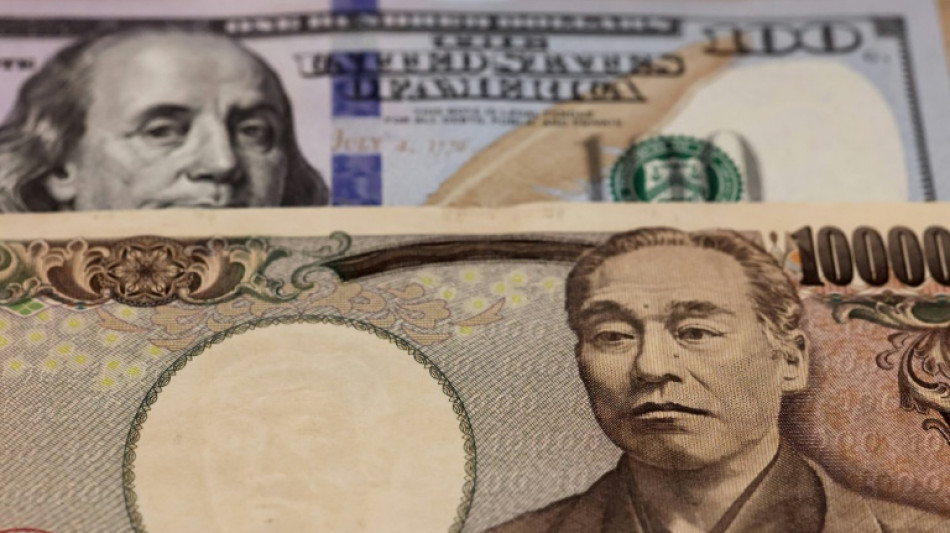
Yen hits lowest level against dollar since 1990 / Photo: Behrouz MEHRI - AFP/File

 Physicians Urge Arizona to Ban Medical Gag Clauses and Enable Private Lawsuits

 New Campaign Highlights Knowledge Gaps on Carbon Monoxide Safety Among Americans

 GoodData.AI Launches the Agentic Serving Plane, a New Category of Enterprise Data Infrastructure for AI Agents

 US Government Questions Effectiveness of Waymo’s School Bus Software Fix

 Panthers expected to begin 2027 NRL season away from new stadium

 Sweet As app launches restaurant discovery platform

 MLA seeks inquiry into reported sectarian gestures on Ormeau Road

 Louise O’Reilly attacks Simon Harris over unemployment remarks

 Virginia overwhelms Arkansas 91-72 behind balanced scoring

 Second major storm brings destructive winds and outages to British Columbia

 Godzilla Minus Zero leads North American box office with $31.6m

The yen on Thursday dropped to the lowest level against the dollar since 1990 after US inflation data indicated more aggressive interest rate hikes from the Federal Reserve.
One dollar was worth 147.67 yen following the stronger-than-expected inflation number, which comes as Japan's central bank holds off from hiking interest rates.
"The yen has been the weakest major currency so far in 2022," noted Carol Kong, a currency strategist at Commonwealth Bank of Australia.
"There are two key reasons behind its rapid weakness. The first is the growing divergence in monetary policy between the US and Japan," she told AFP.
"The Bank of Japan continues to keep monetary policy easy because inflation and wages remain relatively low" in the country.
Kong said the yen had been hit hard also by a collapse in Japan's current account balance after oil prices surged following the invasion of Ukraine by key energy producer Russia.
With Japan relying on oil imports to meet most of its energy needs, the surge in crude costs recently sent its current account into deficit, she pointed out.
On the upside, a weaker yen is helpful to Japanese exporters, whose products turn cheaper for foreign buyers holding stronger currencies.
Fast Retailing, the parent company of Japanese clothing giant Uniqlo, posted on Thursday a record full-year net profit thanks to the weak yen and a rebound in demand after virus lockdowns.
The yen's dramatic fall -- from around 115 against the dollar in February to over 138 in late August -- was a boon for the company, which owns Uniqlo stores worldwide.
Wall Street and European stock markets were meanwhile also down sharply following Thursday's US inflation data that solidified expectations of further big interest rate hikes from the Federal Reserve.
US consumer prices rose 0.4 percent in September compared to August, double the figure projected by analysts.
burs-bcp/rl
H.Portela--PC

