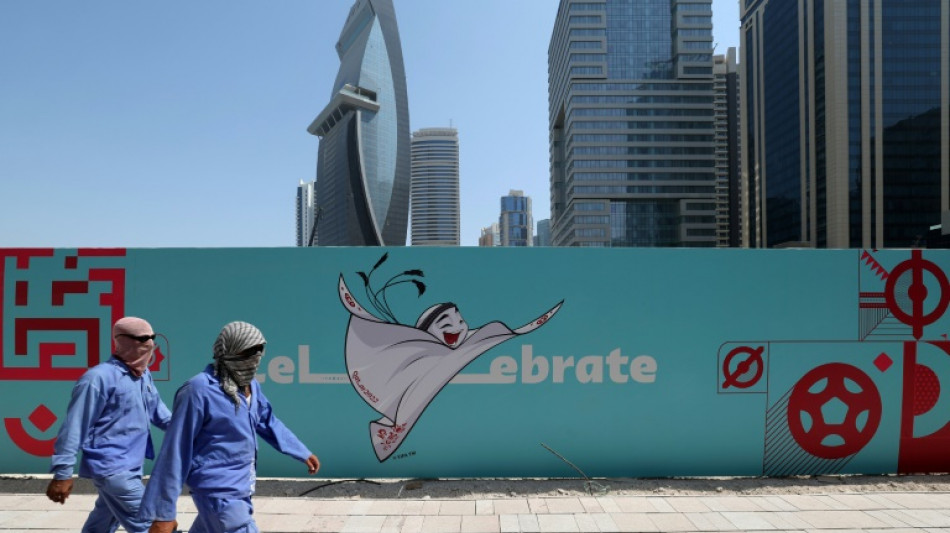
French football chiefs promise checks after workers' conditions in Qatar exposed / Photo: GIUSEPPE CACACE - AFP

 How a Dostoevsky novella took TikTok by storm

 Zverev goes the distance again to reach US Open third round

 German AfD's love for Simson mopeds dismays Jewish family behind brand
 Two trapped tunnel workers rescued in Nepal 'miracle'
 Ex-Pakistan coach Gillespie tells Javed 'look in the mirror' over sackings
 Monfils falls to Tien in US Open in Grand Slam farewell

 Arsenal brace for Chelsea test as Spurs seek spark
 Efficient Rybakina reaches US Open third round
 Taiwan boxer Lin considered 'graceful exit' after Paris Games gold
 'I miss my home': Cambodians displaced by conflict start over
 Ailing Auger-Aliassime falls at US Open as Swiatek, Osaka and Gauff advance
 Tesla launches self-driving 'Cybercab' in Texas
 'Wallace & Gromit' creators turn 50 with spook-tacular Shaun yarn
 New York's Muslims reclaim their city after 9/11 backlash
 Premier League transfer windfall a lifeline for ailing French clubs
 Chile protesters see shades of Pinochet in new security plan
 Carreras reverts to fullback as Argentina change four for Australia Test
 Wilson back to lead Australia as Kiss rotates team for Argentina
 Yen surges on new intervention talk, US stocks rally
 Japan's Ueda fires Lille top of Ligue 1 on debut
 Arsenal chief executive reveals 'dynasty' ambition
 Spanish PM says no 'solid proof' Morocco planned migrant rush
 Iran war is not a war, US VP Vance says
 Khachanov stuns third-seeded Auger-Aliassime in US Open second round
 Bordeaux facing sixth-tier football after French federation upholds relegation
French football authorities said Friday they would carry out their own checks on the working conditions of migrant workers in Qatar ahead of the World Cup after new revelations in a TV documentary.
The France Televisions programme shown on Thursday showed the crowded bedrooms and filthy toilets of migrant workers in the Qatari capital.
The national broadcaster said the images were filmed secretly "before the summer" as part of an investigation into the controversy surrounding the first World Cup to be held in the Middle East.
Qatar has long argued that attacks on its labour rights record are unjustified, instead highlighting reforms it has carried out over the past decade.
One sequence in the France Televisions programme shows the accommodation for the employees of a private security firm, which is sub-contracted by the hotel where the France team will be based during the tournament, which kicks off on November 20.
Another company featured in the documentary is a sub-contractor for the French hotel chain Accor, which is a major supplier of accommodation during the World Cup.
The documentary showed bedrooms infested with insects where workers slept in bunkbeds. The toilets and bathroom facilities were dirty and the walls were stained with damp.
The workers' cooking facilities were little more than a sink and two gas rings and the air conditioning in one of the bedrooms had broken down, leaving the temperature at 35 degrees Celsius (95 degrees Fahrenheit).
Some of the workers interviewed said they hardly ever had a day off and their overtime was not paid.
The French Football Federation (FFF) told the broadcaster it would send a delegation to Qatar in "mid-October" to check the claims.
The FFF said it had already "put in place a series of checks concerning the six contractors for the team's hotel" in Doha.
As a result of these checks, the contract with the security firm had been terminated because of "a number of unacceptable irregularities" and the contractor's failure to respect workers' rights such as providing decent accommodation and confiscating workers' passports.
A letter from the FFF cited in the programme said the World Cup "was an opportunity for progress but taking part in it did not mean it would turn a blind eye".
- 'Reaction lacked humanity' -
FFF president Noel Le Graet told an interviewer in the documentary "I could show you lots of pictures like that in lots of countries, even in some not far from (France)."
He claimed there was "still time to put things right".
France's sports minister Amelie Oudea-Castera said she was "shocked" by Le Graet's reaction.
"This reaction shocked me, I thought it... lacked humanity and even coherence," the minister told RTL.
Qatar's approach to the thousands of migrant workers working in the Gulf state has come under the microscope as the World Cup kickoff approaches.
The Qatari authorities say many of the attacks on its labour rights record are unjustified and have highlighted reforms it has carried out.
They include the virtual abolition of the Kafala system which gave employers extensive powers over workers, including their right to change jobs and to leave the country.
Authorities now monitor salary payments far more closely, after many workers said employers had stolen or withheld their pay and the government now has a blacklist of companies that fail to pay wages.
V.Fontes--PC