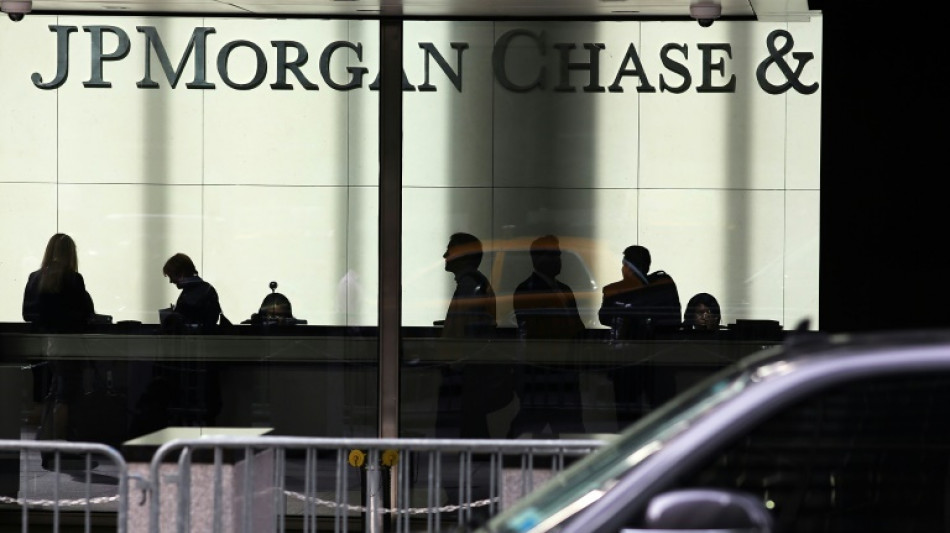
US banks report solid results but warn of rising recession risk / Photo: SPENCER PLATT - GETTY IMAGES NORTH AMERICA/AFP/File

 Physicians Urge Arizona to Ban Medical Gag Clauses and Enable Private Lawsuits

 New Campaign Highlights Knowledge Gaps on Carbon Monoxide Safety Among Americans

 GoodData.AI Launches the Agentic Serving Plane, a New Category of Enterprise Data Infrastructure for AI Agents

 US Government Questions Effectiveness of Waymo’s School Bus Software Fix

 Panthers expected to begin 2027 NRL season away from new stadium

 Sweet As app launches restaurant discovery platform

 MLA seeks inquiry into reported sectarian gestures on Ormeau Road

 Louise O’Reilly attacks Simon Harris over unemployment remarks

 Virginia overwhelms Arkansas 91-72 behind balanced scoring

 Second major storm brings destructive winds and outages to British Columbia

 Godzilla Minus Zero leads North American box office with $31.6m

Large US banks reported a round of solid quarterly profits Friday, but cautioned of rising recession risks as the economy absorbs higher inflation and a dramatic shift is central bank policy.
JPMorgan Chase set aside $808 million in case of bad loans, while Citigroup reserved for $370 million in potential losses and Wells Fargo, $385 million.
These sums are much smaller than the reserves established at the start of the coronavirus pandemic. But they nonetheless point to a much changed environment from a year ago, when bank results were boosted by large releases of funds that had been set aside for loan defaults that did not materialize
Today's litany of worries include stubborn inflation that has prompted significant central bank interest rate hikes; and geopolitical fallout from the Russian invasion of Ukraine, including uncertainty in the oil market and worries about European energy security this winter.
While the US consumer remains "very strong," these obstacles elevate the risk of a downturn, said JPMorgan Chief Executive Jamie Dimon.
The end result could be "anywhere from a soft landing to a hard recession," Dimon told reporters on a conference call. "If it is a hard recession, obviously it has implications for unemployment and business and reserves."
Wells Fargo Chief Executive Charlie Scharf said the bank continues to see "historically low delinquencies," but that it is "monitoring risks" tied to macroeconomic and geopolitical headwinds.
"While we do expect to see continued increases in delinquencies and ultimately credit losses,the timing is unclear," Scarf said.
- Lower profits -
At JPMorgan, profits fell 17 percent to $9.7 billion on a 10 percent increase in revenues to $32.7 billion.
Higher interest rates helped boost the bank's net interest income, but JPMorgan suffered a big drop in investment banking revenues in a period that has seen far fewer initial public offerings compared with a year ago..
Dimon said businesses "remain healthy," but alluded to "significant headwinds immediately in front of us."
In an interview with CNBC earlier this week, Dimon said a US recession was likely in early-to-mid 2023 and that the stock market could fall another 20 percent.
At Citigroup, profits fell 25 percent to $3.5 billion, while revenues rose six percent of $18.5 billion.
Results were boosted by higher net interest income as well a gain from the sale of the bank's Philippines business. These benefits were offset by lower revenues in investment banking and higher operating expenses.
Citi opted to set aside reserves in light of rising recession risk.
Under a "baseline" economic scenario, Citi sees unemployment rising to about four percent from the current 3.5 percent. Under a "downside" scenario, unemployment would be well above five percent, said Citi Chief Financial Officer Mark Mason on a conference call with journalists.
Even under a darker outcome, Mason said "I don't think there's a financial crisis coming anything close to the magnitude of what we've seen."
At Wells Fargo, profits fell 31 percent to $3.5 billion, while revenues rose four percent to $19.5 billion.
Results were dented by $2 billion in fresh costs linked to "litigation, customer remediation and regulatory matters."
During a conference call with analysts, Scharf, who was named CEO in 2019 following a fake accounts scandal under earlier executive regimes, said the bank "still has open regulatory matters" related to earlier times and was looking to get past them "as quickly as we can."
Near 1645 GMT, JPMorgan shares jumped 3.5 percent to $113.14, while Citi rose 1.4 percent to $43.56 and Wells Fargo gained 3.6 percent to $43.90
V.Fontes--PC