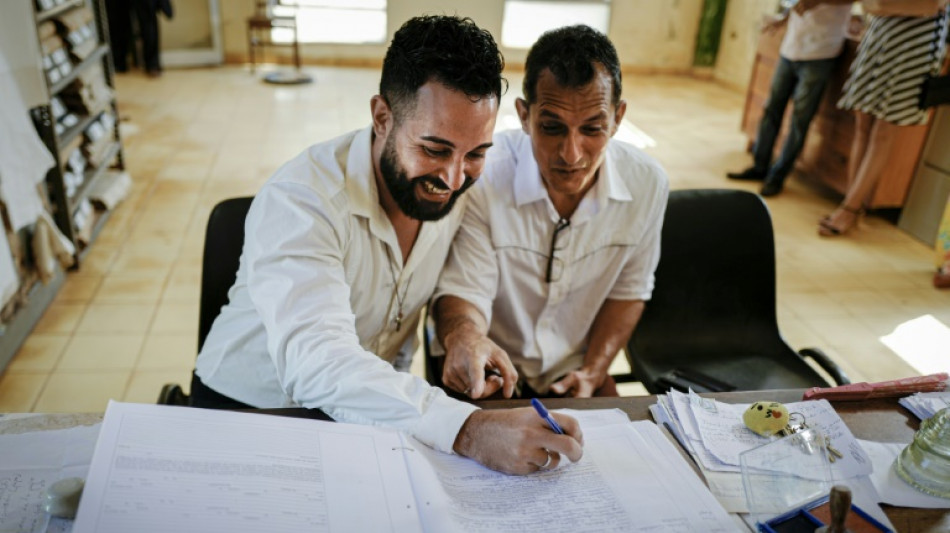
Gay Cuban couple's long wait to tie the knot / Photo: ADALBERTO ROQUE - AFP

 Monfils falls to Tien in US Open in Grand Slam farewell

 Arsenal brace for Chelsea test as Spurs seek spark

 Efficient Rybakina reaches US Open third round

 Taiwan boxer Lin considered 'graceful exit' after Paris Games gold

 'I miss my home': Cambodians displaced by conflict start over

 Ailing Auger-Aliassime falls at US Open as Swiatek, Osaka and Gauff advance

 Tesla launches self-driving 'Cybercab' in Texas

 'Wallace & Gromit' creators turn 50 with spook-tacular Shaun yarn

 New York's Muslims reclaim their city after 9/11 backlash

 Premier League transfer windfall a lifeline for ailing French clubs
 Chile protesters see shades of Pinochet in new security plan
 Carreras reverts to fullback as Argentina change four for Australia Test

 Wilson back to lead Australia as Kiss rotates team for Argentina
 Yen surges on new intervention talk, US stocks rally

 Japan's Ueda fires Lille top of Ligue 1 on debut

 Arsenal chief executive reveals 'dynasty' ambition
 Spanish PM says no 'solid proof' Morocco planned migrant rush

 Iran war is not a war, US VP Vance says

 Khachanov stuns third-seeded Auger-Aliassime in US Open second round

 Bordeaux facing sixth-tier football after French federation upholds relegation
 Stoic Verstappen looking beyond 'painful' Monza weekend

 OpenAI begins rollout of new powerful AI model GPT-6 Astra

 FIFA blasts UEFA 'smear campaign,' fights World Cup plan disclosures
 Zelensky hopes to host US envoys in Kyiv in 'coming days'
 Martinelli joins Al-Hilal from Arsenal for reported £60 million

Adiel Gonzalez, a 32-year-old former theology student, was forced to break with his church eight years ago due to his sexuality.
He became a fierce LGBTQ+ rights campaigner and on Thursday, was able to tie the knot with his long-time partner and fellow activist Lazaro Gonzalez -- among the first gay weddings celebrated in Cuba.
Thanks in large part to the efforts of the pair and others like them, Cuba finally approved same-sex marriage on September 25 after a long battle against religious and cultural resistance in the socially-conservative country.
The Cuban family code adopted last month allows not only legal unions but also adoption, surrogate pregnancy for gay couples and parental rights for non-biological mothers and fathers.
"For us who have been involved so directly" in the struggle, which was "part of our daily life... for seven consecutive years, to get married was the closure, the culmination," Adiel Gonzalez told AFP next to his new husband, a 52-year-old artist, at their home in Bolondron, central Cuba.
On Thursday, Lazaro Gonzalez got up very early to prepare the banquet to which only the pair's closest family and friends were invited.
He cooked traditional fare such as fried rice, a casava dish called "yuca al mojo" and sweet plantain.
"We have been awaiting this moment for so long, it was a dream," he told AFP over coffee before getting dressed for the ceremony.
The happy couple exchanged vows, smiling ear to ear, at the only civil registry in the town of some 7,000 inhabitants.
- Church opposition -
Cubans voted in a referendum last month to approve same-sex marriage, joining only eight other countries in Latin America where it is legal: Argentina, Uruguay, Brazil, Colombia, Ecuador, Costa Rica, Chile and some Mexican states.
The approved family code, which had the support of President Miguel Diaz-Canel, replaced legislation from 1975 that defined marriage as a union between a man and a woman.
The government had sought to change this already in the 2019 constitution, but withdrew its proposal amid strong opposition from churches and conservative groups.
Marginalization of LGBTQ+ people in traditionally macho Cuban society peaked in the 1960s and '70s.
In 2010, Fidel Castro admitted the Cuban revolution had oppressed members of the community as deviants, including with forced labor camps for re-education. Some were driven into exile.
A major opponent of the family code is Cuba's powerful Catholic Church, which maintains "it is a child's right to have a father and a mother."
- 'God does not care' -
Adiel Gonzalez, who wears a religious cross around his neck, said he was born into a "very conservative and fundamentalist" Christian family.
"I was taught to reject any homosexual urges. Any love, even, was considered a sin," he recounted.
From the age of 11, he said, he tried to "change" himself through prayer.
"But it did not work because sexual orientation is not a choice," he told AFP. "I am convinced that God does not care about sexual orientation."
By the time he turned 20, Adiel had accepted his sexuality. He tried to foster grass-roots acceptance at his local church, but finally broke ties with the Church in 2014 to start a Christian LGBTQ+ activist group.
It was a painful process.
"I was in the crossfire because I was doing activism from the point of view of my Christian identity," said Gonzalez, who found himself the target of vicious attacks, including death threats, on social media.
But he did not give up, campaigning for the family code which was finally approved with 66,85 percent of the vote.
"We shouted, we embraced, it was very emotional," said Lazaro of the referendum's outcome. "It really was worth" the battle.
"We do not need a signature to be happy, but to have society recognize that we are in a relationship like any other heterosexual one, and that it is very important for us" to have legal protections, he added as he embraced his husband.
F.Cardoso--PC