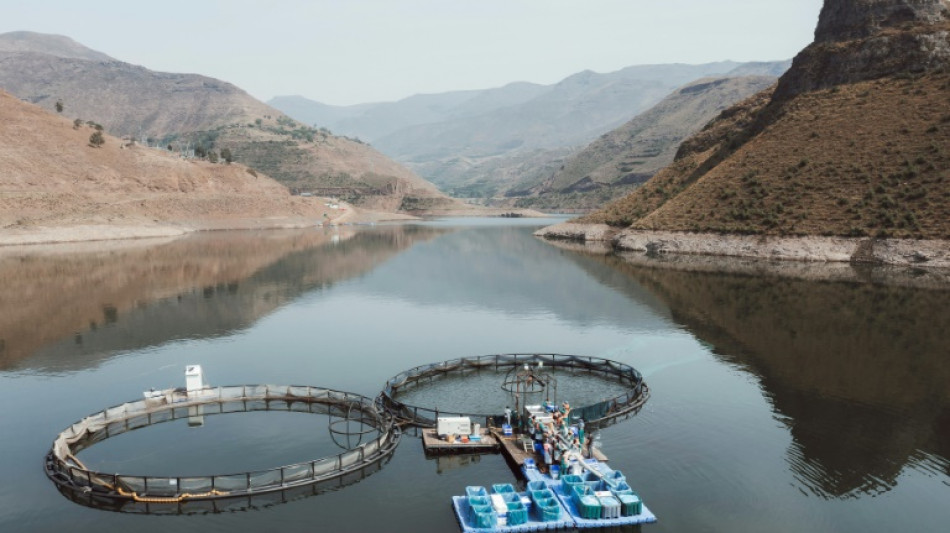
Mountainous Lesotho finds gold in trout fish farming / Photo: Marco LONGARI - AFP

 Monfils falls to Tien in US Open in Grand Slam farewell

 Arsenal brace for Chelsea test as Spurs seek spark

 Efficient Rybakina reaches US Open third round

 Taiwan boxer Lin considered 'graceful exit' after Paris Games gold

 'I miss my home': Cambodians displaced by conflict start over
 Ailing Auger-Aliassime falls at US Open as Swiatek, Osaka and Gauff advance

 Tesla launches self-driving 'Cybercab' in Texas
 'Wallace & Gromit' creators turn 50 with spook-tacular Shaun yarn

 New York's Muslims reclaim their city after 9/11 backlash

 Premier League transfer windfall a lifeline for ailing French clubs

 Chile protesters see shades of Pinochet in new security plan

 Carreras reverts to fullback as Argentina change four for Australia Test

 Wilson back to lead Australia as Kiss rotates team for Argentina

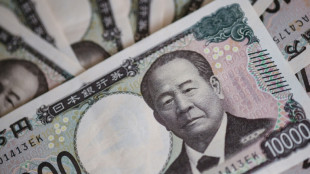 Yen surges on new intervention talk, US stocks rally

 Japan's Ueda fires Lille top of Ligue 1 on debut

 Arsenal chief executive reveals 'dynasty' ambition

 Spanish PM says no 'solid proof' Morocco planned migrant rush

 Iran war is not a war, US VP Vance says

 Khachanov stuns third-seeded Auger-Aliassime in US Open second round
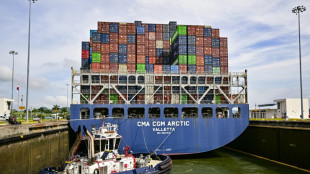
 Bordeaux facing sixth-tier football after French federation upholds relegation

 Stoic Verstappen looking beyond 'painful' Monza weekend
 OpenAI begins rollout of new powerful AI model GPT-6 Astra

 FIFA blasts UEFA 'smear campaign,' fights World Cup plan disclosures

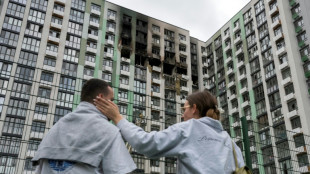 Zelensky hopes to host US envoys in Kyiv in 'coming days'

 Martinelli joins Al-Hilal from Arsenal for reported £60 million

It's harvest time in Lejone, a small village nestling in mountains in southern Africa more than two thousand metres above sea level.
The yield is not grain or fruit, but rainbow trout -- the bounty from an undulating river at the foot of the peaks of Lesotho.
Fishermen haul nets bulging with trout onto a floating platform.
The fish are killed and put on ice, the first step on their journey to dinner tables in neighbouring South Africa.
The settlement is home to one of Lesotho's two professional fish farms -- pioneering ventures in the poor landlocked kingdom.
Stephen Phakisi, 59, launched Katse Fish Farms with two partners in 2005.
Today, he chuckles at how the trio leapt into the business with meagre knowledge about some of its unknowns, including the best feed for fattening fish quickly.
"For five years, it was totally uneconomical," Phakisi says.
He recalls how he once found a shoal of fish dead and belly-up in the water, while another time a full cargo of imported fingerlings died on a 16-hour drive from Cape Town.
Today, the company is profitable, with a yearly output of 800 tonnes of fish, which is sold at about $4 a kilogram.
It supplies a few local restaurants, where the trout is usually pan-fried in butter for a few minutes and served with a side dish of kale and potato chips or rice.
But the bulk of its production lands on the shelves of high-end supermarkets in neighbouring South Africa, where a vacuum-packed one-kilo bag can cost up to $50.
- 'Heads and bones' -
Trout farming in Lesotho has grown on the back of another of the mountain country's most famous exports: water.
South Africa gets much of its water from its neighbour, which has dammed several of its waterways over the past three decades.
The dams have widened riverbeds, creating inlets and basins that are ideal for trout farming.
Katse Fish Farms lies more than 2,000 metres (6,500 feet) above sea level on the Malibamatso River, upstream from the giant Katse Dam reservoir that supplies South Africa's capital Pretoria and the largest city, Johannesburg.
Fish farming currently accounts for less than 0.1 percent of Lesotho's $2 billion GDP.
Locals say they have always eaten salted, sun-dried freshwater fish. And young boys sell fresh catch to passing motorists.
But as dam construction continues the country has the potential "to become the regional leader in aquaculture," according to the Lesotho National Development Corporation.
In this country of just over two million people, who rank among the poorest in the world, few seem to be benefiting so far from the water boom.
"We are selling water to South Africa but we have no water to our homes," says Joshua Sefali, a village leader in Lejone.
Many of the village's stone houses with thatched roofs have no mains water or electricity.
Large swathes of land were flooded after dams went up.
Some people lost their homes and access to farmland, receiving only small compensation in return.
Machaka Khalala, 31, said she received about $165 when the field where she used to grow corn and spinach was submerged.
Now she makes a living selling "fat cakes," a local doughnut.
But that's often not enough to make ends meet.
A cap on her head, Khalala was among dozens of people queueing up in the cold, a bucket in hand, on a mountain roadside.
Here, Lesotho's other fish farm hands out leftovers every week -- "the heads and backbones," Khalala said.
A.P.Maia--PC