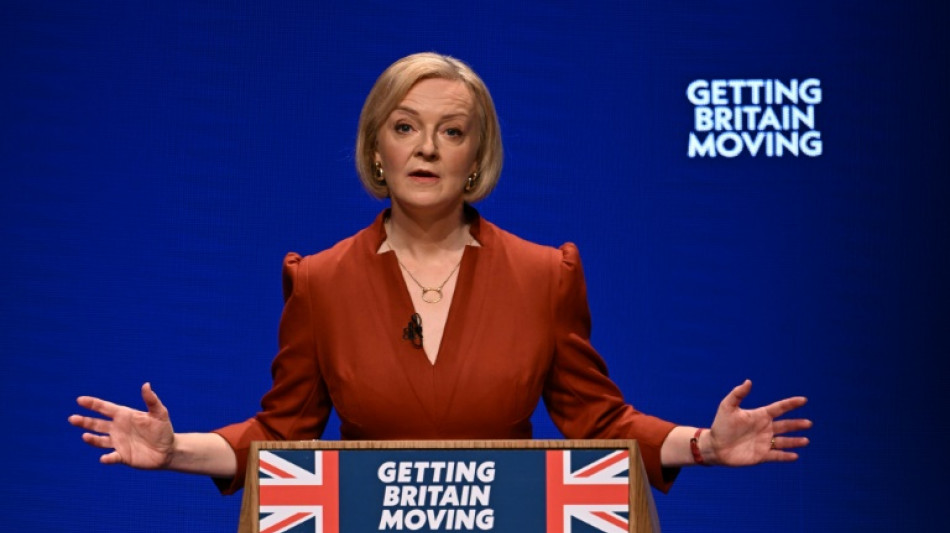
Truss budget fiasco shows power of the markets / Photo: Paul ELLIS - AFP/File

 'I miss my home': Cambodians displaced by conflict start over

 Ailing Auger-Aliassime falls at US Open as Swiatek, Osaka and Gauff advance

 Tesla launches self-driving 'Cybercab' in Texas

 'Wallace & Gromit' creators turn 50 with spook-tacular Shaun yarn

 New York's Muslims reclaim their city after 9/11 backlash

 Premier League transfer windfall a lifeline for ailing French clubs

 Chile protesters see shades of Pinochet in new security plan
 Carreras reverts to fullback as Argentina change four for Australia Test

 Wilson back to lead Australia as Kiss rotates team for Argentina

 Yen surges on new intervention talk, US stocks rally

 Japan's Ueda fires Lille top of Ligue 1 on debut

 Arsenal chief executive reveals 'dynasty' ambition

 Spanish PM says no 'solid proof' Morocco planned migrant rush

 Iran war is not a war, US VP Vance says

 Khachanov stuns third-seeded Auger-Aliassime in US Open second round

 Bordeaux facing sixth-tier football after French federation upholds relegation

 Stoic Verstappen looking beyond 'painful' Monza weekend

 OpenAI begins rollout of new powerful AI model GPT-6 Astra

 FIFA blasts UEFA 'smear campaign,' fights World Cup plan disclosures

 Zelensky hopes to host US envoys in Kyiv in 'coming days'

 Martinelli joins Al-Hilal from Arsenal for reported £60 million

 Tesla's semi-autonomous driving could be adapted to EU norms: France

 37 people die from fumes during oil pipeline theft in Nigeria: NGO

 Ahead of elections, Israel tests West's patience on West Bank violence
 Antonelli will obey Mercedes orders to help 'tow' teammate Russell

British Prime Minister Liz Truss's humiliating budget U-turn shows how markets can wield influence over government fiscal policy.
The premier on Monday shredded her tax-slashing budget after it sparked markets chaos over rocketing state debt, as traders questioned the government's credibility on public finances.
Truss was elected last month on a tax-cutting platform and her astonishing reversal prompted talk of a rebellion within the governing Conservative party.
The furore "is a rather extreme example of how markets react when a change in policy does not appear to be credible", said economist Antoine Bouet at French economic forecaster CEPII.
- Not the first -
The Truss budget is not the first time that world governments have failed to overcome the verdict of markets.
Other examples include the pound's exit from the gold standard in 1931 and from the Exchange Rate Mechanism in 1992, as well as the Asian financial crisis in 1997, analysts say.
Britain's reversal has echoes of 1983 France, when socialist president Francois Mitterand switched to austerity in a major U-turn to restore market stability.
Truss's flagship mini-budget on September 23 was aimed at boosting the recession-threatened economy and easing a cost-of-living crisis.
But her costly universal energy price freeze and tax cuts were financed by debt, fuelling fears of even higher inflation.
That sent UK government bond yields rocketing and the pound collapsing to a record dollar-low on debt concerns.
In reaction, the Bank of England launched an emergency bond-buying plan to help avert a financial catastrophe, while the International Monetary Fund urged a budget rethink amid a surge also in mortgage rates.
Three weeks later, Truss fired finance minister Kwasi Kwarteng and replaced him with Jeremy Hunt -- who then axed most of the tax cuts, slashed the energy-price cap and warned of tough spending cutbacks.
"No government can control the markets but every government can give certainty about the sustainability of public finances," Hunt said Monday as he took the axe to the budget.
- 'Room for manoeuvre' -
Bouet argued the markets did not dictate the political and economic policy, rather they reacted to it.
"There is a large amount of room for manoeuvre for governments, provided they do not go completely off the rails," the economist told AFP.
The reaction would have been "on a smaller scale" if the UK had announced smaller tax cuts -- or energy price assistance that was more targeted.
The market response was "brutal" because of "major inconsistencies", Bouet said.
Truss' budget was seen as adding to already sky-high inflation, which the Bank of England is struggling to bring down.
The BoE is set to deliver a super-sized interest rate hike next month after UK inflation hit a 40-year high of 10.1 percent in September.
Russ Mould, strategist at stockbroker AJ Bell, said the sheer size of bond and foreign exchange markets gave them a unique power to impact the UK economy.
- No 'convincing plan' -
"Financial markets can and will push governments around, especially if governments -- or central banks -- do something stupid," Mould told AFP.
"Bond and currency markets are so large they can overwhelm almost anyone."
Some have tried to take on markets, such as in 2012 when Mario Draghi -- at the time head of the European Central Bank -- vowed "to do whatever it takes" to save the euro.
Draghi helped avert a eurozone debt crisis, although the euro weakened significantly.
"The EU debt crisis is a good example where markets lost confidence in debt sustainability in various southern European countries," noted analyst Kay Neufeld at research group CEBR.
The Truss budget drama "showed what happens if you surprise markets -- and don't have a convincing plan on how to pay" for costly measures.
P.Mira--PC