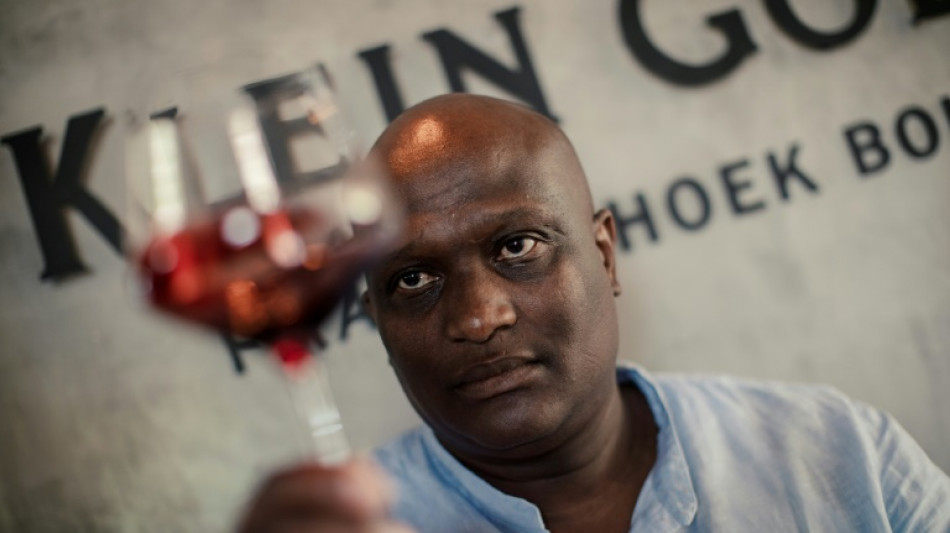
Black South Africans break into once white-only wine industry / Photo: GIANLUIGI GUERCIA - AFP

 Kyrgios gets month ban for cocaine, enters treatment programme

 Colombian judge bans strikes on guerrillas if minors are present

 Khachanov shocks ailing Auger-Aliassime, Swiatek and Osaka advance at US Open

 Lone juror blocking verdict in US mother's child murder trial: defense

 'Kinda chic' - Williams sisters set to launch US Open doubles bid

 Volkswagen says cutting 100,000 jobs by end of decade

 Russia slaps curfew on charity director over army criticism

 Ailing Auger-Aliassime upset by Khachanov at US Open

 Richarlison omitted from Tottenham's Premier League squad

 How El Nino is choking the Panama Canal

 Hamilton drives his Ferrari dream at Monza

 Senegal has an IMF loan, now what?

 Auger-Aliassime upset by Khachanov at US Open

 Hugging Face, the French start-up that became AI's warehouse

 World Cup winner Llorente retires from Spain team at 31

 Osaka squeezes into US Open third round

 Apple faces £2 bn lawsuit in UK over app privacy feature
 Former champ Swiatek eases into US Open third round

 DR Congo latest to promise moving Israel embassy to Jerusalem

 War criminal Mladic's body returns to Serbia with military honours

 Pierre Cardin museum brings designer's futurist style to Venice

 Slovenian rookie Omrzel triumphs as Mas extends Vuelta lead

 British, French leaders talk migrants, EU relations

 Heading for Ferrari's home race, Leclerc still dreams of world title

 Cafe at centre of Israel culture clash agrees to shut on Sabbath

Winemaking was a profession most South African parents could never have envisioned for their children.
But Black South Africans are today managing to break through multiple barriers into the renowned industry, transforming a landscape that was historically white.
Paul Siguqa, 41, bought Klein Goederust farm (Afrikaans for "a little good rest") after saving up for 15 years.
His mother had for 37 years worked at a farm in South Africa's Cape winelands under the white minority apartheid regime.
"If you grow up on a farm as children of farm labourers -- black farm labourers -- you are raised to be the next crop of labour for that farmer," said Siguqa.
He finally purchased the "rundown" farm in 2019, renovated it and opened last year.
"If we want to see change in an industry, we need to be the change," he told AFP after inspecting his flowering grape crop at the farm in Franschhoek (French corner), a region dotted with centuries-old vineyards.
The rise of entrepreneurs of colour has been slow and still faces serious obstacles, including lack of access to land and capital. As a result an industry push is underway to try to accelerate the pace of change.
"Nobody's getting nowhere slowly," said Wendy Petersen, manager at SA Wine Industry Transformation Unit which organises grants and internships for startups. Often the resources are not enough and have to be spread thinly among the candidates.
To help them grow, the organisation has launched the Wine Arc tasting room, in South Africa's wine producing hub Stellenbosch, to promote budding producers.
Among the brands featured there is Carmen Stevens Wines, which became South Africa's first fully black-owned winery when launched in 2011 and released its first vintage in 2014.
- 'Land, biggest barrier' -
"The difficult part of winemaking is selling this product, is getting this product to somebody's table and somebody coming back and saying 'I want more'," Stevens said.
The 51-year-old is an unlikely winemaker, having grown up in the Cape Flats -- an area marred by poverty and gangsters.
Her mother, a factory worker, would buy her Mills & Boon fiction novels, many set in vineyards and involving wine.
South Africa was still under the racially segregated apartheid regime when Stevens made her first attempt to study winemaking in 1991. After being repeatedly refused, she was accepted at a college in 1993.
Her perseverance has paid off. This year she took home three gold medals at a South African wine and spirits award event for her sauvignon blanc and newly-released rose named after her mother Julie.
But like many black-owned brands, she procures her grapes from farmers in the region, not yet having her own land to cultivate.
Land access is "the biggest barrier for black people participating in the wine industry," Siguqa says.
"That's very political," because historically the majority of black people, who make up about 80 percent of the population, don't have access to land.
Black people "are competing, with old inter-generational, white rands" as well as with foreign buyers that are purchasing prime land... You are competing with the US dollars, with the pound and the euro," said Siguqa.
The first vineyards were established in the 1600s by French Huguenots.
Since then, land has passed down through generations and when sales do occur, it has often been to neighbours, leaving little opportunity for newcomers to enter the market, said Maryna Calow, of the Wines of South Africa industry group.
But for those non-white operators who have broken the barriers into the industry, it's been a bittersweet journey so far -- having taken so long to achieve and, once in, the pressure to not fail.
"We've been free for 28 years and one would have wanted to see a lot more black people participating in the industry," said Siguqa, wine bottles lined up on a table next to him.
Originally established in 1905 his farm this month scooped an award in Cape Town for offering an authentic South African experience.
Out of the hundreds of winemakers in the country, Africa's top wine producer, only just over 80 brands are black-owned, according to Petersen.
F.Cardoso--PC