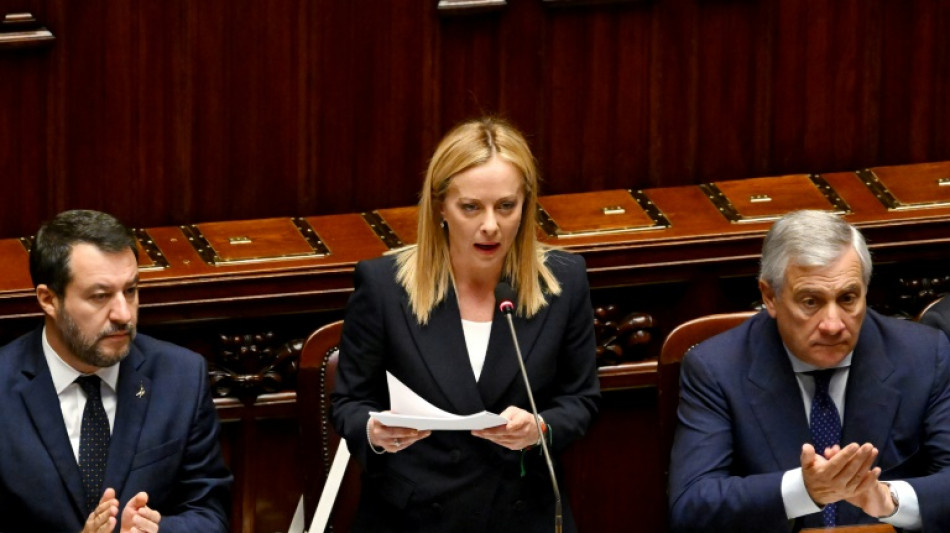
New PM Meloni confirms Italy's place in Europe, NATO / Photo: Andreas SOLARO - AFP

 Carreras reverts to fullback as Argentina change four for Australia Test
 Wilson back to lead Australia as Kiss rotates team for Argentina
 Yen surges on new intervention talk, US stocks rally
 Japan's Ueda fires Lille top of Ligue 1 on debut
 Arsenal chief executive reveals 'dynasty' ambition
 Spanish PM says no 'solid proof' Morocco planned migrant rush
 Iran war is not a war, US VP Vance says

 Khachanov stuns third-seeded Auger-Aliassime in US Open second round
 Bordeaux facing sixth-tier football after French federation upholds relegation
 Stoic Verstappen looking beyond 'painful' Monza weekend
 OpenAI begins rollout of new powerful AI model GPT-6 Astra
 FIFA blasts UEFA 'smear campaign,' fights World Cup plan disclosures
 Zelensky hopes to host US envoys in Kyiv in 'coming days'
 Martinelli joins Al-Hilal from Arsenal for reported £60 million
 Tesla's semi-autonomous driving could be adapted to EU norms: France

 37 people die from fumes during oil pipeline theft in Nigeria: NGO
 Ahead of elections, Israel tests West's patience on West Bank violence
 Antonelli will obey Mercedes orders to help 'tow' teammate Russell
 UK fintech Revolut gains conditional US banking licence
 Mara sisters channel childhood energy for twins performance at Venice
 UN's Sudan probe says foreign fighters fuelling conflict
 Violence erupts at S.Africa anti-migrant protest
 Nothing left: Nepal flood survivors face loss and uncertainty
 Tesla to launch self-driving 'Cybercab' in Texas
 Europe struggles to respond as Russia escalates shadow warfare
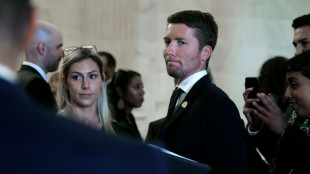
New Italian Prime Minister Giorgia Meloni set out her programme for government on Tuesday, reaffirming her support for the EU and Ukraine and promising to boost economic growth while rejecting Fascism.
One month after her far-right Brothers of Italy party won general elections, Meloni used her inaugural speech to parliament to tell her country and its allies she was a steady hand on the eurozone's third-largest economy.
"Italy is fully part of Europe and the Western world," the 45-year-old told the lower house, adding that it would "continue to be a reliable partner of NATO in supporting Ukraine".
Meloni, who was sworn in as Italy's first woman premier on Saturday, also rejected any links with her country's Fascist past, saying she had "never felt sympathy or closeness to undemocratic regimes... including Fascism".
The prospect of a Eurosceptic, populist government in Italy -- a founding member of NATO and the European Union -- sparked concern in Brussels, although EU leaders were quick to send their congratulations on her appointment and promise their cooperation.
The last government under Mario Draghi was one of the strongest EU supporters of sanctions on Russia over its invasion of Ukraine, and also sent weapons to Kyiv.
Despite being in opposition, Meloni strongly backed Draghi's Ukraine policy. But one of her coalition partners, former premier Silvio Berlusconi, was recorded last week defending his old friend, Russian President Vladimir Putin.
Italy was heavily dependent on Russian gas before the war and is currently battling soaring inflation, fuelled by sky-high energy bills, which risks sparking a recession next year.
Meloni said she would strengthen existing measures to help businesses and households cope with rising prices, but said she would not give in to "Putin's blackmail on energy".
Lawmakers will hold a vote of confidence in Meloni's government on Tuesday evening, followed by another in the Senate on Wednesday.
The votes are largely procedural as she has a comfortable majority in parliament thanks to her coalition with Berlusconi's Forza Italia party and Matteo Salvini's far-right League.
- Recovery plan -
In a speech lasting more than an hour, Meloni promised to cut taxes for business and families while simplifying bureaucracy to encourage investment.
She said "lasting and structural growth" was the answer to reducing Italy's colossal debt -- forecast to be 145 percent of gross domestic product this year, the highest ratio in the eurozone after Greece.
The priority was to tackle soaring energy bills that have left many families and businesses desperate, she said, and seeking alternative sources to Russian gas.
However, she warned that help in this area "will drain a large part of the available resources, and will force us to postpone other measures" she had hoped to introduce in the next budget, without specifying.
Key to Italy's future growth is almost 200 billion euros ($197 billion) in grants and loans from the EU's post-pandemic recovery fund, which depend on Rome implementing major reforms from criminal justice to public administration.
Meloni said the money was "an extraordinary opportunity to modernise Italy", but said she would seek "adjustments" to the plan to take into account the rising cost of energy and raw materials.
- Underdog -
Meloni's party, which has neo-fascist roots, has never been in power and her own government experience is limited to serving as youth minister under Berlusconi in the 2000s.
But she declared she was ready to lead Italy in "the midst of a storm".
"I am what the British would call an 'underdog', the one, let's say, who is not the favourite. The one who to succeed must defy all predictions ... That's what I intend to do again, defy the predictions," she said.
In a bid to reassure investors, she has appointed as economy minister Giancarlo Giorgetti, a relatively moderate member of the League who was economic development minister under Draghi's outgoing government.
Roberto Cingolani, who served as energy minister and helped reduce Italy's reliance on Russian gas from 40 percent to 10 percent since the war, will also stay on as an adviser.
Meloni vowed to see out the full five-year term but tensions within her government had led many commentators to predict it may be much more short-lived.
Berlusconi's musings on Putin embarrassed her last week, while ahead of her speech, Salvini, her deputy prime minister who is also in charge of infrastructure and transport, set out his own programme for government.
In a series of tweets late Monday, the League leader committed himself among other policies to building a long discussed -- and hugely costly -- bridge between mainland Italy and Sicily, which he said would create 100,000 jobs.
A.P.Maia--PC