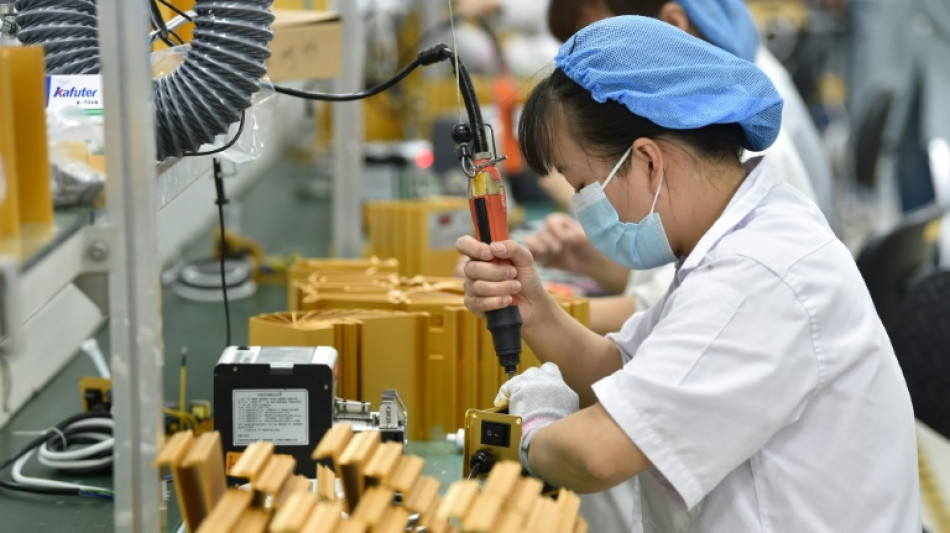
China fiscal deficit balloons to nearly $1 trillion as economy cools / Photo: STR - AFP

 Physicians Urge Arizona to Ban Medical Gag Clauses and Enable Private Lawsuits

 New Campaign Highlights Knowledge Gaps on Carbon Monoxide Safety Among Americans

 GoodData.AI Launches the Agentic Serving Plane, a New Category of Enterprise Data Infrastructure for AI Agents

 US Government Questions Effectiveness of Waymo’s School Bus Software Fix

 Panthers expected to begin 2027 NRL season away from new stadium

 Sweet As app launches restaurant discovery platform

 MLA seeks inquiry into reported sectarian gestures on Ormeau Road

 Louise O’Reilly attacks Simon Harris over unemployment remarks
China's fiscal deficit ballooned to an all-time high of nearly $1 trillion in the first nine months of the year, analysis of government data by Bloomberg showed, as a real estate crisis and tax rebates to boost a cooling economy emptied government coffers.
The budget shortfall for all levels of government from January to September was 7.16 trillion yuan ($980 billion), according to an analysis based on data released by Beijing's Ministry of Finance on Tuesday -- almost three times the 2.6 trillion shortfall over the same period last year.
Overall government revenue dropped 6.6 percent to 15.3 trillion yuan from January to September as the government dolled out more tax rebates to businesses, according to the finance ministry.
Fiscal expenditure then rose 6.2 percent to 19.04 trillion yuan in the first nine months, following a government-driven infrastructure push to boost growth and create employment.
China's economy grew 3.9 percent year-on-year in the third quarter, data showed this week, beating expectations.
But President Xi Jinping's re-election to a historic third term as leader of the Communist Party spooked investors Monday, with China's currency slumping and stocks in Hong Kong nosediving to their lowest level since the global financial crisis.
China is also battling an unprecedented crisis in its real estate sector, which makes up more than a quarter of the country's GDP when combined with construction.
In October, second-hand home prices fell by the highest month-on-month rate since 2014.
"The housing market is still stuck in a downward spiral, global demand is set to cool further, and the weak renminbi is constraining the central bank's ability to provide policy support," Julian Evans-Pritchard from Capital Economics wrote in a research note.
Consumer demand has also been dampened by sudden lockdowns and strict travel restrictions under Beijing's strict zero-Covid policy.
China is the last of the world's major economies still sticking to a zero-Covid strategy.
"There is no clear sign of a significant easing of the zero-Covid strategy," Ting Lu, chief China economist at Nomura, said, adding that at least 207 million people were under some form of lockdown across 28 cities in China earlier this week.
"The actual economic recovery momentum is not strong," he added.
M.A.Vaz--PC

