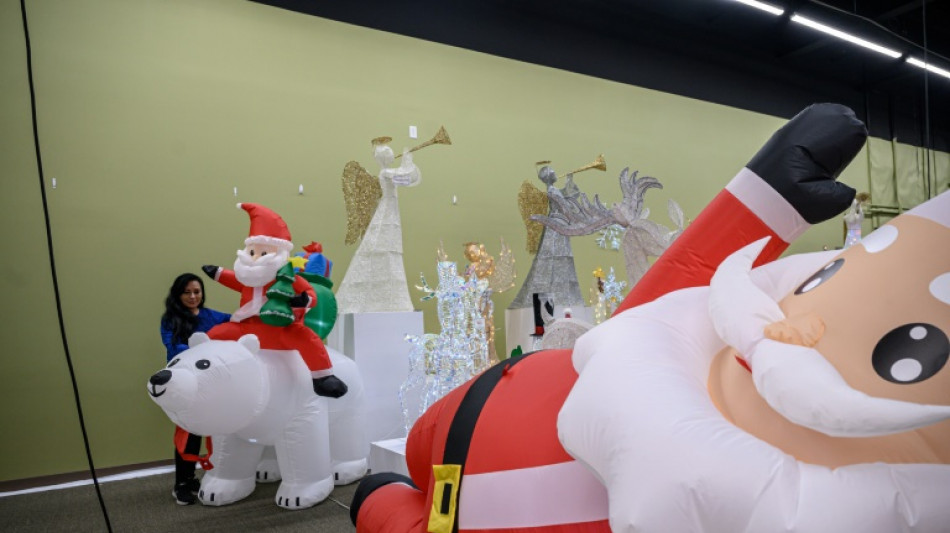
US retailers battle high costs clearing Christmas stockpiles / Photo: Ed JONES - AFP

 Physicians Urge Arizona to Ban Medical Gag Clauses and Enable Private Lawsuits

 New Campaign Highlights Knowledge Gaps on Carbon Monoxide Safety Among Americans

 GoodData.AI Launches the Agentic Serving Plane, a New Category of Enterprise Data Infrastructure for AI Agents

 US Government Questions Effectiveness of Waymo’s School Bus Software Fix

 Panthers expected to begin 2027 NRL season away from new stadium

 Sweet As app launches restaurant discovery platform

 MLA seeks inquiry into reported sectarian gestures on Ormeau Road

 Louise O’Reilly attacks Simon Harris over unemployment remarks
US retailers are hustling to sell their stockpiles of Christmas decorations as the festive season approaches, after tangled supply chains caused many shipments to arrive only after the holidays last year.
As major economies bounced back from the pandemic, companies had struggled to keep up with soaring demand, with manufacturing hit by factory shutdowns during virus outbreaks.
The situation was worsened by a shortage of shipping containers, along with delays at ports from a lack of workers to unload products and transport them to retailers.
It was "very difficult with supply" last year, especially to procure enough Christmas trees and products for customers, said Chris Butler, CEO of decorations seller National Tree.
"This year is a little bit of the opposite," he told AFP.
"Every retailer, every manufacturer has a lot of trees, has a lot of garlands because everything came late," he added.
Due to supply chain problems, retailers said part of their festive decorations arrived only in January or February.
"We went from 'we don't have enough' to now 'we have too much,'" said James Zahn, editor-in-chief at trade publication The Toy Book.
- Reduced spending -
But with soaring consumer prices weighing on household budgets, business executives have expressed concern that customers may tighten their purse strings.
"Consumers might not spend as much," Butler said.
Inflation rose 8.2 percent from a year ago in September, and the elevated figure triggered concerns that price pressures have become more ingrained.
The Federal Reserve is now walking a tightrope trying to wrestle cost increases down without triggering a recession in the world's biggest economy.
For toy makers such as Hasbro, which distributes Monopoly, Nerf guns and Transformers action figures, all this means adapting to parents' reduced purchasing power.
Customers have "become increasingly price-sensitive as the year has progressed," Hasbro CEO Chris Cocks told an earnings call this month, adding that promotions "will be key in the quarters ahead."
Similarly, Mattel, the seller of Barbie dolls and Fisher-Price toys, said this week that it would have more discounts as the holidays approach.
"Instead of shippers ramping up activity to prepare for the holiday season, September brought a change of fortune as shipping volumes slowed and shipping prices declined," said Oren Klachkin, lead US economist at Oxford Economics, in a recent note.
He cited weaker consumer demand and overstocked sellers, factors which experts say could result in steep discounting that cuts profit margins.
- Higher costs -
Some toys have become about 15 percent more expensive due to inflation, said Zahn of The Toy Book.
"That is going to make a difference for families that are already feeling a pinch when groceries and fuel are more expensive," he said.
Even including storage costs and interest, goods that arrived too late for last year's holiday season were "still a little cheaper" than those added to inventory this year, Costco chief financial officer Richard Galanti told a recent earnings call.
Merchants like clothing chain Express are opting to sell their products this year in factory outlets instead of clearing them out at lower margins, said chief financial officer Jason Judd at a September conference.
"Santa, snowmen and Christmas trees haven't changed a lot," said Jill Timm, chief financial officer at department store chain Kohl's in a recent conference.
"They're still going to sell," he said.
P.Cavaco--PC

