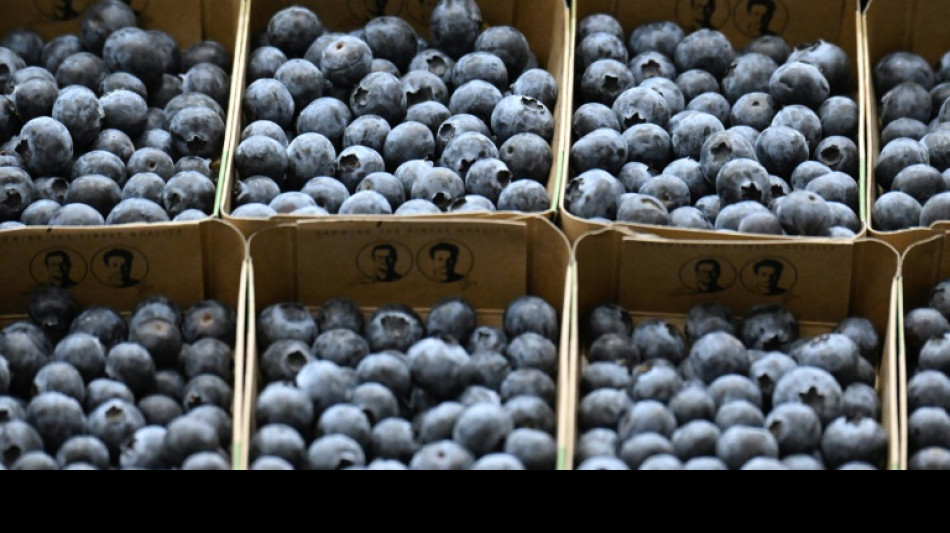
Scottish blueberry farmer donates 'unviable' crop to charity / Photo: Tobias SCHWARZ - AFP

 Spanish PM says no 'solid proof' Morocco planned migrant rush

 Iran war is not a war, US VP Vance says

 Khachanov stuns third-seeded Auger-Aliassime in US Open second round

 Bordeaux facing sixth-tier football after French federation upholds relegation

 Stoic Verstappen looking beyond 'painful' Monza weekend

 OpenAI begins rollout of new powerful AI model GPT-6 Astra

 FIFA blasts UEFA 'smear campaign,' fights World Cup plan disclosures

 Zelensky hopes to host US envoys in Kyiv in 'coming days'

 Martinelli joins Al-Hilal from Arsenal for reported £60 million

 Tesla's semi-autonomous driving could be adapted to EU norms: France

 37 people die from fumes during oil pipeline theft in Nigeria: NGO

 Ahead of elections, Israel tests West's patience on West Bank violence

 Antonelli will obey Mercedes orders to help 'tow' teammate Russell

 UK fintech Revolut gains conditional US banking licence

 Mara sisters channel childhood energy for twins performance at Venice

 UN's Sudan probe says foreign fighters fuelling conflict

 Violence erupts at S.Africa anti-migrant protest

 Nothing left: Nepal flood survivors face loss and uncertainty

 Tesla to launch self-driving 'Cybercab' in Texas

 Europe struggles to respond as Russia escalates shadow warfare

 Malta PM urges 'caution' after acquittal in journalist's murder

 Spanish PM says no 'solid proof' Morocco planned Ceuta migrant rush

 Venezuela's Maduro seek immunity from US drug charges

 Tazapay Now Live on the Borderless.xyz Network For Seamless Money Movement to Asia Pacific and Latin America

 DWF Labs Expands Global Regulatory Footprint with BVI Virtual Asset Service Provider Approval

A Scottish farmer is giving away his entire crop of blueberries, worth £2 million, to charity, saying cheap imports and high labour costs have made harvesting the fruit economically unviable.
Peter Thomson has been growing blueberries at his farm in Blairgowrie, northeast Scotland, for more than four decades, producing 300 tonnes of fruit per year.
But now, he said, growers in Peru and South Africa can sell their berries in the UK at a far lower price, while a shortage of pickers caused by Brexit has made the harvest unviable.
"They've started planting huge areas of blueberries in the subtropics like Peru and South Africa," said Thomson, who started growing blueberries in 1976.
"Their costs of production are so low that we can't compete."
Normally, said Thomson, 200 workers would have picked around 300 tonnes of blueberries this year with 50 more working in the packhouse.
In 2014, the price paid to Scottish farmers for blueberries was £17.50 per kilo, he said. Today however, supermarkets pay less than £7.
Labour costs meanwhile have risen from £7 an hour five years ago to £10.10 today, even before state pension contributions and holiday pay are taken into account.
This meant that the value of crop of berries, which would once have been worth £3 million or more, fell to £2 million this year.
Retailers are unwilling to pay a premium for Scottish produce as shoppers target bargains during the cost-of-living squeeze, Thomson said.
- The Brexit factor -
The cheaper imports started last year after countries including Peru and South Africa, where pickers are paid substantially less, started using a new cultivar of the blueberry plant.
The sweet juicy berries grow densely on bushes with scarlet leaves that are planted in rows.
Blueberries usually require a frost before they flower, which meant farmers in Scotland had the market to themselves in September and October and could command a higher price.
The new cultivar, however, does not need a frost to thrive.
The new blueberry variety is also popular with supermarkets as the fruit are larger and firmer and can be shipped -- rather than airfreighted -- to UK supermarkets over a number of weeks without spoiling.
Another economic impact has come from Brexit, which has pushed up the price of labour and made it difficult to find skilled pickers.
Before Brexit, said Thomson, the farm’s village of caravans was filled with skilled European pickers, who were experienced and harvested the berries at a faster pace.
Today the caravans stand empty.
"Brexit has had the consequence of making our labour more expensive," Thomson said.
"We have to get labour now from places like Turkmenistan and Kyrgyzstan, Nepal, and it comes from so far that it is expensive."
- 'It is devastating' -
Thomson said he had invited the public to fill up buckets of blueberries in exchange for a donation to a cancer charity. A portion of the berries is also being given to food banks.
Hundreds of local residents have responded to Thomson's invitation to pick for charity, many of them arriving at the farm with buckets and boxes.
Local resident Amanda Taylor, who was one of those picking berries at the farm, said it was devastating to see the crops rotting in a field when so many cannot afford food.
"It's quite an emotional thing actually, that we're having to fly produce from Peru when I have this on my doorstep," she said.
Pauline Cropper, who is volunteering to organise pickers at the farm, said people were finding it difficult to afford their shopping bills and were picking the cheapest options available.
"Meanwhile, the berries here are sitting on the bushes and going to waste -- they're falling off the bushes, there's so many of them, because it's not viable for the local farmer to pay a decent wage," she said.
Thomson said his plants could have kept producing berries for another 50 years, but continuing to prune and maintain them was too costly.
"It is devastating for us, but it doesn't make economic sense to take the fruit to the shops," he said.
"We have no realistic prospect of making money unless the supermarkets are prepared to pay (more) for Scottish blueberries."
He plans to continue farming his other crop, cherries, but may build houses on some of his land.
T.Batista--PC