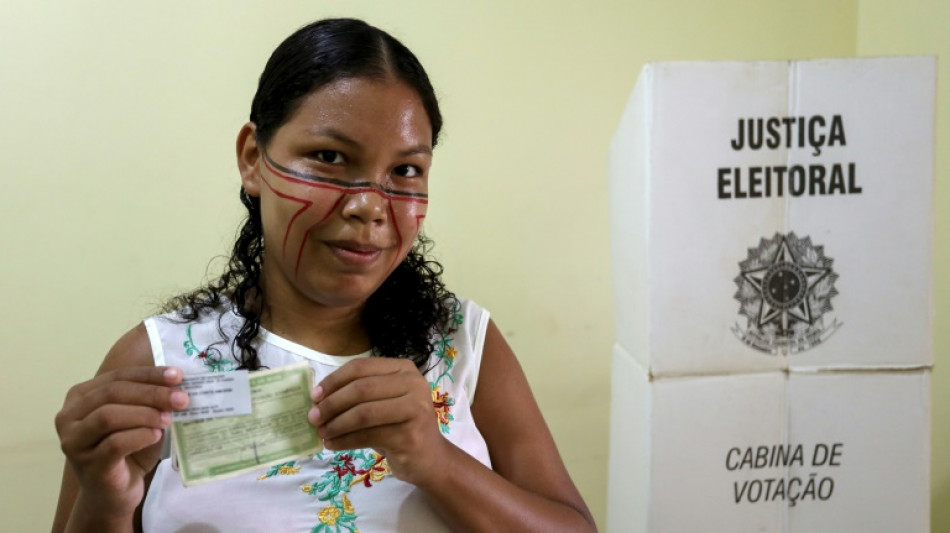
In Amazon, Indigenous voters wear Lula support painted on faces / Photo: Michael DANTAS - AFP

 Physicians Urge Arizona to Ban Medical Gag Clauses and Enable Private Lawsuits

 New Campaign Highlights Knowledge Gaps on Carbon Monoxide Safety Among Americans

 GoodData.AI Launches the Agentic Serving Plane, a New Category of Enterprise Data Infrastructure for AI Agents

 US Government Questions Effectiveness of Waymo’s School Bus Software Fix

 Panthers expected to begin 2027 NRL season away from new stadium

 Sweet As app launches restaurant discovery platform

 MLA seeks inquiry into reported sectarian gestures on Ormeau Road

 Louise O’Reilly attacks Simon Harris over unemployment remarks
In the Brazilian Amazon, members of an Indigenous community painted their faces and put on traditional feather headdresses as they set out to vote Sunday in the hard-fought presidential runoff election.
The Satere-Mawe people of the village of Sahu-Ape say it is important to them to participate in what many are calling the most important elections in Brazil's recent history.
They set out on foot from their wood houses for the county seat, Iranduba, 80 kilometers (50 miles) from Manaus, the capital of the northern state of Amazonas.
But before going to their polling station, they paint red and black arrows on their faces, a symbol of their mission: unseat far-right incumbent Jair Bolsonaro and elect veteran leftist Luiz Inacio Lula da Silva.
The Satere-Mawe men wear feather headdresses, the women colorful feather earrings.
As they leave the village, Beth da Silva blows into a "rurru," an Indigenous instrument traditionally used in war rituals.
This time, "it's not to ask for strength, it's to help us achieve our goal: elect Lula and change Brazil," she says.
"We've suffered a lot these past four years."
A community shaman, Sahu da Silva, 42, says it is "very important" for ex-president Lula (2003-2010) to win a third term.
"He at least tried to protect our ancestral lands," he says.
Bolsonaro, by contrast, came to office in 2019 vowing not to allow "one more centimeter" of protected Indigenous reservations in Brazil.
Indigenous Brazilians have been fierce critics of the conservative ex-army captain, who has presided over a surge of destruction and fires in the Amazon, the world's biggest rainforest and a key resource in the race to curb global warming -- as well as the livelihood of many Indigenous peoples.
"Lula knows how much we need a better quality of life," says Zelinda Araujo, 27.
"That man who's in power now, he doesn't even look at us lowly little people. He doesn't know what we need in our daily lives."
Lula, an ex-metalworker who grew up in poverty, "is different," she says.
"He knows what it is to struggle every day. He knows how hard it is for us."
P.Queiroz--PC

